Small country, few people.
Enable the existence of various tools, yet never need them.
Enable the people attach importance to death, yet not travel around.
Although there exists boats and carriages, there is no place to ride them.
Although there exists weapons, there is no place to deploy them.
Enable the people to again use the knotted rope.
Find their food sweet, their clothes beautiful.
Peaceful in their lives, happy in their customs.
Neighboring countries mutually seen in the distance,
Of chicken and dog sounds mutually heard.
People until death not mutually come and go.
~~~~~~~~~~~~~~~~~~~~~~~~~~~~~~~~~~~~~~

Word for Word
Limits: Translations, even the nearly literal one above, lose some of the original meaning due to the cultural context of contemporary words. Studying the numerous synonym-like meanings of the Chinese characters in the Word-for-Word translation mitigates this.
Fourth Pass: Chapter of the Month
(pandemic era)
Archive: Characters and past commentary
Zoom on YouTube Recordings:
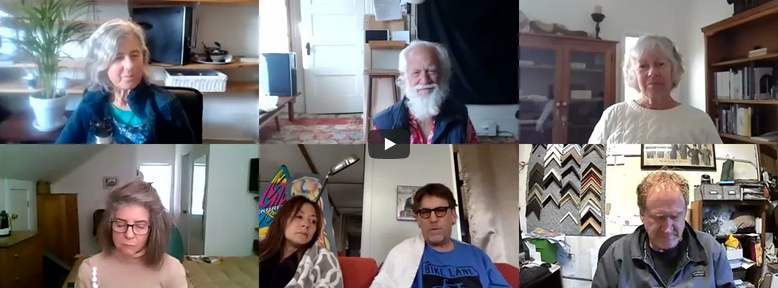
https://youtu.be/VzgRtG7EZyE is the link to the Zoom video of this month’s Sunday meeting. The shorter first part of the meeting begins with a chapter reading followed by attendees’ commentary, if any. A little later on begins the longer open discussion part of the meeting when those who wish to discuss how the chapter relates to their personal experience.
Corrections?
None this time.
Reflections:
Small country, few people.
Enable the existence of various tools, yet never need them.
Enable the people attach importance to death, yet not travel around.
I believe I’ve always interpreted this chapter to be a recommendation for how to fix humanity’s problem. For example, when it says Enable the existence of various tools, yet never need them sounds like something someone in charge of people should Enable. Seen as such, this always felt to be an unrealistic ideal that would be impossible to implement, although, I suppose if the situation was Small country, few people some of the suggestions that follow might be achievable to a limited degree. Still, it comes across as just too pie in the sky. Isn’t the power over people (society) what religion and politics always attempts to do… and always fails in the end?
Today I see this as offering a much more realistic and practical way to resolve our personal difficulty rather than some society-wide solution. Here, the suggestion to Enable the existence of various tools, yet never need them would mean for me personally to take inventory of my life, and at least question why I am drawn to using various tools.
Enable the people attach importance to death, yet not travel around still feels a bit odd. Enabling [my self to] attach importance to death has always helped me broaden my perspective. Indeed, it is the contrast between life and death that makes life a more vivid, albeit mysterious, experience. That is certainly one sobering benefit of a close call with death. Unfortunately, that effect wears off all too quickly.
The odd part of this is the yet not travel around aspect. However, I do notice that the more fully engaged with life I feel, the less push I feel to travel around. I assume travel around affords some promise of enhanced life meaning. When I’m fully engaged in the ‘here and now’, the need for life meaning is satisfied.
Here though, it seems to imply that attaching importance to death creates an itch to travel around. Perhaps this is referring to FOMO (the ‘Fear Of Missing Out’). Such fear might result from a keen awareness of one’s mortality.
Although there exists boats and carriages, there is no place to ride them.
Although there exists weapons, there is no place to deploy them.
Enable the people to again use the knotted rope.
Find their food sweet, their clothes beautiful.
Peaceful in their lives, happy in their customs.
Although there exists boats and carriages, there is no place to ride them follows the same line of thought that I commented on above. These suggestions can either be seen as an idealistic prescription for action on the part of some great ruler, or more realistically, as a way of pondering one’s own approach to life.
The opportunities to act using technology— boats, carriages, weapons… and you name it—all depend on one essential factor—motivation. Need and fear drive us to leave a ‘so-so here’ to go to a ‘better there’. New technologies arise to outperform old technologies, i.e., the computer works better than the abacus, the abacus works better than the knotted rope.
The question to ponder is this: was the person using the knotted rope any more content than the person later on using the abacus, or more content than the person even much later using the computer? Most of what technology does is enable us to get a task done faster, which then frees up time to tackle another task sooner. Yet, does the ability to increase the rate of getting things done in life make for a better or happier life? This is the false promise of all progress really. Yes, times change, but the eternal moment does not. The more we chase after ‘next’ the less presence of mind we have for ‘now’. Chapter 2 implies this more peaceful pace of life, Considering this, the wise person manages without doing anything. And chapter 48 brings it home…
In pondering ‘next’ versus ‘now’ it is intuitively obvious that contentment and happiness can only exist in ‘now’… never in ‘next’. The only thing ‘next’ promises is the possibility of a happier moment later on when ‘next’ comes to pass. The irony here is that when ‘next’ comes to pass, ‘now’ takes its place, followed by a yearning for the next ‘next’. It is a vicious cycle ruling our life until we take a deeper inventory of what actually makes life meaningful. If we seek progress and improvement, the journey never ends. Conversely, if we seek integrity and appreciation, the journey turns back on itself. As chapter 16 says, Returning to the root cause is called stillness; this means answering to one’s destiny. And again in chapter 40, In the opposite direction, of the way moves.
Neighboring countries mutually seen in the distance,
Of chicken and dog sounds mutually heard.
People until death not mutually come and go.
I feel much of this chapter describes the subjective process of aging. Indeed, my new and more inward way of seeing this chapter is happening as I experience my 81st year. I am becoming Lao Tzu, as will most people approaching the end of life, at least subconsciously. Only through traveling this journey for a while can one see the forest amidst the trees. Naturally, as with everything in nature, this conforms to a bell curve of sorts—some see deeper sooner; some see deeper later. However, the trajectory for all living things follows this path. To grasp this intuitively, simply ponder ‘the young puppy versus the old dog’ reality.
Chapter Archive https://youtu.be/GAD9IAc–js
This is the complete video. It begins with blowing Zen followed by the meeting