True speech isn’t beautiful.
Beautiful speech isn’t true,
Expertise doesn’t debate.
Debate isn’t expertise,
Knowing isn’t wealth.
Wealth doesn’t know,
The holy person doesn’t accumulate.
Already, considers people’s personal healing his own.
Already, so as to support people’s personal healing more.
Nature’s way benefits, and yet doesn’t harm.
The holy person’s way acts, and yet doesn’t contend.
~~~~~~~~~~~~~~~~~~~~~~~~~~~~~~~~~~~~~~

Word for Word
Limits: Translations, even the nearly literal one above, lose some of the original meaning due to the cultural context of contemporary words. Studying the numerous synonym-like meanings of the Chinese characters in the Word-for-Word translation mitigates this.
Fourth Pass: Chapter of the Month
(pandemic era)
Archive: Characters and past commentary
Zoom on YouTube Recordings:
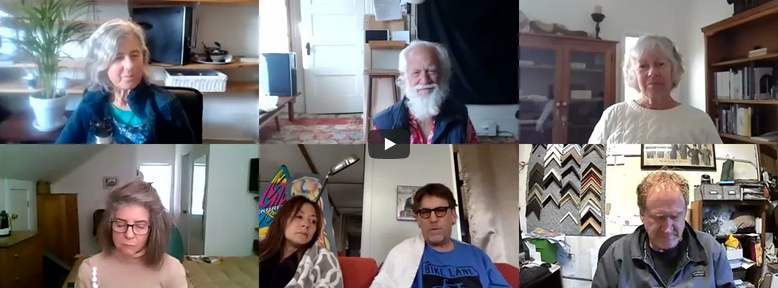
https://youtu.be/COITe243ug8 is the link to the Zoom video of this month’s Sunday meeting. The shorter first part of the meeting begins with a chapter reading followed by attendees’ commentary, if any. A little later on begins the longer open discussion part of the meeting when those who wish to discuss how the chapter relates to their personal experience.
Corrections?
None this time.
Reflections:
True speech isn’t beautiful.
Beautiful speech isn’t true,
These first 6 lines challenge me to contemplate the actual meaning of the words juxtaposed here, i.e., true vs. beautiful; expertise vs. debate; knowing vs. wealth. The unbridled faith we place on word meaning inhibits any deeper cognitive journey we may wish to take. Of course, this faith took root in our earliest childhood, and so it’s not surprising that we take whatever meaning we see in a word as being a kind of object truth outside ourselves. Alas for us, nothing could be further from the truth. Hence, the cognitive disease that chapter 71 outlines.
We innately tend to place more weight on beautiful speech. This is akin to how we also tend to place more importance on body shape, size, age, and so forth. I’d call this a kind of built-in organic bias. This bias certainly would have had an evolutionary benefit for our prehistoric ancestors. Such biases now have a pronounced cultural side, which seems more problematic than beneficial.
True speech often offends or threatens the listener’s own cultural biases. We are deaf to any element of truth that threatens our sacred cows. Simply put, we want out biases supported, not challenged or overturned by any deeper, impartial points of view.
Finally, beautiful requires one to hold an esthetic “reality”, which is essentially oxymoronic. Reality—nature—is neither beautiful nor ugly. Beautiful is simply an emotional bias that pulls us in, and vice versa for ugly. This zero-sum nonsense harkens back to chapter 2…
Expertise doesn’t debate.
Debate isn’t expertise,
Debate occurs between two opposing points of view, like ‘left’ vs. ‘right’. Each side feels they are correct and that truth is on their side, and they will use beautiful speech as a way to persuade. Seen deeper, the energy of debate arises from the insecurity and fear experienced from not intuitively knowing the interconnectedness of all things. As chapter 56 puts it, This is called profound sameness.
The way of nature plays out just the opposite, each side without the need to win, or the fear of losing. Opposing forces compete and what survives from that process is true expertise. I’d call this evolutionary expertise. Expertise is the result of opposing forces coming together and producing an outcome that resolves the conflict. As such, expertise is silent and invisible; silent and invisible especially if one is seeking a particular outcome. Chapter 25 gives us a hint…
In expertise, the process is the sacred vehicle, the result is the perfect death of the process, i.e., nothing more needs to be, nor can be, done. Here, Doing without doing, following without exception rules.
Knowing isn’t wealth.
Wealth doesn’t know,
We innately feel that wealthy people may know something that we don’t, and that is one reason they are wealthy. This is often true, at least on the surface. An insider tip on the stock market can bring wealth, for example. Pondered deeper, I must ask myself what is knowing truly?
Realizing I don’t’ know is better; not knowing this knowing is disease is quite different from the worldly practical type of knowledge knowing. Worldly knowing increases as the wheels of civilization turn… mostly through science and technology, which affords us the tools to deepen our knowledge of all aspects of life. From this worldly knowing, wealth increases. For example, the knowledge and application of electricity has made us all incredibly wealthy. We’ve replaced the human slaves that used fans to cool rich people on hot days with electric fan ‘slaves’ that do the same for us all.
In contrast to such worldly knowing that increases day by day, year by year, century by century, millennia by millennia, is the deeper knowing, the knowing that I don’t know. I expect this can only result through relying less and less on worldly knowing. Chapter 48 seems to point the way…
The holy person doesn’t accumulate.
Already, considers people’s personal healing his own.
Already, so as to support people’s personal healing more.
The holy person doesn’t accumulate parallels Buddha’s 2nd Truth’s “The illusion of self originates and manifests itself in a cleaving to things”, with “things” being both material (stuff), emotional (fears and needs), and conceptual (ideals). The more robust the illusion of self (ego) is, the less able we are to consider people’s personal healing his own. Additionally—and ironically—the stronger the ego, the more likely we will be compelled to act and “help” others with their personal healing rather than simply allowing nature to play out. As the saying goes, “The road to hell is paved with good intentions”. The more we identify personally with something, the more “good” intentions drive our actions.
Nature’s way benefits, and yet doesn’t harm.
The holy person’s way acts, and yet doesn’t contend.
Nature’s way benefits, and yet doesn’t harm can be more deeply understood by contemplating the interconnected meaning of both benefits and harms. On the surface, these feel very different. Of course, that simply reflects one’s own preference for benefit over harm. Similar is our preference for life over death. Considered from just one side of nature’s equation gets us nowhere.
One way I look at this is remember that every benefit and gain I accrue comes with a equal and opposite harm and loss to something out there… and vice versa. Benefit and harm, gain and loss, good and evil, are intertwined sides of the same whole.
However, we’ve evolved to distinguish one separate from the other in a kind of life vs. death framework. We, and perhaps all living creatures, have evolved to notice the hard edges of difference more keenly than the soft edges of similarity. It serves survival well, even if it sets us up with a distorted view of the ‘whole’. In the wild, this functions well as a tool of evolution. Human cognition has turned this natural bias into a knife that cuts off our connection with the cosmic unity of existence. Chapter 56 depicts our predicament nicely…
The Bhagavad Gita 2:28 speaks nicely to the life vs. death side of such profound sameness… “Invisible before birth are all beings and after death invisible again. They are seen between two unseens. Why in this truth find sorrow?”
Chapter 56 goes on to say…
We are innately compelled to ‘open exchange, open the gates, enhance the sharpness, tie the tangles, raise the brightness, and shake off the dust’. Thus, For this reason, Unobtainable yet intimate, and so on down the line. Unobtainable is due to having evolved to survive via a bias favoring the perception of differences. The yet intimate and the rest speak to our being connected at our core to the profound sameness of existence. We feel this, but only as a passive background sense; we can’t act on it.
The holy person’s way acts, and yet doesn’t contend depersonalizes actions that life compels us to take. ‘All-in’ contending only comes about when contending becomes a personal issue, bolstered by the self-righteousness of thought.
The trick is to jump into life, to contend and yet not contend. The Bhagavad Gita speaks to this when Krishna attempts to teach Arjuna that life is action, and that refraining from action is not an option. Note: It may help to interpret word definition loosely. Unlike the Tao Te Ching, the Bhagavad Gita states matters very concretely. Such explicitness about inexplicable matters leads to misunderstanding. In other words, the Bhagavad Gita is written as a very explicit story concerning life and death. Its very explicitness skews the truth. As chapter 1 reminds, The way possible to think, runs counter to the constant way. The name possible to express runs counter to the constant name. Thus, try reading the following verses between the lines…
2:9 When Arjuna the great warrior had thus unburdened his heart. ‘I will not fight Krishna.’ he said, and then fell silent.
2:10 Krishna smiled and spoke to Arjuna there between the two armies the voice of God spoke these words:
KRISHNA
2:11 Thy tears are for those beyond tears; and are thy words of wisdom? The wise grieve not for those who live; and they grieve not for those who die ‑ for life and death shall pass away.
2:12 Because we all have been for all time: I, and thou, and those kings of men. And we all shall be for all time, we all for ever and ever.
2:13 As the Spirit of our mortal body wanders on in childhood, and youth and old age, the Spirit wanders on to a new body: of this the sage has no doubts.
2:14 From the world of the senses, Arjuna, comes heat and comes cold, and pleasure and pain. They come and they go: they are transient. Arise above them, strong soul.
2:15 The man whom these cannot move, whose soul is one, beyond pleasure and pain, is worthy of life in Eternity.
2:16 The unreal never is: the Real never is not. This truth indeed has been seen by those who can see the true.
2:17 Interwoven in his creation, the Spirit is beyond destruction. No one can bring to an end the Spirit which is everlasting.
2:18 For beyond time he dwells in these bodies, though these bodies have an end in their time: but he remains immeasurable immortal. Therefore. great warrior, carry on thy fight.
2:19 If any man thinks he slays, and if another thinks he is slain, neither knows the ways of truth. The Eternal in man cannot kill: the Eternal in man cannot die.
2:20 He is never born, and he never dies. He is in Eternity : he is for evermore. Never‑born and eternal, beyond times gone or to come, he does not die when the body dies.
2:21 When a man knows him as never‑born, everlasting, never changing, beyond all destruction, how can that man kill a man, or cause another to kill?
2:22 As a man leaves an old garment and puts on one that is new, the Spirit leaves his mortal body and then puts on one that is new.
2:23 Weapons cannot hurt the Spirit and fire can never burn him. Untouched is he by drenching waters, untouched is he by parching winds.
2:24 Beyond the power of sword and fire, beyond the power of waters and winds, the Spirit is everlasting, omnipresent, never‑changing, never‑moving, ever One.
2:25 Invisible is he to mortal eyes, beyond thought and beyond change. Know that he is, and cease from sorrow.
2:26 But if he were born again and again, and again and again he were to die, even then, victorious man, cease thou from sorrow.
2:27 For all things born in truth must die, and out of death in truth comes life. Face to face with what must be, cease thou from sorrow.
2:28 Invisible before birth are all beings and after death invisible again. They are seen between two unseens. Why in this truth find sorrow?
Chapter Archive https://youtu.be/YNVQmgHbJaE
This is the complete video. It begins with blowing Zen followed by the meeting