Thirty widths share one hub, out of its nothingness exists the useful vehicle.
Mix water with clay soil, think utensil, out of its nothingness exists the useful utensil.
Cut out a door and window, think room, out of its nothingness exists the useful room.
Hence, of having what is thought favorable, of the nothing think as the useful.
~~~~~~~~~~~~~~~~~~~~~~~~~~~~~~~~~~~~~~

Word for Word
Limits: Translations, even the nearly literal one above, lose some of the original meaning due to the cultural context of contemporary words. Studying the numerous synonym-like meanings of the Chinese characters in the Word-for-Word translation mitigates this.
Fourth Pass: Chapter of the Month
(pandemic era)
Archive: Characters and past commentary
Zoom on YouTube Recordings:
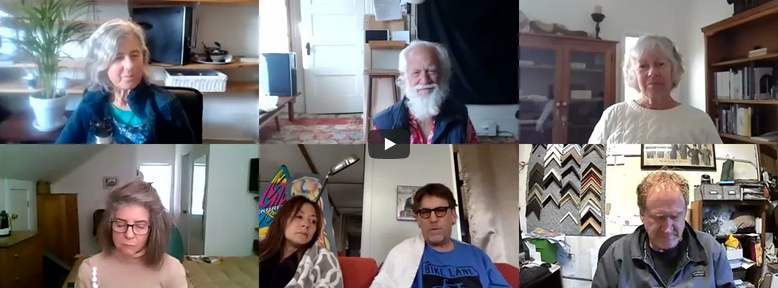
https://youtu.be/bPr2gnTJlKc is the link to the Zoom video of this month’s Sunday meeting. The shorter first part of the meeting begins with a chapter reading followed by attendees’ commentary, if any. A little later on begins the longer open discussion part of the meeting when those who wish to discuss how the chapter relates to their personal experience.
Corrections?
None this time.
Reflections:
Thirty widths share one hub,
out of its nothingness exists the useful vehicle.
Mix water with clay soil, think utensil,
out of its nothingness exists the useful utensil.
Cut out a door and window,
think room, out of its nothingness exists the useful room.
I see the first three lines of this chapter as setting the stage for the meta-view offered in the last line, Hence, of having what is thought favorable, of the nothing think as the useful. Let’s face it, no animal is comfortable with the profound sameness of nothingness, and for a highly imaginative species like us, all the more fearful nothingness can feel.
Contemplated deeply, it becomes apparent how nothingness shares similar qualities with the other cohorts on the yin side of existence’s coin, e.g., nothingness ≈ emptiness ≈ death ≈ loss ≈ entropy ≈ failure, etc. (See Tools of Taoist Thought: Correlations). We, and all living things, naturally notice the something-ness of existence much more than the nothingness. If anything, it is the ongoing apprehension of nothingness that drives living creatures to act, to do something, to live. (See Fear & Need Born in Nothing)
By more deeply contemplating a wheel, a pot, and a room, it becomes apparent that nothingness plays a key role. Without nothingness, these don’t exist.
Hence, of having what is thought favorable,
of the nothing think as the useful.
This last line is another way of pointing out how connected something-ness and nothingness truly are. As chapter 2 notes, Hence existence and nothing give birth to one another. This interconnectedness of apparent opposites is not how we tend to see the world. We are biologically biased to pay attention to the something side of reality’s equation. And rightly so for practical survival reasons. However, for human mental health (balance), if serves us well to recognize and appreciate this interdependent connectedness in general, and of nothingness in particular. Frankly, what is meditation really but a quest to invite a slice of nothingness into our awareness?
The promise of nothingness that meditation practices offer helps to slow us down and calm our emotions. But if meditation could truly sink us deep into nothingness we’d freak out… it would be too much of a good thing! However, we needn’t be concerned because our wandering mind always keeps us floating safely above the void. Yet, paradoxically, we meditate to find relief from our wandering mind. For more, see Wandering Mind Is Unhappy Mind.
Having seen how crucial nothingness is to the existence of a wheel, a pot, or a room, helps invite the mind to contemplate the profound role nothingness plays in the existence of everything. Chapter 40 highlights more deeply the vital role nothingness plays …
The action of all living things arises out of an urge to attain favorable conditions. Of course, the outcomes can be utterly unfavorable, but that is not the ‘plan’. Herein lies the value of appreciating the key role nothingness plays in any attempt to act, accomplish, and end with a favorable result. The quality of patience is a practical way to view nothingness. ‘Exercising’ patience is practicing nothingness… watching and waiting. And invariably, out of the nothingness we have a better chance of achieving a favorable outcome.
What stands in the way of patience then? If this practice of nothingness is the wisest way to go, why do we have so much difficulty practicing it? Chapter 29 offers us this …
Chapter 37 pulls the view deeper…
The final lines of chapter 57 makes it more personal…
It may help to note here that it is not that the holy person acts this way; it is more that the closer you are to acting this way, the more ‘holy’ you naturally are. Is this making a distinction without a difference? Perhaps this helps us see that there is no ‘holy person’ per se… ever. Rather, when one is approaching life this way for whatever moment they are in, they are ‘holy’.
I find that the ‘holy person’ story all too easily becomes an idealized goal or point of admiration, which completely misses the ‘rubber hits the road’ point. In other words, there is no way any human can transcend their biology, despite all the myths to the contrary. We all exist on an emotional bell-curve—some with more desire and fear; some with less desire and fear. Not because they willed themselves to be so, but rather because of the evolutionary and genetic role of the dice. (See Nature’s Bell Curve in the Postscript)
Finally, I would say that the key here is to have a greater appreciation of the natural process, of the foundational role nothingness plays in existence. To what extent that can influence our actions depends on our own biological and cultural makeup… I suppose. Either way, NO ONE, NO THING, can ever possess nothingness. Indeed, it is out of nothingness that our something-ness arises. The end of chapter 56 alludes to this…
And chapter 70 states this unobtainable aspect even more bluntly…
Chapter Archive https://youtu.be/3fQ4cIG2NTQ
This is the complete video. It begins with blowing Zen followed by the meeting