The five colors make people’s eyes blind.
The five sounds make people’s ears deaf.
The five tastes make people’s mouths brittle.
Rushed hunting makes people’s hearts go crazy.
Goods hard to come by make people behave harmfully.
Because of this, the wise person acts for the belly, not the eye.
Hence, he leaves that and takes this.
~~~~~~~~~~~~~~~~~~~~~~~~~~~~~~~~~~~~~~
Word for Word
Limits: Translations, even the nearly literal one above, lose some of the original meaning due to the cultural context of contemporary words. Studying the numerous synonym-like meanings of the Chinese characters in the Word-for-Word translation mitigates this.
Fourth Pass: Chapter of the Month
(pandemic era)
Archive: Characters and past commentary
Zoom on YouTube Recordings:
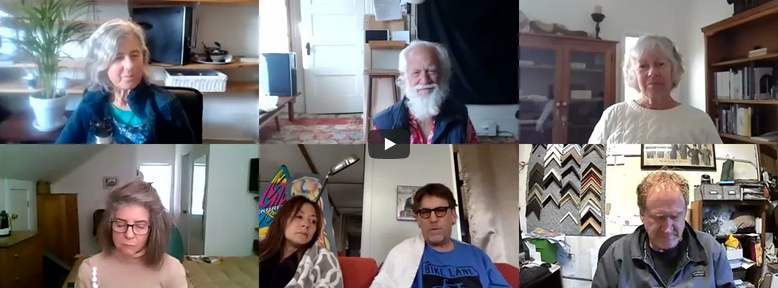
https://youtu.be/vJ-T5Yqy5qk is the link to the Zoom video of this month’s Sunday meeting. The shorter first part of the meeting begins with a chapter reading followed by attendees’ commentary, if any. A little later on begins the longer open discussion part of the meeting when those who wish to discuss how the chapter relates to their personal experience.
Corrections?
None this time.
Reflections:
The five colors make people’s eyes blind.
The five sounds make people’s ears deaf.
The five tastes make people’s mouths brittle.
First, I have to ask myself what is it about colors, sounds, and tastes that’s problematic? I mean we’ve naturally evolved to perceive this sensory input, like all the other animals on the planet. Thought, being the one thing that separates us from all the other animals, must be the key to the problem here. The blinding effect must come from how deeply we attach ourselves—our story—to particular colors, sounds, and tastes.
This brings to mind Buddha’s observation mentioned in his 2nd Noble Truth, “The illusion of self originates and manifests itself in a cleaving to things”. (See Buddha’s Four Noble Truths) Obviously, “things”, is much more than material stuff. It is also the thoughts, ideals and stories to which we “cleave” that augment our sense of self. Loving particular melodies, foods, or colors, helps bolster my self-identity. For example, if I love jazz, then that love becomes a defining aspect of my self. Likewise, detesting any particular sound, food, or color also helps reinforce my sense of self, i.e., “I am not those things”. What we love and what we hate becomes part of our identity, our self-narrative, and belief itself. See Belief: Are We Just Fooling Ourselves?
This ‘circling the wagons’ of self-identity hinders our ability to approach life spontaneously and fresh. Our loves and hates blind us to the deeper existential mystery of life. Instead of perceiving the world in its own right, we are blinded by the beliefs we hold and the judgments we make upon the world.
Of course, judgments by themselves are not the main problem. Indeed, survival for all animals depends on passing judgment on the external world. The problem lies in how we accumulate our judgments in memory and cleave to them as beliefs in our need to validate our illusion of self—our ego. This brings me to the profound wisdom of chapter 71, Realizing I don’t’ know is better; not knowing this knowing is disease. Alas, casting any shadow of doubt upon our cherished loves and hates—our judgments and beliefs—threatens the foundations of self-identity. Thus, it would seem that life-experience is the only path to realizing I don’t’ know. The longer we live, the more likely self-integrity has a chance to supplant self-identity.
Rushed hunting makes people’s hearts go crazy.
Goods hard to come by make people behave harmfully.
The very essence of survival rests upon every animals urge to ‘hunt and gather’. We innately see ‘the cup half empty’, no matter the level of abundance we have in life. The sense ‘more is better’ drives all life to act and survive. This instinct certainly begs the question, “How would any animal know when to stop or know when it had enough?” Chapter 46 says, Therefore, in being contented with one’s lot, enough is usually enough indeed, but this seems to put the cart before the horse. The hitch here is that feeling content is not a de fault instinct. At best, contentment is a short-lived period of tranquility until the next urge overrides contentment.
In the wild, natural competition and scarcity limit an animals ‘reach’… limits an animal’s ability to rushed hunting. One of civilization’s main purposes is to remove natural restrictions on human life. This allows Rushed hunting makes people’s hearts go crazy to come about. Of course, the rushed hunting is no longer just a pursuit of food, but rather a pursuit of anything we deem valuable. This easily leads to Goods hard to come by make people behave harmfully. The liberation from the limitations of our ancestral hunter-gatherer existence has opened a Pandora’s Box of surplus and “freedom”. (For deeper background, see The Tradeoff)
Because of this, the wise person acts for the belly, not the eye.
Hence, he leaves that and takes this.
The wise person acts for the belly, not the eye reminds me of the saying ‘Your eyes are bigger than your stomach’. Here, eye is describing our mind’s imagination. The virtual reality of imagination makes it extremely easy to see ourselves doing something, or to seeing other people doing something. But, when the rubber hits the road, we constantly fall short. Imagination has no natural limits set upon its reach. Only lifetime experience can temper and reign in those flights of fancy.
Hence, he leaves that and takes this. It helps to focus on the difference between ‘this’ and ‘that’. Our natural tendency to see the cup half empty locks us into survival’s hunt-and-gather role. Yet, this innate urge has none of the natural restraints that would be there in the wild. Simply put, we can go all out in our pursuit of an imagined THAT as we blindly skip over the current THIS. This is the finger pointing to our most personal inner reality. It is what is right here and now in your moment to moment, not the “that” over there that you are constantly chasing.
Ironically, as soon as we achieve a “that”, it becomes a “this” and off we go on the pursuit of the next “that” which promises to make our life whole. Conversely, the “this” of our lives is where the whole actually lies. We spend our lives chasing the illusion of a future “that” which promises to deliver us to the wholeness of “this”. For me, this parallels Theravada Buddism’s beginningless round of rebirths called the ‘Wheel of the round of rebirths’ (samsāracakka).
Consider, for example, how easy it is to get caught up in the desire to accomplish “that”, which ironically means we discount the lifetime of previous quests for “that” which have now become integral to our life’s “this”—our here and now. Always seeking “that” blinds us to the wealth of lifetime’s accumulation of “this”. Valuing the future “that” we are seeking can’t help but place our present moment of “this” in a less favorable light. Oddly, we easily end up completing with ourselves… where we are now vs. where we ideally wish to be, making for a ‘beginningless round of rebirths’.
Chapter Archive https://youtu.be/9bvcHCvJDEc
This is the complete video. It begins with blowing Zen followed by the meeting