Devote effort to emptiness, sincerely watch stillness.
Everything ‘out there’ rises up together, and I watch again.
Everything ‘out there’, one and all, return again to their root cause.
Returning to the root cause is called stillness;
this means answering to one’s destiny.
Answering to one’s destiny is called the constant;
knowing the constant is called honest.
Not knowing the constant, rash actions lead to ominous results.
Knowing the constant allows, allowing therefore impartial,
Impartial therefore whole, whole therefore natural,
Natural therefore the way.
The way therefore long enduring, nearly rising beyond oneself.
~~~~~~~~~~~~~~~~~~~~~~~~~~~~~~~~~~~~~~

Word for Word
Limits: Translations, even the nearly literal one above, lose some of the original meaning due to the cultural context of contemporary words. Studying the numerous synonym-like meanings of the Chinese characters in the Word-for-Word translation mitigates this.
Fourth Pass: Chapter of the Month
(pandemic era)
Archive: Characters and past commentary
Zoom on YouTube Recordings:
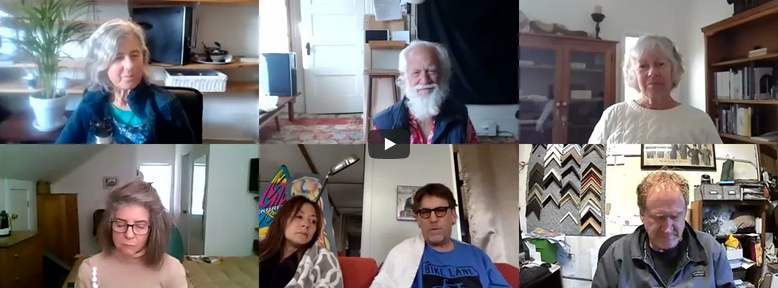
https://youtu.be/IkyX_CGowzo is the link to the Zoom video of this month’s Sunday meeting. The shorter first part of the meeting begins with a chapter reading followed by attendees’ commentary, if any. A little later on begins the longer open discussion part of the meeting when those who wish to discuss how the chapter relates to their personal experience.
Corrections?
None this time.
Reflections:
Devote effort to emptiness, sincerely watch stillness.
Everything ‘out there’ rises up together, and I watch again.
Everything ‘out there’, one and all, return again to their root cause.
For me, the root cause is the nothing referred to in chapter 2’s Hence existence and nothing give birth to one another. Everything ‘out there’ rises up together, and I watch again applies to existence, at least the existence of everything of which I’m aware, both internally and externally. Obviously, there is also the existence of what lies beyond my awareness… but commentary on that mystery is not a game I want to play.
Everything ‘out there’ encompasses all my object oriented observations, whether that be about me (i.e. self-judgment) or about you, that, them, or those. Ultimately, all this lies in the realm of passing judgment on Everything ‘out there’.
If I have sufficiently devoted effort to emptiness, I’m able to sincerely watch stillness. Of course, this is only possible after I have laid my own agenda (my needs and fears) to rest for a few calm moments. In this emotional stillness, I am able to suspend judgment and simply perceive the one and all return again to their root cause.
As I see it, the root cause that everything ‘out there’ shares is nothing. Mind you, this is not “nothing” as commonly defined, (i.e., a: something that does not exist b: the absence of all magnitude or quantity the absence of something), but rather as chapter 2 frames it, the primal source of “something”— Hence existence and nothing give birth to one another. Chapter 40 may frame it even better—Having is born in nothing.
In other words, the disparate forces and phenomena in the vast ‘out there’ all originated as an infinitesimal beginning ‘seed’, which in turn is the result of some previous loss through death. This trail of breadcrumbs goes all the way back to the ‘seed’ of creation we call the Big Bang, i.e., the Big Bang’s root cause was nothing. Naturally, this root cause can never be scientifically verified. Science can only examine the ‘somethings’ of the universe, not the precursor of the ‘somethings’, as it were. Only intuition can catch a glimpse of this way’s mysterious process.
Returning to the root cause is called stillness; this means answering to one’s destiny.
Answering to one’s destiny is called the constant; knowing the constant is called honest.
Entertaining this abstract model helps my mind to move in the opposite direction in which emotion invariably pulls it. This always deepens and broadens my perspective. With that, I can see both the forest and the trees, so to speak. From such detachment, the turbulence at the surface waters of existence wanes and everything returns to the root cause.
Accordingly, Answering to one’s destiny is actively realizing the process of nature at work… stillness begets turmoil begets stillness; death begets life begets death… and so on. It feels like a cycle of nature, yet deeper down I see this as a continuum—the constant. Existence and nothing—life and death—are not the separate polarities we biologically perceive them to be, but rather a mysterious co-generating unity. Merely acknowledging this, without tangibly perceiving this unfathomable mystery, is often enough to open the door to emptiness and stillness. As the last lines of chapter 1 conclude…
Naturally, if at any point this mystery becomes fathomable, the ‘wondrous entrance’ vanishes. These last lines of chapter 1 refer to Normally without desire so as to observe its wonder. Normally having desire so as to observe its boundary. But these, as all other polar opposites, are merely stand-ins for the much more pithy, existence and nothing. Getting past such polar distinctions is our greatest challenge because we did not evolve to perceive such unity. Indeed, we are biologically biased to keenly notice difference and react. Slowing down this impulsive reactivity is the key to psycho-emotional stability.
An important clue to what the constant actually is can be found in the translation of the common Chinese charater, 常 = cháng = ordinary, normal, often, constant. That means knowing the constant is called honest is about seeing the overall process and not getting caught up in, and biased by, the passing drama of the moment. Obviously, we are biologically set up to be drawn toward and react to the drama. I think of this chapter, along with the Tao Te Ching overall, as being a cognitive lever to help us slow down our over impulsive reaction time.
Not knowing the constant, rash actions lead to ominous results.
Knowing the constant allows, allowing therefore impartial,
Impartial therefore whole, whole therefore natural,
Natural therefore the way.
The way therefore long enduring, nearly rising beyond oneself.
Isn’t this line, Knowing the constant allows, allowing therefore impartial, a fair description of patience. We are most impatient when we are highly focused on an outcome we feel favorable. Impatience arises when conditions stall our desired outcome. Impatience is a failure of not returning to the root cause and instead trying to force the outcome we expect. Impatient reactions more often than not end with poor long-term outcomes. In other words, Not knowing the constant, rash actions lead to ominous results. Without a doubt, patience is the ultimate virtue.
The great blessing I find in being as impartial as possible helps to instill a very real sense of wholeness. Nothing is left out. I can’t but help feel immersed in the natural—Impartial therefore whole, whole therefore natural, Natural therefore the way. Impartiality makes judging the ‘value’ or ‘virtue’ of anything or anyone less likely to take hold and much easier to let go. Seeing—feeling—we are all in the same boat, the same root cause, entangles me with you, me with them, me with everything.
Of course, one can’t just flip an internal switch and behold the root cause and so on. To do so, is really going against the biological grain, so to speak. Again, as chapter 40 reminds us, In the opposite direction, of the way moves. I take this to refer to what is opposite of the direction that we feel to be the normal direction that common sense takes us. Indeed, it feels remarkable to be able to grasp even a glimpse of nature’s mysterious ways. Overall, “In the opposite direction, of the way moves” seems to be one of nature’s well kept secrets.
A challenge
See how well you can discern the ‘normal direction’ from the ‘opposite direction’. When moving through life in the normal direction, we (and all animals) don’t realize that what we see and feel is actually a projection of our own internal biological state (mood, expectations, needs, fears). We take our perceptions of the world ‘out there’ to be reality, and naturally so. Here we tend to judge the ‘out there’ either positively or negatively depending on our own emotion backed expectations and ideals.
The challenge will be to see how well you can catch yourself succumbing to this normal biological trap. You might even record such instances. Naturally, the quicker you can catch yourself, the more readily you will be able to Devote effort to emptiness, sincerely watch stillness. Everything ‘out there’ rises up together, and I watch again. Everything ‘out there’, one and all, return again to their root cause.
As you may notice, this issue is closely linked to chapter 71’s Realizing I don’t’ know is better; not knowing this knowing is disease. Thus, a similar challenge will be to see how continuously you can realize you don’t know.
Now you may wonder how to know exactly when you’re beginning to fall into this perceptual trap. That’s easy! Any emotional stirrings, either positive or negative (i.e., happy, angry, sad, etc) are a warning sign… ‘a canary in the coal mine’, so to speak. The quicker you can recognize it happening, the easier it is to move in the opposite direction. The only hitch here is the blinding effect emotions have on perception. They capture all your attention and leave little perception open to notice what is happening ‘in the eye of the beholder’. Of course, persistent practice can only help overcome this hurdle over time.
Chapter Archive https://youtu.be/kC6XUDiRd-0
This is the complete video. It begins with blowing Zen followed by the meeting