The greatest heights lie below what we realize.
Next comes what we praise.
Next comes what we fear.
Next comes what we bully.
When faith is lacking, there is no faith.
Long drawn out speech is noble,
Meritorious accomplishment is fulfilling,
The people all say, “I am natural”.
~~~~~~~~~~~~~~~~~~~~~~~~~~~~~~~~~~~~~~
Word for Word
Limits: Translations, even the nearly literal one above, lose some of the original meaning due to the cultural context of contemporary words. Studying the numerous synonym-like meanings of the Chinese characters in the Word-for-Word translation mitigates this.
Fourth Pass: Chapter of the Month
(pandemic era)
Archive: Characters and past commentary
Zoom on YouTube Recordings:
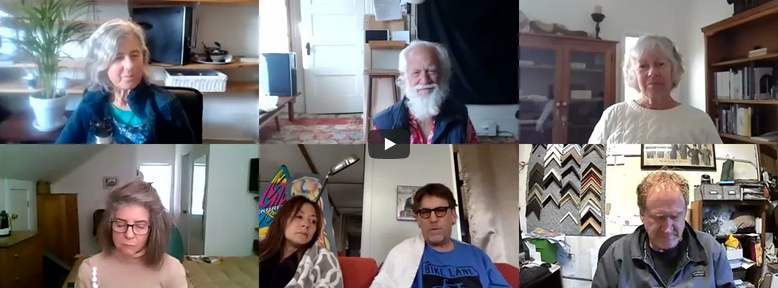
https://youtu.be/snzB46-wF6E is the link to the Zoom video of this month’s Sunday meeting. The shorter first part of the meeting begins with a chapter reading followed by attendees’ commentary, if any. A little later on begins the longer open discussion part of the meeting when those who wish to discuss how the chapter relates to their personal experience.
Corrections?
I may need to change line 6. Currently it says, Long drawn out speech is noble. I notice that some people take this to mean a long string of chatter. I’d change Long drawn out to leisurely, which is another synonym for the actual Chinese character. Other synonyms for Leisurely include relaxed, calm, even paces… all of which parallel Long drawn out.
Reflections:
The greatest heights lie below what we realize.
Next comes what we praise.
Next comes what we fear.
Next comes what we bully.
I notice how our species has an innate tendency be attracted by, and attach importance to, The greatest heights, whether that be tall people, mountains, skyscrapers… etc. Similarly, we attach importance to, and are attracted by, other superlatives like great size, depth, intelligence, wealth, knowledge… you name it. The greatest heights lie below what we realize attempts to open our eye to the vast world of the unnoticed, the mystery… the profound sameness.
This is similar to how chapter 40’s, In the opposite direction, of the way moves, points out how our innate biases—‘normal direction’—don’t really accurately describe how the way moves… how nature moves. Our profound bias to ‘size’ and ‘height’ is probably a result of our transition from an egalitarian hunter-gatherer social structure to a very hierarchical civilized social structure . (See Taoist Thought) We can’t help but view life in a much more hierarchical way than our ancestors did. And that does nothing to enhance our peace of mind!
I suppose the next three lines lay out our emotional priorities. We are drawn to what we praise most readily. Next likely comes what we fear, and finally comes what we bully as our ‘last resort’, which I suspect results from a deeper aspect of praise and fear, in some way or another. And certainly, bullying others raises our status relative to the one we are bullying. Being a hyper-empathic species, praise of others or even of self is certainly a prime characteristic.
Think how many people so easily fall under the sway of charismatic leaders… singers, prophets, teachers, kings… this hierarchical leaning list is long indeed, and usually symbolizing one greatest height or another.
When faith is lacking, there is no faith.
When I’m fully connected to my action, my faith is total—I am one with my action. When I’m wavering, weary, or otherwise disconnected from my actions, there is no fait. One is either on or off. There is really no in-between when it comes to one’s integrity. Thus, ‘trying’ is simply when there is no faith, but rather an intension to ‘find faith’. I suppose second-guessing one’s self happens when there is no faith, which I would feel is actually positive at that moment. If I lack faith in what I doing, it always turns out best if I take time to second-guess myself. As chapter 71 reminds us… Realizing I don’t’ know is better; not knowing this knowing is disease. Certainly, this means to be cautious about placing too much faith in thoughts and beliefs… see Belief: Are We Just Fooling Ourselves?
Long drawn out speech is noble,
The other synonym for Long drawn out is leisurely which may be the better word to use here. It appears that people can easily interpret long drawn out speech to be someone just chattering on endlessly, which doesn’t feel that noble. However, leisurely (relaxed, mellow, calm) speech comes across as natural balanced speech, and not speech driven by some emotional agenda or cause. Long drawn out speech is noble is natural speech without artifice.
Meritorious accomplishment is fulfilling,
This reminds me of the eight-fold path laid out in Buddha’s Four Noble Truths, beginning with the Forth Truth… “There is salvation for him whose self disappears before truth, whose will is bent on what he ought to do, whose sole desire is the performance of his duty. He who is wise will enter this path and make an end to suffering”.
When my actions mirror what I perceive to be my duty, what I ought to do, my life feels fulfilling. The merit lies in how closely my actions align with my duty and what I innately feel I ought to do. If there is no daylight between my duty and my actions, then I feel Meritorious accomplishment… without any need to have others acknowledge this. True merit is internal and extremely ephemeral… as chapter 9 puts it, Meritorious deeds that satisfy oneself recede; This is the way of nature. Chapter 22 describes what occurs in our psyche when we do what we ought to do… He does not attack himself for he has merit; he is not self important for he endures. We only attack ourselves when faith is lacking. Chapter 34 and 77 speak to qualities of genuine merit… Meritorious accomplishment, yet anonymous and Meritorious deeds result, yet not dwelled within.
I suppose the modern term for this integrity-of-being is called living one’s authentic self. Of course, “living one’s authentic self” opens itself up to skepticism when it is not more defined. Without a deeper definition, it is just a slogan.
The people all say, “I am natural”.
Today I discovered two ways to see this. I have always thought of this as meaning the people regard themselves as natural which still makes sense, I feel. Importantly, I added those quote marks, which may bias the view toward how the people regard themselves. The original Chinese has no quote marks.
Take away the quote marks, and this can easily also mean that the people will regard one who fulfills the criteria laid out in this chapter as being natural. In other words, if you live with personal integrity, most of the world will see you as having integrity… of being natural in the best sense of the word.
Chapter Archive https://youtu.be/6KTKKZtzEis
This is the complete video. It begins with blowing Zen followed by the meeting