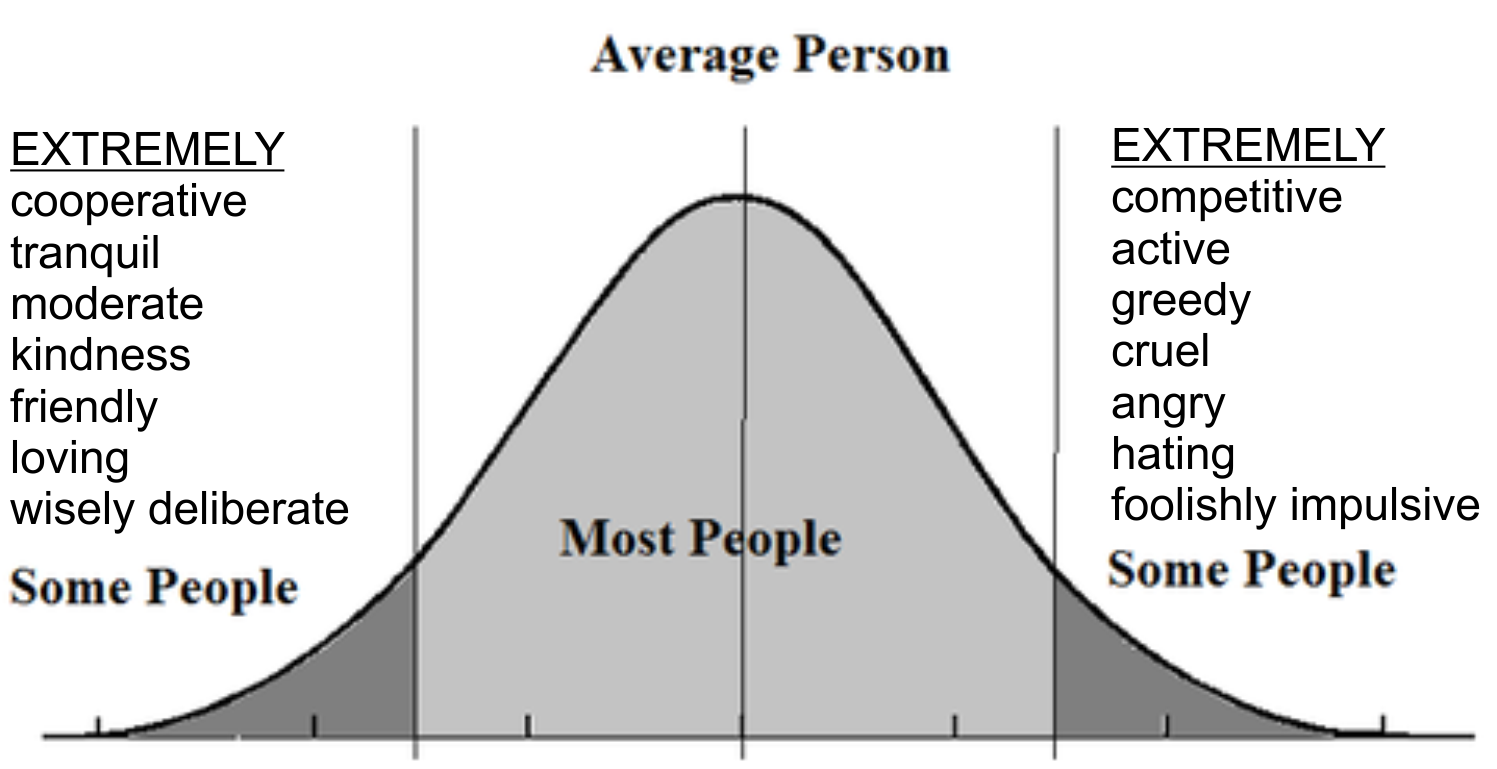
 A bell curve is a type of normal probability distribution for a variable in nature. The top of the curve shows the mean and median of the data. Its standard deviation depicts the bell curve’s relative width around the mean.
Undoubtedly, I’m using the bell curve distribution less rigorously than a professional would. But hey, this is taoist thought after all. 🙂
It is important to note that becoming aware of Nature’s bell curve is certainly not about changing anything! Nature’s bell curve describes how things are. When you can clearly perceive how things are, you will be better able to conform to reality and cease attempting to change the unchangeable. Conversely, ignorance of Nature’s bell curve makes our futile attempt to change reality unavoidable and unending. Only seeing and accepting Nature as it is can provide peace of mind.
Nature plays out on a bell curve of possibility. You could see this loosely as the extreme ‘yin’ on one end and the extreme ‘yang’ on the other. We innately have both poles within us, a bell curve spanning the whole of human (a.k.a. animal) nature. Ponder this listing of a few of these poles:
Cooperative vs. competitive; tranquil vs. active; moderate vs. greedy; kindness vs. cruelty; friendly vs. angry; love vs. hate; wisely deliberate vs. foolishly impulsive; and so on down the line of temperament responses .
The chart shows the probability of some temperament extremes. Some people will be extremely kind, others extremely cruel, and most of us a blend of both but not usually to the extreme. However, this chart can also represent the range of extremes within each person that can sometimes play out, even if rarely, depending on circumstance and such.
We are biologically social animals and this means we are innately predisposed toward kindness and cooperation. The Biblical sentiment, “on earth peace, good will toward men”, speaks to our social instinct for cooperation, kindness, love. This instinctive selfless sentiment is like the glue that binds us together as a social species.
The other side of this curve, the innate impulsive, competitive, active, greedy, cruel, angry, and hateful characteristics are the self-protective responses that help glue the individual ‘selfish’ self together, so to speak. These ‘yang’ emotions can overtake us when circumstances threaten our expectations, whether imagined or biologically innate. This threat triggers fear, including innate fear of loss, pain, failure, and death. Fear then fires up pressing needs that demand urgent satisfaction.
Survival is the primary aim of life, with pleasure and pain pulling or pushing our selfless and selfish emotions in ways that we intuitively feel will fulfill that innate goal. Which pole emerges to express itself, which emotion plays out at any given moment, is a function of circumstances and temperament—never one of ‘free’ choice, despite our belief to the contrary. We are but spectators in this game of life. Oh, but how we believe otherwise, wishing and struggling to control our moment. The final line of chapter 3 gives a most helpful hint on how to deal with this, Doing without doing, following without exception rules.
At it happens, we usually maintain a happy middle point on this bell curve of reaction, but circumstances can change that instantly. Clearly, we wish we had the ability to manage our reactions better, and wish even more that others would. In fact, our wish for free will is so deep, even instinctive, that it is natural to believe we truly have free will. Granted, we do have a moderate ability to make choices, to guide our actions, and to moderate our reactions, even to sit still and meditate. However, our innate temperament, over which we have zero control, determines our ability to do even this. In fact, chemistry (alcohol, drugs, food) is our only easy way to briefly influence temperament and the rest.
Nature is a package deal
The observations I make on how we are emotion driven animals is an abstract scientific reality that is intellectually comfortable enough for me. However, I find that emotionally facing the ruthless reality of that to be extremely heart sinking at times. The real-world facts can be very uncomfortable for anyone who is not sociopathic. I feel a visceral deep-seated need for us to get along, be kind, honest, fair… but reality simply crushes this wish. To be sure, we humans have our moments of kindness and the like, but the bottom line is how easily we can turn on a dime and revert to our innate selfish instincts, which are merely the complementary side of our selfless ones. The fact is, nature is a package deal. Yet, I innately feel a continuous urge to increase the ‘good’ and decrease the ‘bad’. Surely, this urge must be one of the driving forces behind religion, e.g., “Glory to God in the highest, and on earth peace, good will toward men”.
I find the first step towards leaving some of this naive ‘good’ positive baggage behind and “nearly rising beyond oneself” is openly recognizing these poles within me. They are all there in one degree or another, depending upon personal temperament and circumstance. Naturally, I am more inclined to notice the ‘good’ aspects of my character and turn a blind eye toward the ‘bad’. Yet, the ‘bad’ always lurks in the background. ‘Good’ and ‘bad’ are two sides of the profound sameness coin. In seeking or in avoiding one always creates the other. As the beginning of chapter 2 cautions,
It takes self-honesty to peek behind my curtains of self-rationalization. Yet, even here, I’m stuck with honesty (good) vs. prevarication (bad). Certainly, finding a pathway through one’s own limitations must count as life’s ultimate challenge.
Resolving the problem of injustice
The Tradeoff went a long way toward resolving my deep urge to ‘solve the world’s problems’, as they say. When I witness hurtful and unfair human behavior, I am able to diffuse much of my angst by chalking it up to being a natural consequence of hierarchical civilization. Humanity simply traded the egalitarian old way of the hunter-gatherer for the increased comfort and security of civilization, and we all must pay a price for that. Nature won’t allow us to have it both ways!
Yet, still, I feel the instinctive distress of witnessing injustice and the like. I may be civilized on the outside, but deep down, I’m still a hunter-gatherer hominid. We all are! We just do our hunting and gathering in different ways now, yet moved by the same instincts as our ancestors. Those ancient egalitarian social instincts still tug on my heart, your heart, our hearts. What to do? Chapter 65 offers me a hint…
Accordingly, the only solution I’ve found is to maintain a rather continuous awareness that this inner sorrow I feel is (1) natural and (2) impossible to escape. It is part of life. It is a cross we all bear, whether we can acknowledge it or not. I have no choice but to conform to nature’s way. Chapter 63 suggests a way, with the last lines summing it up well, Accordingly, the wise man, still of difficulty, For this reason, in the end, without difficulty. Now from the top…
Just allow myself to be, to strive on diligently. ‘Then, and only then, reaching great conformity’ as chapter 65 put it.
The bell curve in natural phenomena
While I’ve been discussing the bell curve vis-à-vis emotional temperament responses, the bell curve distribution can also offer insight on a wide range of natural phenomena. For example, the Trump presidency has baffled me for a while. How could so many people, half the country, support someone of such low noble character? Finally, the bell curve offers me a clue. Briefly, just as some folks innately prefer chocolate and some vanilla, so too do some innately prefer a dictatorship and some a more egalitarian form of government. That would explain the rise to power of many a tyrant—Stalin, Hitler, and Mao in particular; kings and warlords in general. It is a visceral choice, not a rational one, and certainly not a free choice one. Circumstances undoubtedly play a large role in this choice. In other words, current circumstances play a major role in the bell curve’s distribution of variables. In trying times, more will support the supposed strong man. See also, Democracy as Myth, p.177.
Additionally, our very social nature as a species exacerbates these matters. Our tribal instinct easily overrides any evidence that threatens group solidarity. The resulting social groupthink means we are more ‘monkey see, monkey do’ animals than we’d like to admit. The self-image we have of ourselves, our species, is very out of sync with the reality… We are 99% emotional and 1% rationale, but we view ourselves just the opposite. The only mitigation factor is the slight increase in wisdom that comes with a long life, as the science on wisdom is now revealing. Individuals simply have to live long enough to outgrow some of their childlike groupthink inclinations. Indeed, the younger we are, the more certain we feel that our beliefs (whatever they are) are true. We feel that our take on the world is accurate. It is we, in our beliefs, not ostriches who stick their heads in the sand. The odds of doing that can only decrease as life experience pushes back on the ‘disease’ to which chapter 71 refers. Viewed as a bell curve, youthful characteristics are on one end, old-age characteristics are on the opposite end. As the median age of the population increases, the median characteristics of old age become the new normal.
Homo sapian asapian?
I must say though, that this Trump era has been a truly sobering experience. It bears out much of what I write about. We are animals, through and through. Yet we have a story that paints us in a higher light, a wiser light. Take how we name ourselves, Homo sapian sapian . Sapian comes from a Latin word meaning “one who knows” (Latin: sapere = to know). Thus, Homo sapian sapian = the human who knows that he knows. But as chapter 71 observes, this is our ‘disease’. The true game changer will occur when our species finally realizes this and changes its name. Perhaps to Homo sapian asapian, or something to reflect our realization that we don’t know. (‘a’ is the Latin prefix for not, as in asocial, amoral, asexual, and so on.)
Still, it is always heart sinking for me to see how far from being sapient we are, which in itself is odd. Honestly, that must be just part of my ‘disease’… i.e., chapter 71’s Realizing I don’t’ know is better; not knowing this knowing is disease. Even while I do realize I don’t know, I still think; the dipolar nature of that alone is an act of thinking that I know, as Correlations (p.565) demonstrate. There is no escaping being human, eh?
The dipolar mind: A dipole is a term in physics that refers to a pair of separated electric charges or magnetic poles, of equal magnitude but of opposite polarity, i.e., negative (–) vs. positive (+) or N. vs. S. Life has adopted this natural dynamic to perceive its surroundings in a way that promotes survival in a competitive environment. In life forms with a nervous system, neurons communicate through an electrochemical process… (–) vs. (+). Given this, it is not surprising we see reality in a (–) vs. (+) mode. This (–) vs. (+) dynamic influences how humans label their perceptions: yes vs. no, good vs. bad, yin vs. yang, life vs. death, active vs. passive, go vs. stop, hot vs. cold, before vs. after, hard vs. soft, heaven vs. hell, male vs. female, white vs. black, and so on. Thus, I see language is the emergent property of a fundamental negative (–) vs. positive (+). See Tao As Emergent Property, p.121.
Naturally, such dipolar-like perception is essential for survival in the wild. It boils choices down to the simplest level — yes (+) vs. no (–). However, the human ability to think and remember makes this both a blessing and a curse. Chapter 1’s, These two are the same coming out, yet differ in name hints at the curse. Not only do we see life through simplistic dipolar names; this dipolar thought locks the illusion into memory. For us, dipolar-like perception hinders recognizing that all this is simply, albeit profoundly, two sides of the same coin. Chapter 56 is forthright about this…
See Yin Yang, Nature’s Hoodwink, p.35, and for even more, see also, Seat of Consciousness, p271, What Shapes How You Think?, p.124, and What is ‘the Tao’ actually?,p.39.
It fascinates me how disappointing it all feels for me, given my deep realization that humans are not different from other animals. It is as if a species-centric ‘we are better than that’ story lingers in my deep subconscious. It must lie at an innate visceral level. My emotions can’t accept what my mind’s eye clearly observes. I imagine all this results from how my brain’s empathy inducing mirror neurons naturally pull me into expecting better behavior from us all. Still, the mystery lingers.