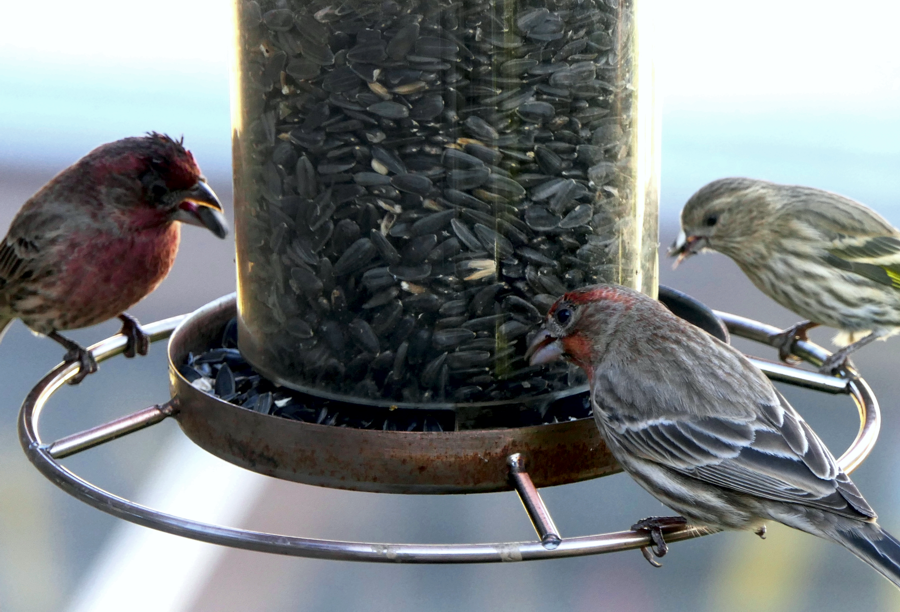
 I was looking out the window this bright sunny morning watching all the birds dining at our bird feeder. They were busy going about doing their thing, which at the moment was eating sunflower seeds. Next, I thought of the role they serve in nature by eating seeds. Presumably, they deposit some of those seeds elsewhere and some eventually sprout. Of course, they are not aware of the vital propagation role they play in nature. They simply follow their needs or fears of the moment.
This pondering instilled in me a sense of awesome underlying unity throughout nature, or as chapter 56 puts it, This is called profound sameness. To be sure, I’ve always regarded our place in nature as being essentially no different from other animals. We simply follow our needs or fears of the moment, unaware of our fundamental role in nature. The trick is to maintain a deep sense of this connection, this “profound sameness”, as much as possible. It is all too easy to become blinded by moments of need or fear—effectively no different from the birds I was watching. The only slight difference is the human imagination’s ability to perceive outside the subjective box of need and fear. Alas, life constantly pulls me back into the ‘game’, and emotionally skews imagination in the process.
The New Science of Practical Wisdom
My pondering this morning leads me to add this summary to the book, to wrap up the story I’ve been telling for these past two decades. Pushing 80, I’ve said most of what I had to say. Wrapping things up actually began with The Tradeoff (p.549), which concisely summarized my views of how our species got to where we are, and where we may be headed.
Briefly, humanity is truly in the early days of civilization. It’s only been some 10,000 years, which evolutionarily speaking, is only the end of the beginning, if that. Much of civilization’s processes are at odds with humanity’s innate emotional needs. Indeed, most of the problems in the world we see are a result of this mismatch. Naturally, civilization will evolve over the coming millennia to a point where it is less problematic. In part, that will happen due to extending the human lifespan. You know, “Older and wiser”. Of course, as Oscar Wilde noted, ‘With age comes wisdom, but sometimes age comes alone.’ Certainly, we all have known some unwise older adults, but overall aging does bring wisdom. Consider these few excerpts from The New Science of Practical Wisdom. Google [The New Science of Practical Wisdom – NCBI – NIH]
When reviewing the relationship between aging and wisdom, it is worth considering how the biological machinery of wisdom changes over the life course. From a peek under the neural hood, does the aging process result in a tuning of the engine, or a rusting of the gears?
In this respect, neurodevelopmental trajectories may be pertinent both in youth and in older age. Reward motivation and emotional circuits develop faster than pre-frontal control circuits, resulting in greater emotional reactivity, reward-seeking behaviors, impulsivity, and risk-taking in youth, with subsequent reductions in such activities with enhancement of prefrontal inhibitory control, leading to a higher level of practical wisdom.
This indicates that although deficits in sensory processing increase with aging, the brain may be bringing online regions highlighted above as being associated with wisdom. Essentially, cognitive and sensory deficits associated with aging may be accompanied by an uptick in the use of the wiser parts of the brain.
Finally, as the brain ages it also changes in how it responds to emotions. Central to the processing of emotions is the amygdala, and recent research has shown that its sensitivity to emotional stimuli changes across the lifetime. The amygdala in younger people shows heightened activity in response to both positive and negative visual images in comparison with neutral images. In older adults, negative images no longer trigger heightened amygdala activity, but positive images continue to do so. This age-related ‘Positivity Effect’ may underlie the calmer and more positive behavior in older age.
Wisdom is associated with greater subjective well-being in older adults. This suggests that, while the aging process may well help facilitate the development of wisdom, the resulting wisdom may, in turn, help in navigating the inevitable challenges that all humans face – those of aging and dying well.
We humans are not the only animals that face the “inevitable challenges that all humans face – those of aging and dying well”. The work of living is a reality all animals endure. In addition, we also deal with an existential stress resulting in part from our cognitive “disease”, as chapter 71 calls it, i.e., Realizing I don’t’ know is better; not knowing this knowing is disease.
All the same, each generation of a species must learn through living how to balance the instinctive forces within. This is why I feel much of Buddha’s Four Truths apply to all animals (see Buddha’s Truths Pertain To All Life, p.545). It is essentially on-the-job training for us all. As animals, we try, we stumble, we adjust, and we get a little better at the skill of living as we age—increasing wisdom is an inextricable result of aging. These Wrapping up posts are my attempt to summarize the main themes I’ve been exploring for much of my life.