When the great way is abandoned, there exists benevolent justice.
When intelligence increases, there exists great falseness.
When relationships lack coherence, there exists respectful kindness.
When the country is confused and chaotic, there exist loyal officials.
~~~~~~~~~~~~~~~~~~~~~~~~~~~~~~~~~~~~~~

Word for Word
Limits: Translations, even the nearly literal one above, lose some of the original meaning due to the cultural context of contemporary words. Studying the numerous synonym-like meanings of the Chinese characters in the Word-for-Word translation mitigates this.
Fourth Pass: Chapter of the Month
(pandemic era)
Archive: Characters and past commentary
Zoom on YouTube Recordings:
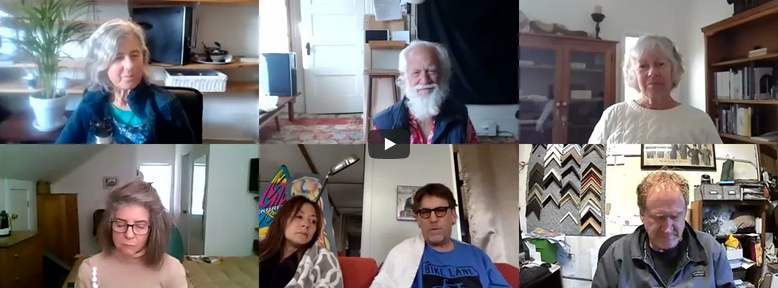 https://youtu.be/Y6YS14f2pNQ is the link to the Zoom video of this month’s Sunday meeting. The shorter first part of the meeting begins with a chapter reading followed by attendees’ commentary, if any. A little later on begins the longer open discussion part of the meeting when those who wish to discuss how the chapter relates to their personal experience.
Corrections?
None this time.
Reflections:
When the great way is abandoned, there exists benevolent justice.
This chapter is similar to the last half of chapter 38 (see below). Both of these chapters show the chain of events that spiral ‘downward’ when the way is lost. It helps to consider the lines, When the great way is abandoned (chapter 18) and Hence Virtue follows loss of way (chapter 38) as referring to your subjective sense of the way, and not any loss of the way in any objective sense. As chapter 73 reminds us, Nature’s net is vast and thin, yet never misses, or as D.C.Lau translates it, The net of heaven is cast wide. Though the mesh is not fine, yet nothing ever slips through.
When we are consumed with emotion, our subjective sense of the way is drowned-out. Fight or flight emotions take over. And, it doesn’t take all that much inner turmoil to overshadow our ability to feel connected… to feel the way. As chapter 14 puts this connection to the way, Hold the ancient way in order to manage today. The ability to know the ancient beginning; this is called the way’s discipline.
Note: The root word of discipline is discere, which means, “to learn”. In other words, cognitive diligence is necessary to hold the ancient way. Our mind is both a blessing and a curse. As chapter 71 cautions, Realizing I don’t’ know is better; not knowing this knowing is disease.
This “disease” obstructs our ability to know the ancient beginning. It is the blind certainty we have in what we think we know that is the disease, and so accepting uncertainty opens the mind to deep learning, i.e., an ability to know the ancient beginning. Being alive to uncertainty naturally pulls us into our moment at hand. Conversely, certainty allows us to leap ahead of ourselves in our anticipation of the next moment, as it were.
One way to be alive to uncertainty is to know the ancient beginning. While this is unattainable at first, learning the outline of history, from the big bang to the present can gradually help the mind take this leap of insight. By keeping one eye on the current moment and the other on the broadest sense of history you can manage, helps put the current situation in a much broader perspective. And this fosters a greater peace of mind.
The last half of chapter 38…
When the great way is abandoned, there exists benevolent justice speaks to how far we’ve traveled from who we were as a species as evidenced by the old ways of our distant ancestors (see The Tradeoff for a detailed account of this journey). Now, we feel blessed just to achieve a large serving of benevolent justice. Clearly, the benevolence, justice, and virtue that civilization exalts are mere “table scraps” compared to holding the ancient way.
When intelligence increases, there exists great falseness.
Just consider how highly civilized societies value intelligence. And we do anything to increase it, no less. When I look around, I see much of our problem stems from too much intelligence. Intelligence enables us to rationalize our action, our hypocrisy, and let ourselves play both sides of an issue, depending on what our own ulterior needs are. We are too intelligent to perceive our own ignorance. Again, as chapter 71 observes, Realizing I don’t’ know is better; not knowing this knowing is disease. Trusting and believing our own beliefs is the foundation of our ignorance.
When relationships lack coherence, there exists respectful kindness.
Most all of our relationships lack coherence, at least compared to the deep social connection that our distant ancestors experienced. This is a tradeoff our species made when replacing our traditional egalitarian way of life for a civilized one. To compensate for the loss of coherent relationships, society (religion) came up with rules of behavior, morality, etiquette. Sure, these work to an extent… perhaps enough to keep things just limping along, barely on the stable side of chaos.
When the country is confused and chaotic, there exist loyal officials.
Anyone who feels a sense of duty to their country, and is in a position of management, would be inclined to feel worried when the country was veering into chaos. They would feel pressure to ‘fix’ the problem, and work together to that end.
This follows a natural social dynamic: When a social group confronts a common enemy, that group unites and loyally strives to overcome the enemy. Here, confusion and chaos are the enemy threatening the country, which causes the officials to put aside their petty bickering and unite in common cause.
Chapter Archive https://youtu.be/6KTKKZtzEis
This is the complete video. It begins with blowing Zen followed by the meeting