Cut off the sage, discard wisdom,
And the people benefit hundred fold.
Cut off benevolence, throw away justice,
And the people resume mourning kindness.
Cut off cleverness, discard advantage,
And robbers will not exist.
These three, considering culture, are not enough.
For this reason, make something to belong to;
See simply, embrace the plain, and have few personal desires.
~~~~~~~~~~~~~~~~~~~~~~~~~~~~~~~~~~~~~~

Word for Word
Limits: Translations, even the nearly literal one above, lose some of the original meaning due to the cultural context of contemporary words. Studying the numerous synonym-like meanings of the Chinese characters in the Word-for-Word translation mitigates this.
Fourth Pass: Chapter of the Month
(Trump era)
Archive: Characters and past commentary
Zoom on YouTube Recordings:
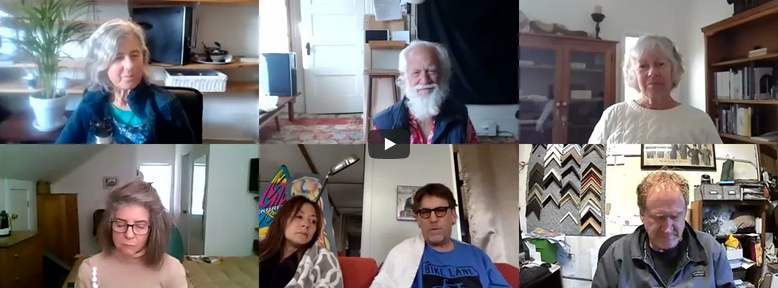
https://youtu.be/8KTgVsk3TKo is the link to the Zoom video of this month’s Sunday meeting. The shorter first part of the meeting begins with a chapter reading followed by attendees’ commentary, if any. A little later on begins the longer open discussion part of the meeting when those who wish to discuss how the chapter relates to their personal experience.
Corrections?
None this time.
Reflections:
Cut off the sage, discard wisdom,
And the people benefit hundred fold.
Cut off benevolence, throw away justice,
And the people resume mourning kindness.
Cut off cleverness, discard advantage,
And robbers will not exist.
These three lines come across as a cause and effect process. They imply that if you get rid of the sage, wisdom, benevolence, justice, cleverness and advantage, the people will all benefit and resume mourning kindness. This is clearly not the case, to which line 7 alludes.
Is this an example of chapter 40’s In the opposite direction, of the way moves? I mean, ‘common sense’ tells us that the cause and effect process laid out in the first 6 lines is correct, whether or not you agree with the result. I assume such ‘common sense’ is instinctive, and part of Nature’s hoodwink. We are biased to pay more attention to what is there than to what is missing. Nature, on the other hand, is powered by what is missing—the Great Nothing, so to speak. As chapters 40 and 11 observe, Having is born in nothing and Hence, of having what is thought favorable, of the nothing think as the useful.
It is because the people have lost mourning kindness, and natural benefit that these cultural ideals, i.e., wisdom, sage, benevolence, etc., arose. As chapter 18 observes, When the great way is abandoned, there exists benevolent justice. These lines from chapter 38 break this downward-spiral even better,
These three, considering culture, are not enough.
Cultures are deluded by believing that the sage, wisdom, justice, and such are the solution to societal dysfunction, if only they could be implemented better. This fantasy has persisted from the earliest days of civilization, going back thousands of years. Alas, as long as we continue to treat these symptoms of dysfunction as remedies we will get nowhere.
If society ever reaches the point where it can see these solutions as symptoms of our dysfunction instead, we may have a better chance of managing our dysfunction better. The only true “cure” would be to return to the old way of our hunter-gatherer ancestors, as chapter 80 proposed, i.e., Enable the people to again use the knotted rope and the rest. Now, there is no way that can ever happen! We would be biologically incapable of returning to that more perilous, uncomfortable, and arduous way of life. For more on our transition from our ancestral ways to civilization see The Tradeoff.
One reason culture holds onto its naive and futile solutions for the ills of civilization is probably due to the simple fact that those people old enough to begin to realize the real cause die off and are replaced by newborns—the next generation. Deep wisdom is acquired gradually through living many decades, and can’t be taught, i.e., We only understand what we already know. Of course, we can intellectually learn the principles, and aspire to integrate them into our daily life. However, it is only through experiencing the ups and downs over a lifetime that we can begin to verify them. And only after we verify them can we truly implement them. So, it isn’t surprising that humanity keeps repeating the same fruitless fixes. Obviously, this is completely natural. After all, we are just animals. Perhaps it would help if we faced that fact more honestly. But here again greater self-honesty comes with age. It is kind of a Catch-22, I suppose.
Acknowledging that there is truly NO SOLUTION to reversing the consequences of the tradeoff may sound awfully negative and fatalistic. That feels awful, which makes it all the more unpalatable. However, in my experience, facing up to the actual how and why of our circumstances allows me to deal with any situation much more effectively than when I used to believe in “solutions”. We don’t need “solutions” to our problems. Problems are here to stay. All we need is the most effective way to deal with them, and facing actual causes increases our chances of doing just that. Note: I do recognize that it may take another 10,000 years of stumbling along with failed “solutions” before we’re able to see the deeper forces at play.
For this reason, make something to belong to;
See simply, embrace the plain, and have few personal desires.
For this reason, make something to belong to brings us back to the essential cause for much of our social dysfunction. We are not able to feel the sense of connection to each other and to nature as deeply as our hunter-gatherer ancestors did. The only situations where we can see a deeper sense of connection is when we are faced with dire survival situations. Combat soldiers powerfully exemplify that bond in times of war. Not surprisingly, their return to “normal” civilian life can be a very difficult transition… trading a very intimate social bond for a looser one.
There is a society-wide need to have something to belong to. This need is the glue that holds religions and political parties together, with their respective ideologies and theologies trailing far behind. Indeed, the need for something to belong to is the core raison d’être (reason for existence) for clubs, sports teams, parades, social media, knitting circles, etc.
The question is, do these somethings to belong to actually work? Yes, to a certain degree, but in the end, nothing can replace the kind of social belonging—social security—that our ancestors experienced. We simply can’t have it both ways. We long ago opted for the increased personal independence, comfort and security made possible through civilization, i.e., hierarchical organization of people, in lieu of the egalitarian ways of our ancestors.
Thus, the last line, See simply, embrace the plain, and have few personal desires, suggests how the individual—at least—can turn the clock back, as it were. The ability to intuitively embody these qualities helps us return to the original self, the self we were born as, before culture trained us to be “good citizens”. In other words, when you can See simply, embrace the plain, and have few personal desires, you cease having a need for virtue, benevolence, justice, and the rest. The only thing left is nature… the way.
Note: See simply, embrace the plain, and have few personal desires is obviously easier said than done. One way to help this along is the ability to know the ancient beginning. While this maybe unattainable at first, learning the outlines of history, from the big bang to the present can gradually help the mind take this leap of insight. In particular, by keeping one eye on your current moment and the other on the broadest sense of history you can manage, helps put the current situation in a much broader perspective. See simply, embrace the plain naturally follows in due course. These, in turn, cultivate having fewer personal desires.
Chapter Archive https://youtu.be/Vke3HcP0Cb4
This is the complete video. It begins with blowing Zen followed by the meeting