In using the way to assist in managing people,
Avoid strong-arming anything under heaven.
Such affairs easily rebound.
Where masters live, why do thorn bushes grow?
Where armies have been, years of crop failure follow.Those most adept have results, yet stop, not daring to seek better.
Have results yet don’t pity.
Have results yet don’t attack.
Have results yet don’t be proud.
Have results yet not complacent afterwards.
Have results yet don’t strive.
Making matters better as a long-term rule, is not of the dao.
Not of the dao ends early.
~~~~~~~~~~~~~~~~~~~~~~~~~~~~~~~~~~~~~~

Word for Word
Limits: Translations, even the nearly literal one above, lose some of the original meaning due to the cultural context of contemporary words. Studying the numerous synonym-like meanings of the Chinese characters in the Word-for-Word translation mitigates this.
Fourth Pass: Chapter of the Month
(Trump era)
Archive: Characters and past commentary
Zoom on YouTube Recordings:
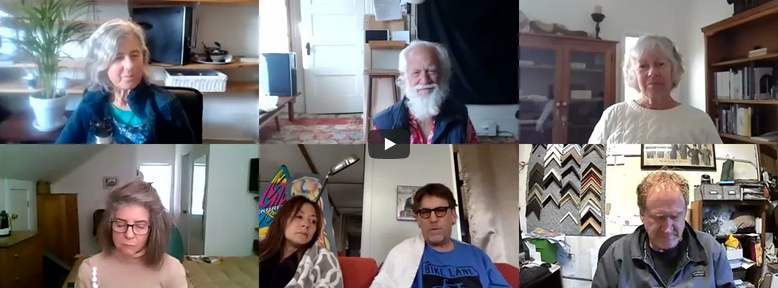
https://youtu.be/fUy4VmEGhd0 is the link to the Zoom video of this month’s Sunday meeting. The shorter first part of the meeting begins with a chapter reading followed by attendees’ commentary, if any. A little later on begins the longer open discussion part of the meeting when those who wish to discuss how the chapter relates to their personal experience.
Corrections?
None this time.
Reflections:
In using the way to assist in managing people,
Avoid strong-arming anything under heaven.
Such affairs easily rebound.
Where masters live, why do thorn bushes grow?
Where armies have been, years of crop failure follow.
The first thing that came to my mind in this chapter was the chasm that exists between what we idealize and wish for, and nature’s reality and our biological role in it. We intellectually know through our experience, and history overall, the wisdom to Avoid strong-arming anything under heaven. Such affairs easily rebound.
Yet, in real life, we can only truly avoid strong-arming anything when we are emotionally calm enough—or when, knowing the adverse consequences keenly enough, fear compels us to avoid strong-arming anything. But is this latter avoidance, due to fear, not of the dao? Is even the ignorant folly of strong-arming anything not of the dao? The question is, is there any true difference between any of these scenarios?
I find fear is the process that informs wisdom. Indeed, we can never truly cease wishing to have control over life despite all the evidence pointing to our lack of control. Thus, we always end up learning the hard way, so to speak. In the end, our reactions to events are entirely natural! Here is a pithy overview of what I see as the bottom-up chain-of-causation that applies to all living things. (Note: → = gives rise to, begets, causes,) Entropy → fear → need → action (i.e., negentropy) → life meaning → “happiness” . For details, see Life’s Chain of Causation.
So here, we see that the only difference is in the expenditure of energy. The person acting out of fear spends a great deal of energy (stress). The person acting out of wisdom achieves the same result while remaining emotionally calm. Same outcome, different cost, and thus a different subjective sense of the dao—the former distant, the latter close at hand.
Where masters live, why do thorn bushes grow? puzzles me. Which way should I spin this? Interpreting the word masters positively, I see this as saying masters live more in harmony with their surrounding and so they let thorn bushes grow when there is no actual survival need to cut them down, e.g., like needing to plow them up to grow food. Now if I interpret the word masters negatively, I see this as saying the masters are too lost in their mastery to take care of practical matters like dealing with the thorn bushes while they are small, e.g., like absent minded professors neglect of practical matters. This exemplifies how the interpretation of words and their context is crucial for understanding and communication.
Those most adept have results, yet stop, not daring to seek better.
Have results yet don’t pity.
Have results yet don’t attack.
Have results yet don’t be proud.
Have results yet not complacent afterwards.
Have results yet don’t strive.
Those most adept have results, yet stop, not daring to seek better makes the false impression that we have control over our lives, otherwise known as either explicit or implicit free will (See Free Will: Fact or Wishful Thinking?). A better word than adept would be wise. Wisdom is not a thing one can strive to attain; wisdom is something that accumulates through facing life’s pits and falls. The old dog, fish, crow, gopher, etc. have learned through narrow escapes to be more circumspect, more in awe, more respectful of fear. As the old saying goes, “Fools rush in where the wise fear to tread”.
The next five lines all begin with, Have results yet… Thus, when you accept things as they are you naturally don’t pity. When you are satiated with success, you don’t attack. When you feel self secure, there is no reason to be proud. When you are alive to the constant of constant change, you are not complacent afterwards. When you a content with results, there is nothing left to strive for.
All of these occur much more easily as one ages. These are not proper approaches to life for youth. Youth is biologically set up to be more reckless, ambitious, impatient, and caution free, just as nature intends youth to be!
Making matters better as a long-term rule, is not of the dao.
Not of the dao ends early.
Making matters better as a long-term rule, is not of the dao calls for considering how we interpret dao. On one hand, chapter 34 states, The great way flows, such as it may left and right. Or again in chapter 73, Nature’s net is vast and thin, yet never misses. Seen this way, there can be nothing that is not of the dao. There is nothing that ends early that is not supposed to naturally end when it does.
On the other hand, chapter 38 puts forth a more conditional view as these lines show, Hence, Virtue follows loss of way. Benevolence follows loss of virtue. Justice follows loss of benevolence. Ritual follows loss of justice. I see this as speaking to our subjective sense of the dao. When we strive for making matters better, we are pushing back on entropy. Pushing back on entropy means actively applying energy and focus to create and maintain order—to survive against the natural tendency towards disorder, decay, and death. In the throes of such stress, we don’t feel the great way flowing, or nature’s net never missing. When in the thick of life’s challenges, emotions push and pull us this way and that. Our subjective sense of the dao is out of our mental and emotional reach. This definitely feels not of the dao. However, because all of this is the transient roller coaster of emotion, it soon passes… Not of the dao (always) ends early.
Chapter Archive https://youtu.be/Lu_vId9dXRU
This is the complete video. It begins with blowing Zen followed by the meeting