The way constant is without name.
Simple! Though small, nothing under heaven can subjugate it as well.
Great men, if able to observe it,
All things would take the role of guest.
Heaven and earth would join letting sweet dew fall,
The people, of none decree, yet self balanced.Only when restricted, are there names.
Names already exist,
Man handles the realization to stop.
Knowing to stop [he] can be without danger.
Analogy: of the way’s existence under heaven,
Liken this to the river of the valley flowing to the great river and the sea.
~~~~~~~~~~~~~~~~~~~~~~~~~~~~~~~~~~~~~~

Word for Word
Limits: Translations, even the nearly literal one above, lose some of the original meaning due to the cultural context of contemporary words. Studying the numerous synonym-like meanings of the Chinese characters in the Word-for-Word translation mitigates this.
Fourth Pass: Chapter of the Month
(Trump era)
Archive: Characters and past commentary
Zoom on YouTube Recordings:
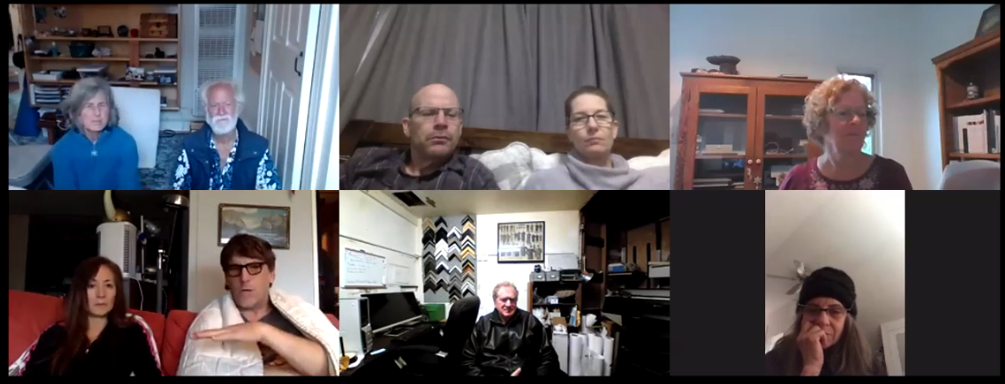
https://youtu.be/zmIafk5t2Io is the link to the Zoom video of this month’s Sunday meeting. The shorter first part of the meeting begins with a chapter reading followed by attendees’ commentary, if any. A little later on begins the longer open discussion part of the meeting when those who wish to discuss how the chapter relates to their personal experience.
Corrections?
None this time.
Reflections:
The way constant is without name.
Simple! Though small, nothing under heaven can subjugate it as well.
The way constant is without name reiterates chapter one’s opening disclaimer, The way possible to think, runs counter to the constant way. The name possible to express runs counter to the constant name. Few if any cultural traditions open with so direct a disclaimer about their own limitations; just the opposite! This simple fact can’t be overstated given how deeply embedded in the human brain words and stories are. On one hand, words easily complicate nature’s simple. On the other hand, their natural deeper function in our species parallels the social exchange that sniffing accomplishes for dogs and the nit picking that serves our primate brothers. This use of language is a healthy and natural means of social bonding, not to mention how deeply it benefits survival—at least up to a point.
We leave the healthy and natural behind when names and words dominate perception. Then, when backed with emotional certainty, names and words transform into a uniquely human disease. As chapter 71 cautions, Realizing I don’t know is better; not knowing this knowing is disease.
Great men, if able to observe it,
All things would take the role of guest.
Heaven and earth would join letting sweet dew fall,
The people, of none decree, yet self balanced.
Reading these first six lines had me a little stumped this morning. I initially interpreted this as a kind of objective result of observation, i.e., Great men, if able to observe it. That implies that a sage with rare insight can solve our yet unsolved problems. Surely, this is not different from any other human heroic ideal, like in how the second coming of Christ can solve humanity’s problems, or the more mundane expectation that the next President will be a “God send” for the nation. Both reflect a comfortable ignorance of nature as a whole.
These lines only make real practical sense if they describe how worldly circumstances might appear to any person whose mind is returning and resting in the honest Simple! As chapter 16 says, Returning to the root cause is called stillness; this means answering to one’s destiny. Answering to one’s destiny is called the constant; knowing the constant is called honest.
Our negative view of the world is essentially a reflection of our expectations of how we want the world to be. And our expectations are driven by fear and its offspring desire. Naturally, there is nothing wrong or mistaken with this—fear and need are fundamental to life (see Life’s Chain of Causation). However, the simple fact is, our expectations are the source of our suffering. Self balance is only possible when expectations match the reality of what is. Chapter 19 sums it up briefly, See simply, embrace the plain, and have few personal desires. Buddha sums this up in more detail in his two Noble Truths…
The Second Noble Truth is the cause of suffering. The cause of suffering is lust. The surrounding world affects sensation and begets a craving thirst that clamors for immediate satisfaction. The illusion of self originates and manifests itself in a cleaving to things. The desire to live for the enjoyment of self entangles us in the net of sorrows. Pleasures are the bait and the result is pain.
Of course, the popular interpretation of these lines is about non-interference (Wu Wei), where when a ruler does nothing, the people will self-balance because the natural equilibrium of the system isn’t being disrupted by ego-driven policies. Like “Peace on Earth and Good Will to all Men”, this is what the empathic emotions of humanity project onto their stories, including Taoist stories. History clearly demonstrates reality never conforms to our ideals long term, i.e., at least for more than a few fleeting historical moments. Nature ebbs and flows, never stagnating in the idealized state of harmony we wish for in our imagination.
Only when restricted, are there names.
Names already exist,
Man handles the realization to stop.
Knowing to stop [he] can be without danger.
“Only when restricted, are there names” points to the tradeoff we make by relying so exclusively on words, names, language, and the stories we get our minds locked onto. Names have enabled us to ‘divide and conquer’ nature, which has put us at the tip-top of the food web. The price we pay for this survival advantage lies in the way this boxes-in our mind. “Think outside the box” is a little absurd at its core—it is thinking that initially boxes us in.
Names already exist is just affirming the evolved nature of the human mind. Names for us are as natural as our feet are for walking. The trick lies in handling the realization to stop. Essentially, we have here a ‘too much of a good thing’ problem. The insidious aspect of language—and the stories we dwell upon—lies in how easily it becomes a self-reinforcing neurotic mental spiral that hampers handling the realization to stop. That is a Catch-22 if ever there was one.
Knowing to stop [he/she] can be without danger is easier said than done, of course. We might even say thoughts are addictive. The emotional stake we have in our thoughts makes us unable to turn off the mind’s spigot. So much of the danger we feel ourselves surrounded by is actually a product of our own making, again fear and need driving imagination’s narrative.
The modern world with its internet, social media and AI thrust us even more into the realm of the imagined, making it all the more difficult to see beyond the stories we’re locked into. Our connection to the actual ground—dirt and nature—is being replaced by the ease and comfort that technology affords us. Even more potent is how technological progress is accelerating exponentially. We did not evolve to handle the uncertainty, un-groundedness, and stresses that such a ramped up rate of change produces. And to top all this off is how we are convinced that the solution lies ahead.
Analogy: of the way’s existence under heaven,
Liken this to the river of the valley flowing to the great river and the sea.
In a way, this is a metaphor for entropy — the flow of gradients toward equilibrium, like a river emptying into the sea. In that sense, entropy resembles one visible tendency within the larger flow the Tao Te Ching points toward. Yet the sea does not remain still; its waters rise and return, and the river flows again. As chapter 40 hints at, reversal is the movement of the Way:
Or, as these chapters also hint at…
Dead, and yet not gone; This is longevity;
Soften its brightness, be the same as dust, This is called profound sameness.
The way of nature decreases surplus yet benefits the insufficient.
Of weakness and loss through death, superior to strength.
Chapter Archive https://youtu.be/oqERjLDWbZ0
This is the complete video. It begins with blowing Zen followed by the meeting