Knowing people is wisdom.
Knowing self is honesty.
Success with people is ability.
Success with self is strength.
Being content is wealth.
Striving to be current is will.
Not losing place is endurance.
Dead, and yet not gone;
This is longevity.
~~~~~~~~~~~~~~~~~~~~~~~~~~~~~~~~~~~~~~

Word for Word
Limits: Translations, even the nearly literal one above, lose some of the original meaning due to the cultural context of contemporary words. Studying the numerous synonym-like meanings of the Chinese characters in the Word-for-Word translation mitigates this.
Fourth Pass: Chapter of the Month
(Trump era)
Archive: Characters and past commentary
Zoom on YouTube Recordings:
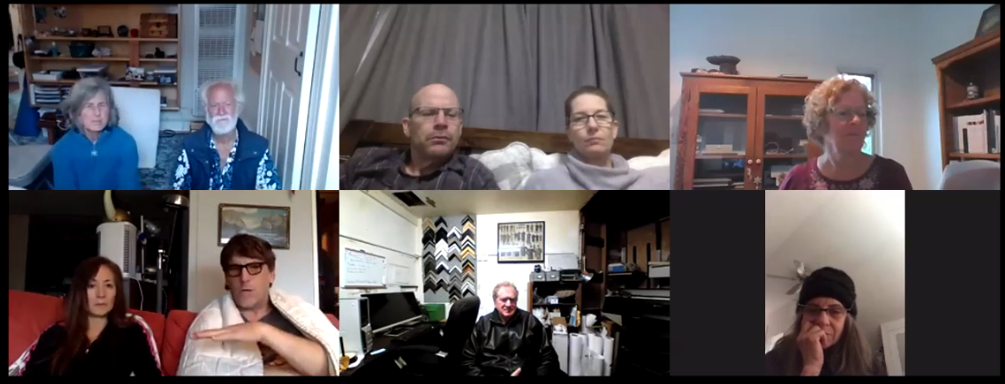
https://youtu.be/zmIafk5t2Io is the link to the Zoom video of this month’s Sunday meeting. The shorter first part of the meeting begins with a chapter reading followed by attendees’ commentary, if any. A little later on begins the longer open discussion part of the meeting when those who wish to discuss how the chapter relates to their personal experience.
Corrections?
https://youtu.be/G_ZbMCoSe5Y is the link to the Zoom video of this month’s Sunday meeting. The shorter first part of the meeting begins with a chapter reading followed by attendees’ commentary, if any. A little later on begins the longer open discussion part of the meeting when those who wish to discuss how the chapter relates to their personal experience.
Reflections:
Knowing people is wisdom.
Knowing self is honesty.
Today I see the first six lines differently than before. That’s probably due to the bias D.C. Lau introduced in the first four lines anyway. Take the first two lines for example, He who knows others is clever; He who knows himself has discernment. “Clever” is not viewed favorably throughout the Tao Te Ching. As chapter 18 notes: When cleverness emerges, There is great hypocrisy, or more literally, When intelligence increases, there exists great falseness.
I’d been reading D.C. Lau’s version for 50 years before I dug in to translate it myself… as literally as humanly possible. The literal is much more even handed, and in fact, today I see these first two lines and the next four lines as supporting each other, and not with the implied “better” and “worse” tilt that D.C. Lau gives it. Why did he do that? Clearly, being as succinct as it is, the Tao Te Ching can be easily interpreted / translated to lean in a way that matches the translator’s partiality. To avoid this pitfall, one must be as impartial, as humanly possible. For me, impartiality is the gold standard throughout, so I must read Chapter 33 (and every chapter really) through the lens of Chapter 16’s emphasis on impartiality. As chapter 16 frames it,
So, how does anyone know they are being impartial is the real question. Am I impartial enough? I’ve found that any felt preference I have for any observation I make is my “canary in the coal mine” mind space. This immediately awakens my relentless inner devil’s advocate to challenge the felt preference certainty until I have seen both sides even handedly. Admittedly, that can take a little while, but my devil’s advocate doesn’t relent until it’s satisfied.
In translating specifically, impartiality also means to translate the Chinese as literal as possible, but through the context of the whole of the Tao Te Ching, which means softening the hard worldly meanings of the characters and also frequently ending up with awkward English. There is a side advantage in doing this too. With awkward English, the mind must slow down and slowly think things over. And, this is fully in keeping with chapter 81’s True speech isn’t beautiful,Beautiful speech isn’t true.
Success with people is ability.
Success with self is strength.
Being content is wealth.
Striving to be current is will.
Reading the Chinese literally, I don’t see any “better” vs. “worse” morality that translations often read into these lines. Instead, my life has shown me they work together, with the second in each pair often feeling like it is a prerequisite for the first. I have found that Knowing self is honesty is actually a prerequisite for Knowing people is wisdom. The depth of my self honesty determines the depth of my wisdom and knowing of people… and actually of every living being. When I have success with self, that strength improves my ability to have success with people, relationship-wise anyway.
Conversely, any lack of self-strength or wisdom automatically causes me to project that deficiency onto others, often by judgments like “they should, or shouldn’t” be a certain way or do certain actions. I think Jesus’ admonition, “Judge not lest ye be judged” is a de facto recognition: the outward judgments we make are simply reflections of our own self-judgment. In other words, a poisoned heart sees poison “out there”. Note: the Chinese simply lines these up in parallel — it doesn’t assert one causes the other. What I’m describing is what experience has shown me, and nothing more.
To me, Striving to be current is will states the essence of will. All life is in a struggle against entropy. As chapter 32 puts it, Liken this to the river of the valley flowing to the great river and the sea. All living things work hard, Striving to be current… is will … to move in the other direction… up “the great river”, so to speak ― simply life’s negentropic struggle against entropy — a struggle it can only maintain temporarily.
All species move within this struggle naturally, i.e., wei wu wei. Humans do as well, but our reflective mind often interferes with that spontaneity. The Tao Te Ching helps wake us up to this seemingly paradoxical wei wu wei — action without action. Not paradoxical to nature itself, of course — as chapter 78 concludes, straight and honest words seem inside out. For a closer look at entropy and life, see Life’s Chain of Causation.
Not losing place is endurance.
Dead, and yet not gone;
This is longevity.
Not losing place is endurance feels parallel to the previous Striving to be current is will. Merely not losing place while in the great river of life is endurance. In that sense, it also echoes dead, and yet not gone and this is longevity.
Read literally, Dead, and yet not gone, is puzzling. For me, it points toward how life and death are imagined realities in the human mind, layered on top of what life and death are in nature’s reality. Fear drives this imagination. Dipolar thinking, along with its “illusion of self”, shapes our ideals (religion, etc.) and much of our behavior. Our natural life drive to avoid losing place, and striving to be current is will, are transformed by imagination into what I call Instinctive Free Will. For a deeper look at self and will, see Buddhism and the Thermodynamic Chain.
The possible, and for me probable, universal connection between all living things, not only now but across time, is not an easy subject to put into words. Yet, I keep “tilting at windmills”. Here are a few of those windmills, You are Immortal! and Quantum Superposition as the Driver of Insight.
As a side note on Being content is wealth and Striving to be current is will: your body must feel you’re serious before it puts any genuine resources behind your intention. Take muscle for example. Just doing the same thing daily won’t build new muscle, and as you age and gradually slow down, your body reads that as a signal: “he doesn’t really need this muscle anymore — convert the protein for other uses.” That’s not failure, that’s evolutionary wisdom. Sarcopenia — the age-related loss of muscle mass and strength — is simply this process running quietly in the background, so gradual that you don’t notice it until it becomes a problem. To reverse or slow it down, your intentions must be backed by visceral will to be current. The body has to feel survival necessity, not just wish. This principle runs through all life functions, not just muscle.
Chapter Archive https://youtu.be/-vjiPC2XKQo
This is the complete video. It begins with blowing Zen followed by the meeting