The great way flows, such as it may left and right.
All things on earth depend on it for existence, yet it never declines,
Meritorious accomplishment, yet anonymous.
Clothes and supports all things on earth, yet doesn’t act as master.
Always without desire, befits the name small.
All things on earth return here, Why?
Not being their master, befits the name great.
Because of its ultimate non-self, it becomes great.
Hence, it can accomplish such greatness
~~~~~~~~~~~~~~~~~~~~~~~~~~~~~~~~~~~~~~
Word for Word
Limits: Translations, even the nearly literal one above, lose some of the original meaning due to the cultural context of contemporary words. Studying the numerous synonym-like meanings of the Chinese characters in the Word-for-Word translation mitigates this.
Fourth Pass: Chapter of the Month
(Trump era)
Archive: Characters and past commentary
Zoom on YouTube Recordings:
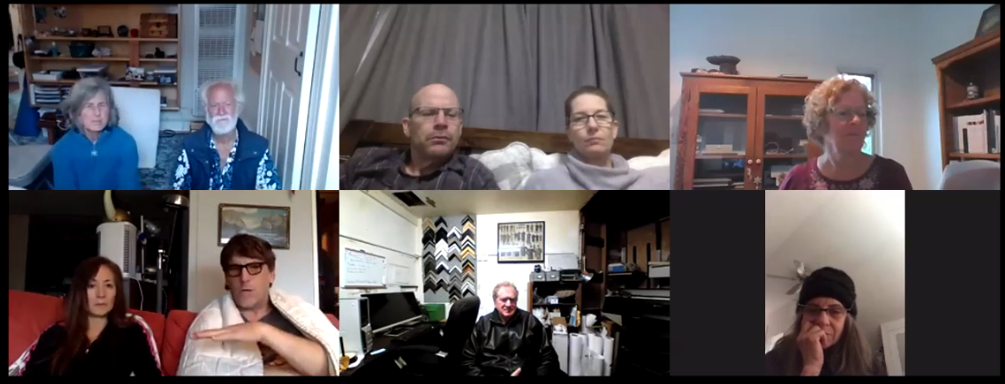
https://youtu.be/zmIafk5t2Io is the link to the Zoom video of this month’s Sunday meeting. The shorter first part of the meeting begins with a chapter reading followed by attendees’ commentary, if any. A little later on begins the longer open discussion part of the meeting when those who wish to discuss how the chapter relates to their personal experience.
Corrections?
None this time.
Reflections:
The great way flows, such as it may left and right.
All things on earth depend on it for existence, yet it never declines,
Meritorious accomplishment, yet anonymous.
Clothes and supports all things on earth, yet doesn’t act as master.
The great way flows, such as it may left and right should remind anyone not seeing life impartially of the evenhanded way of nature. Chapter 16 spells this out beautifully, especially the last half:
To get to the point of knowing the constant, one first needs to take the step the opening half of that chapter counsels:
It is not surprising that we see all the strife down here on earth. Our cognitive biology adds the “noise” of imagination to our perception of “what is so.” We end up leaning left or right, and worse, many feel “if you’re not with us you’re against us.”
Beyond that obvious left-vs-right matter, what struck me this morning in this chapter is how squarely it portrays the sense of awe, mystery, and unknown that haunts the human psyche. This is the unique aspect that separates us from the rest of life on earth, and not in a “good” way either, I dare say.
I suspect this disconnect with reality, or with “what is naturally so”, began as our use of words, language, and imagination took over cognition, splitting experience into opposing poles: left vs. right, life vs. death, happy vs. sad, beauty vs. ugly, and so on. As chapter 2 observes:
That psychological tension, I think, is the engine behind our creation myths. They ease our insecurity by filling in the void with a range of named “whys, hows, whens, and wheres”. This goes back tens of thousands of years, perhaps to Homo species earlier than our own. For most of that time, life was hard, immediate, and wild enough to keep us grounded. Then, with the exponential growth of tool use, written language, and institutional hierarchy, we lost that natural stabilizer. Nature abhors a vacuum, and thus religion arose to replace it with the one God of the West and the compassionate message of the Buddha.
What is striking about this chapter is how it addresses that same mystery without personalization, and in doing so stays true to the impartiality of chapter 16 described above. Meritorious accomplishment, yet anonymous and not being their master, befits the name great stands in stark contrast to God, or even the Enlightened Buddha, both of whom are the very opposite of anonymous! Because most people need something more tangible to hold onto, a named presence, a He, (or a She) the Tao Te Ching will always reach fewer people than a creation myth that spells out an origin story. For many, there is a deeper need to have something more personal to relate to than an omnipresent God. This, along with how we are socially, biologically wired to follow a group leader, makes Jesus, the personalizable saints of the Catholic Church, and Buddha, ideal. See The Tradeoff, which lays out the whole trajectory of this pre-historic to historic timeline.
Always without desire, befits the name small.
All things on earth return here, Why?
Not being their master, befits the name great.
Because of its ultimate non-self, it becomes great.
Hence, it can accomplish such greatness.
Not being their master, befits the name great and Because of its ultimate non-self, it becomes great have a somewhat paradoxical quality to them. The greatness here lies in not being great as we usually think of the word. That would fit right in with the “mission” of the Tao Te Ching, i.e., wean us away from our certainty and trust in words as accurate descriptions of reality.
On a personal note: I used this chapter (along with many more of course) for guidance in raising my two sons. The beauty of using the Tao Te Ching for guidance in parenting is that parenting became much smoother than when drawn into contending with your children. Of course, the same applies to dealing with other adults, but in child rearing, the intense intimacy of that situation benefits more profoundly than normal worldly life. I mean, just notice how well this parallels a parent’s role with their children:
All things (particularly one’s children) on earth depend on it for existence, yet it never declines,
Meritorious accomplishment, yet anonymous.
Clothes and supports all things on earth (particularly one’s children), yet doesn’t act as master.
These lines from chapters 8, 68, 73, and 81 also spoke directly to how I tried to show up as a father:
Nature’s ruthlessness, who knows its cause.
Nature’s way never contending, yet adept in victory.
Nature’s way benefits, and yet doesn’t harm.
The holy person’s way acts, and yet doesn’t contend.
Chapter Archive https://youtu.be/qpR2G3xphqw
This is the complete video. It begins with blowing Zen followed by the meeting