
A dipole is a term in physics that refers to a pair of separated electric charges or magnetic poles, of equal magnitude but of opposite polarity, i.e., negative (–) vs. positive (+) or N. vs. S. Life has adopted this natural dynamic to perceive its surroundings in a way that promotes survival in a competitive […]
Continue reading…Public Tantrums

The Science News report, Public tantrums defeat monkey moms too, offers research that further narrows the gap between humans and other primates. (Also google [Mama monkeys give in to tantrums…when others are watching].) Apparently, rhesus macaque mothers act like human mothers when it comes to nursing their babies. When other monkeys are nearby a mother […]
Continue reading…Understanding Understanding
I’ve been reviewing Buddha’s Four Noble Truths (p.604) for decades while doing my daily yoga headstand. Understanding these appears easy—they are short and straightforward enough. Even so, I plumb deeper meaning from them as the years pass. For example, some years ago the second truth, “The illusion of self originates and manifests itself in a […]
Continue reading…Wealth plays out in odd ways

Wealth is fundamentally an availability of abundant survival resources. Hillsides full of tall green grass are a deer’s wealth. More grassy hills can support more deer. More deer eat more grass until overgrazing causes deer to starve. The deer population drops, grass rebounds, deer population rebounds, grass dwindles… and so on. This is the perpetual […]
Continue reading…Peaches and Pleasure

After living years of hand-to-mouth existence in the developing countries around the world I settled down in Japan for an extended period. My hand to mouth living habits slowly waned as I began to enjoy the comforts of wealthier circumstances. For example, I began to treat myself to a weekly can of peaches. This was utterly […]
Continue reading…Looking Through the Looking Glass

Like a looking glass, Correlations are a tool for seeing yourself — your own mind. (See Tools of Taoist Thought: Correlations, p.565.) As such, they should appeal to anyone seeking deeper underlying causes. Of course, you’ll eventually reach The gateway of the manifold secrets as chapter 1 puts it. Therefore, the Correlation’s process may only […]
Continue reading…Even a little progress is freedom from fear
Chapter two of the Bhagavad-Gita (2:40) says, “No step is lost on this path, and no dangers are found. And even a little progress is freedom from fear.” This struck home the first time I read it. That’s understandable, for I’ve always felt from early childhood that if I didn’t face my fears, the fears […]
Continue reading…Religion: The best placebo?

The Science News report, Imagination Medicine, covers research on how the placebo effect functions in the brain. (Also, google [More Than Just a Sugar Pill].) It confirms my sense that religion also works by way of the placebo effect. Consider this excerpt from the report for example… It all boils down to expectation. If you […]
Continue reading…Correlation’s ‘Prime Directive’

Centertao member Cuc made a good attempt at Correlations despite some inconsistencies. For this process to succeed, two things are essential: (1) Find the antonym for each word you are pondering. (2) Align all the similar meaning words — ‘pseudo synonyms’ I call them — down one column with their antonyms down the opposite column. […]
Continue reading…The Cost of Compassion

I was hitchhiking through West Africa with my future, now ex, wife, when I came down with hepatitis. That knocked the wind out of my sails enough to return to California to see my folks, after seven years abroad. Happily, I recovered within a few months, but sadly, my girl friend and I broke up […]
Continue reading…Can you say what you think?

Can you say what you think, or even think what you know? Honestly, I have found it impossible to say, write, or think about what I intuitively know. What I end up with is a hodgepodge summary of the waves of intuition that ebb and flow through my mind. There are too many caveats to […]
Continue reading…Grinding Out Correlations
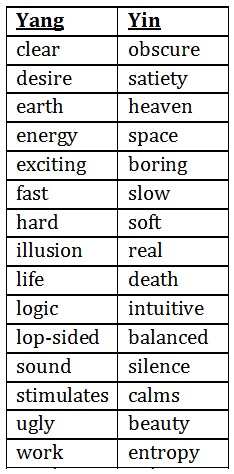
After I finished grinding out Correlations to my satisfaction, I stood back and judged the process by the results, not by the process itself. (See Tools of Taoist Thought: Correlations, p.565.) This was akin to judging a book by its cover. In this delusion, I naively thought this process would shred other people’s preconceptions just […]
Continue reading…