Translation
Devote effort to emptiness, sincerely watch stillness.
Everything ‘out there’ rises up together, and I watch again.
Everything ‘out there’, one and all, return again to their root cause.
Returning to the root cause is called stillness, this means answering to one’s destiny;
Answering to one’s destiny is called the constant, knowing the constant is called honest.
Not knowing the constant, rash actions lead to ominous results.
Knowing the constant allows, allowing therefore impartial,
Impartial therefore whole, whole therefore natural,
Natural therefore the way.
The way therefore long enduring, nearly rising beyond oneself.
1) send (extend; devote effort to) void (emptiness) the utmost point (extreme; pole) defend (keep watch) still (quiet) sincere (earnest). 致虚极守静笃。(zhì xū jí shŏu jìng dŭ.)
2) ten thousand (myriad) thing (matter; the outside world) and (furthermore, simultaneously) do (make; rise; get up; write), I (we) use (<v> take <p> according to; because of <adj> so as to <conj> and) look at (watch; observe) duplicate (answer; recover; again). 万物并作,吾以观复。(wàn wù bìng zuò, wú yĭ guān fù.)
3) husband (man) thing (matter; the outside world) all (every) each (every; various) duplicate (answer; recover; again) return (converge) his (its; their; that; such) root (base; cause; origin). 夫物芸芸各复归其根。(fū wù yún yún gè fù guī qí gēn.)
4) return (converge) root (base; cause; origin) say (call; name) still (quiet; calm), <grm> is (yes <frml> this; that) say (call; name; meaning; sense) duplicate (answer; recover; again) life (lot; destiny; order). 归根曰静,是谓复命;(guī gēn yuē jìng, shì wèi fù mìng;)
5) duplicate (answer; recover; again) life (lot; destiny; order) say (call; name) ordinary (normal; constant), know (realize; be aware of; tell) ordinary (normal; constant) say (call; name) bright (light; distinct; open; honest). 复命曰常,知常曰明。(fù mìng yuē cháng, zhī cháng yuē míng.)
6) no (not) know (realize; be aware of; tell) ordinary (normal; constant), absurd (preposterous; presumptuous; rash) do (make; rise; get up; write) ominous (crop failure; terrible). 不知常,妄作凶。(bù zhī cháng, wàng zuò xiōng.)
7) know (realize; be aware of; tell) ordinary (normal; constant) allow (contain; hold), allow (contain; hold) be (so; therefore; only then; you) common (public; impartial; just), 知常容,容乃公,(zhī cháng róng, róng năi gōng,)
8) common (public; impartial; just) be (so; therefore; only then; you) complete (whole; entire; full), complete (whole; entire; full) be (so; therefore; only then; you) sky (heaven; nature), 公乃全,全乃天,(gōng năi quán, quán năi tiān,)
9) sky (heaven; nature) be (so; therefore; only then; you) road (way, principle; speak; think). 天乃道,(tiān năi dào,)
10) road (way, principle; speak; think) be (so; therefore; only then; you) for a long time (long), sink (rise beyond; disappear; hide; die) body (life; oneself; personally) no (not) danger (nearly almost). 道乃久,没身不殆。(dào năi jiŭ, méi shēn bù dài.)
Fourth Pass: Chapter of the Month
(pandemic era)
Zoom on YouTube Recordings:
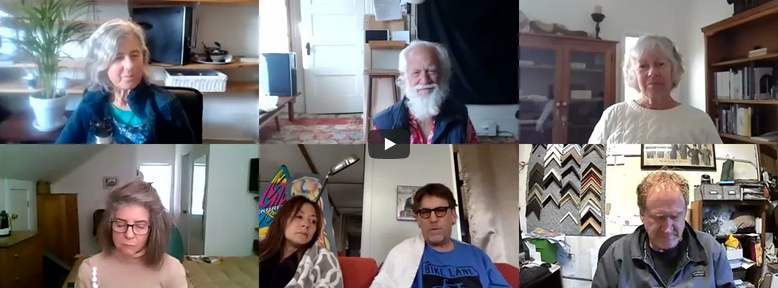
https://youtu.be/IkyX_CGowzo is the link to the Zoom video of this month’s Sunday meeting. The shorter first part of the meeting begins with a chapter reading followed by attendees’ commentary, if any. A little later on begins the longer open discussion part of the meeting when those who wish to discuss how the chapter relates to their personal experience.
Corrections?
None this time.
Reflections:
Note: As an AI generated ‘podcast’ of this chapter, the discussion fails to grasp certain deeper aspects. Thus, study these Reflections carefully to go deeper.
Devote effort to emptiness, sincerely watch stillness.
Everything ‘out there’ rises up together, and I watch again.
Everything ‘out there’, one and all, return again to their root cause.
For me, the root cause is the nothing referred to in chapter 2’s Hence existence and nothing give birth to one another. Everything ‘out there’ rises up together, and I watch again applies to existence, at least the existence of everything of which I’m aware, both internally and externally. Obviously, there is also the existence of what lies beyond my awareness… but commentary on that mystery is not a game I want to play.
Everything ‘out there’ encompasses all my object oriented observations, whether that be about me (i.e. self-judgment) or about you, that, them, or those. Ultimately, all this lies in the realm of passing judgment on Everything ‘out there’.
If I have sufficiently devoted effort to emptiness, I’m able to sincerely watch stillness. Of course, this is only possible after I have laid my own agenda (my needs and fears) to rest for a few calm moments. In this emotional stillness, I am able to suspend judgment and simply perceive the one and all return again to their root cause.
As I see it, the root cause that everything ‘out there’ shares is nothing. Mind you, this is not “nothing” as commonly defined, (i.e., a: something that does not exist b: the absence of all magnitude or quantity the absence of something), but rather as chapter 2 frames it, the primal source of “something”— Hence existence and nothing give birth to one another. Chapter 40 may frame it even better—Having is born in nothing.
In other words, the disparate forces and phenomena in the vast ‘out there’ all originated as an infinitesimal beginning ‘seed’, which in turn is the result of some previous loss through death. This trail of breadcrumbs goes all the way back to the ‘seed’ of creation we call the Big Bang, i.e., the Big Bang’s root cause was nothing. Naturally, this root cause can never be scientifically verified. Science can only examine the ‘somethings’ of the universe, not the precursor of the ‘somethings’, as it were. Only intuition can catch a glimpse of this way’s mysterious process.
Returning to the root cause is called stillness; this means answering to one’s destiny.
Answering to one’s destiny is called the constant; knowing the constant is called honest.
Entertaining this abstract model helps my mind to move in the opposite direction in which emotion invariably pulls it. This always deepens and broadens my perspective. With that, I can see both the forest and the trees, so to speak. From such detachment, the turbulence at the surface waters of existence wanes and everything returns to the root cause.
Accordingly, Answering to one’s destiny is actively realizing the process of nature at work… stillness begets turmoil begets stillness; death begets life begets death… and so on. It feels like a cycle of nature, yet deeper down I see this as a continuum—the constant. Existence and nothing—life and death—are not the separate polarities we biologically perceive them to be, but rather a mysterious co-generating unity. Merely acknowledging this, without tangibly perceiving this unfathomable mystery, is often enough to open the door to emptiness and stillness. As the last lines of chapter 1 conclude…
Naturally, if at any point this mystery becomes fathomable, the ‘wondrous entrance’ vanishes. These last lines of chapter 1 refer to Normally without desire so as to observe its wonder. Normally having desire so as to observe its boundary. But these, as all other polar opposites, are merely stand-ins for the much more pithy, existence and nothing. Getting past such polar distinctions is our greatest challenge because we did not evolve to perceive such unity. Indeed, we are biologically biased to keenly notice difference and react. Slowing down this impulsive reactivity is the key to psycho-emotional stability.
An important clue to what the constant actually is can be found in the translation of the common Chinese charater, 常 = cháng = ordinary, normal, often, constant. That means knowing the constant is called honest is about seeing the overall process and not getting caught up in, and biased by, the passing drama of the moment. Obviously, we are biologically set up to be drawn toward and react to the drama. I think of this chapter, along with the Tao Te Ching overall, as being a cognitive lever to help us slow down our over impulsive reaction time.
Not knowing the constant, rash actions lead to ominous results.
Knowing the constant allows, allowing therefore impartial,
Impartial therefore whole, whole therefore natural,
Natural therefore the way.
The way therefore long enduring, nearly rising beyond oneself.
Isn’t this line, Knowing the constant allows, allowing therefore impartial, a fair description of patience. We are most impatient when we are highly focused on an outcome we feel favorable. Impatience arises when conditions stall our desired outcome. Impatience is a failure of not returning to the root cause and instead trying to force the outcome we expect. Impatient reactions more often than not end with poor long-term outcomes. In other words, Not knowing the constant, rash actions lead to ominous results. Without a doubt, patience is the ultimate virtue.
The great blessing I find in being as impartial as possible helps to instill a very real sense of wholeness. Nothing is left out. I can’t but help feel immersed in the natural—Impartial therefore whole, whole therefore natural, Natural therefore the way. Impartiality makes judging the ‘value’ or ‘virtue’ of anything or anyone less likely to take hold and much easier to let go. Seeing—feeling—we are all in the same boat, the same root cause, entangles me with you, me with them, me with everything.
Of course, one can’t just flip an internal switch and behold the root cause and so on. To do so, is really going against the biological grain, so to speak. Again, as chapter 40 reminds us, In the opposite direction, of the way moves. I take this to refer to what is opposite of the direction that we feel to be the normal direction that common sense takes us. Indeed, it feels remarkable to be able to grasp even a glimpse of nature’s mysterious ways. Overall, “In the opposite direction, of the way moves” seems to be one of nature’s well kept secrets.
Chapter Archive https://youtu.be/kC6XUDiRd-0
This is the complete video. It begins with blowing Zen followed by the meeting
Third Pass: Chapter of the Month
Corrections?
None this time
Reflections:
Not knowing the constant, rash actions lead to ominous results.
Knowing the constant allows, allowing therefore impartial,
Today I noticed a practical way to think about the constant that fits right in with this chapter. This is important because the Chinese character translated only as constant easily implies something extraordinary about the word constant. For example, if nothing else, eternity is constant — ‘God’ is constant. This doesn’t do much to bring it down to a practical level does it? That is why it helps to ponder this character’s broader meanings.
First, consider the character for constant (常cháng). Cháng is an extremely common word that translates as: ordinary; common; normal; constant; invariable; frequently; often; usually.
In terms of real practical life, the constant need for watchfulness is priority Number one, especially in the wild. If an animal doesn’t keep constant watch, it easily becomes another animal’s lunch. In this context, other meanings for the character (常cháng) fit too: An ordinary wild animal is normally watchful, as observation will attest. Of course, this need for constant watchfulness is less noticeable in civilized circumstances since civilization does all it can to ensure comfort and security regardless of our ‘presence’, so to speak. We can walk around in a dream world and not worry about becoming lunch. Nevertheless, instinctive necessity is there, and balance suffers if not met.
Take line 6: Not knowing the constant, rash actions lead to ominous results. If you drive fast without constant vigilance, rash actions are likely to result. If you do a headstand in yoga, constant watchfulness allows you to maintain balance and avoid injury.
The next line says, Knowing the constant allows, allowing therefore impartial. Balance and impartial share a very similar quality, e.g., a balance point of view is impartial. Impartiality also involves a deep sense of before and after. This helps reduce our imagination’s control on intention. Our cognitive projections (ideals) grip us less firmly. Simply put, feeling the constant dampens the need to react impulsively to our imagined needs and fears. For contrast, notice how a bird will perch, watch and wait until it flies away. It stays or moves in the constant moment. Such stillness in ‘watching and waiting’ is ordinary; common; normal; constant; invariable; frequently; often; usually. In short, you might say the constant is simply now — the constant mundane eternal now.
To be fair, I must address the character for impartial ( 公 gōng). Gōng is also an extremely common word that translates as: public; collective; common; general; metric; make; public; equitable; impartial; fair; just; public affairs.
All this goes to show how essential intuitive understanding is, especially when pondering the Tao Te Ching. (See We only understand what we already know). Finally, consider the last lines in the context of constant watchfulness.
Impartial therefore whole, whole therefore natural,
Natural therefore the way.
The way therefore long enduring, nearly rising beyond oneself.
Christian Parallels
I find the more watchful I am moment-to-moment, the less “I” get in the way of being natural. Interestingly, this has a parallel in Christ’s teachings, even if he expressed it a lot more ‘folksy’, i.e., you need to speak in the language you audience can understand.
“Watch therefore: for you know not what hour your Lord does come. But know this, that if the manager of the house had known in what watch the thief would come, he would have watched, and would not have suffered his house to be broken up”. Matthew 24:42.
“Watch and pray, that you enter not into temptation: the spirit indeed is willing, but the flesh is weak”. Matthew 26:41.
“Take you heed, watch and pray: for you know not when the time is”. Mark 13:33.
“Watch you therefore, and pray always, that you may be accounted worthy to escape all these things that shall come to pass, and to stand before the Son of man”. Luke 21:36.
Now notice how the first lines of this chapter directly reference the importance of watchfulness.
Devote effort to emptiness, sincerely watch stillness.
Everything ‘out there’ rises up together, and I watch again.
Everything ‘out there’, one and all, return again to their root cause.
Returning to the root cause is called stillness;
this means answering to one’s destiny.
Answering to one’s destiny is called the constant;
knowing the constant is called honest.
Patience
Finally, I’d sum up this whole chapter as a description of true patience. By that, I mean not forced from outside forces, but a visceral easing off the gas pedal of life. Long ago, I found that when I got to the end of my current run at living, I’d sit down, do absolutely nothing, and patiently wait it out. I had no choice other than to embrace emptiness. My mind and body were out of steam. Curiously, I noticed that before long, even within a day, I’d be rejuvenated and ready to make another run at living life to the fullest.
(Note: As a child, crashing and feeling nausea for a few days was the only way I could bring about a ‘system reboot’, as it were. Fortunately, I’m able to reboot before getting to that point.)
Nothing as the Mother of Action
All this tells me that emptiness, stillness are the root cause. Indeed, nothing is the Mother of action (See, Necessity, the Mother, Necessity is the Mother). As chapter 40 says,
Second Pass: Work in Progress
Issues:
I just needed to repair some punctuation this time.
It probably wouldn’t hurt to look more closely at the last line of the chapter: The way therefore long enduring, nearly rising beyond oneself. The first part makes sense, but the last phrase probably feels a little obtuse on the face of it. The characters are: 没身不殆. Literally, it goes like this: rising beyond oneself nearly almost. Pondering this in terms of the illusion of self (1) may help — like ‘rising beyond ego’ if you like. Also, consider the words in a broader sense to further confuse and enlighten.
mò (没) sink; rise beyond; disappear; hide; die.
shēn (身) body; life; oneself; personally.
bù (不) no; not
dài (殆) danger; nearly almost. the body no danger.
Commentary:
This is one of the most valuable chapters. Of course, I feel silly saying that because each is ‘most valuable’ in its own right. This one, although, goes to the heart of the human condition, and to the source of ominous results our species brings upon itself. Mind you, not that we ever knew the consequences of what we were doing, not back then in early Stone Age—not now!
We’ve followed the natural instinct to take every opportunity to increase our advantage. Every species does that; it’s the survival imperative of life itself. Our difficulty lies in being too clever for our own good. We have too much of a good thing, as they say. Yet, we really don’t accept that. Who can willingly cut off cleverness, discard advantage? That is virtually like suicide — ego suicide anyway.
We instinctively place ‘geniuses’, progress, intelligence, (etc) on the highest of pedestals. I’m not even sure we are capable, generally, of admitting to ourselves the imbalance our cleverness embodies. I find only by deep impartiality combined with clear reasoned observation can I begin to see the predicament we’re in. Even more sobering, I don’t see there is much we can do about this, other than see and accept. On the other hand, this sobriety helps generate a more balanced view of destiny. The resulting impartiality helps me become whole therefore natural.
I should add that if we were living under wilderness conditions, our rash actions would be both limited and balanced by nature’s wild side. The confusing and distracting effect of having many choices would be absent. If you wanted food, you’d have to find it, rather than innovate on choices (all the when, what, where, how, of eating). When it rained we simply get wet, rather than innovate on housing (all the when, where, what, how of housing). All the benefits of civilization mean we do have choices now, which brings us immense comfort and security compared with animals in the wild. The downside consequence of that is the suffering; rash actions lead to ominous results (war, bandits, torture, and whatever ills you see out there). It is a natural trade-off.
Returning to the root cause is called stillness, this means answering to one’s destiny. I suppose destiny is often thought to be about the future… our destination. Destiny is rooted in the past and expressed in the present moment. Knowing where you come from is the only way to know where you are now, and headed tomorrow. Going cross-country without the aid of a trail or a map demonstrates this principle nicely. If you only are feeling the present moment, and/or the future, you get lost. Only by have a sense of where you’ve been can you ‘find yourself’ in the present.
Suggested Revision:
Devote effort to emptiness, sincerely watch stillness.
Everything ‘out there’ rises up together, and I watch again.
Everything ‘out there’, one and all, return again to their root cause.
Returning to the root cause is called stillness;
… this means answering to one’s destiny.
Answering to one’s destiny is called the constant;
… knowing the constant is called honest.
Not knowing the constant, rash actions lead to ominous results.
Knowing the constant allows, allowing therefore impartial,
Impartial therefore whole, whole therefore natural,
Natural therefore the way.
The way therefore long enduring, nearly rising beyond oneself.
First Pass: Chapter of the Week
Today this chapter speaks to the experience of consciousness more directly than it ever has before (or so it feels like today). The constant feels like my mind’s mirror, its consciousness neither pulled or pushed by emotion. Returning to root causes is only temporary, for the emotional impact of everything ‘out there’, (the teaming, myriad creatures), waxes forth again soon enough. So, I enjoy it while I can!
Answering to one’s destiny is an odd concept perhaps, especially as we feel that time moves forward. This is nature’s greatest hoodwink. Turning back is how the way moves, but we are not biologically set up to feel that. Correlations allows us to peak into this. Consider these few:
| ACTIVE | PASSIVE |
| energy | time |
| future | past |
| illusion | real |
| forward | behind |
| clear | obscure. |
It appears that what we call ‘time’ is actually energy moving forward through time turning back. (It’s spooky enough to raise the hair on the back of one’s head.) Life insists we be forward looking and active, resisting entropy every moment of life. The bio-illusion (the innate, biology based hoodwink) that drives us moving forward is a visceral sense that we will become whole and fulfilled once we satiate our most pressing desire of the moment.
Devoting effort to emptiness and sincerely watching stillness doesn’t seem to lead forward and fulfill our desires. Our difficulty lies in not knowing that the way that leads forward seems to lead backward. And so we rush forward into the future thinking the answer must lie ‘out there’. Off balance, we feel even more desperate to make ‘everything out there’ fulfill our desires and make whole our destiny.
Simply said, we yearn for the constant yet pursue ‘everything out there‘, none of which are constant. i.e., The way that can be spoken of is not the constant way. The more we expect ‘out there‘ to be constant, the less content and more numerous our desires. Certainly, all life is driven by this emotional hoodwink. However, our superior thinking mind / brain turns this emotional hoodwink into an illusion which then feeds back upon emotion. We easily end up going around in circles… neurotic vicious circles!
The great image has no shape; the answer is the question. Yet we are compelled to nail down an answer. How can we ever feel secure when we settle for the answer that can be nailed down (named), or the image that has a shape? Impartiality is beyond reach as long as we impose a shape upon the constant. Never feeling secure in our destiny, we are then driven to hold even more tightly to ‘everything’, to ‘God’, or whatever else we name ‘it’.