Translation
When the great way is abandoned, there exists benevolent justice.
When intelligence increases, there exists great falseness.
When relationships lack coherence, there exists respectful kindness.
When the country is confused and chaotic, there exist loyal officials.
1) big (great; loud) road (way, path; principle) give up (abandon; abolish; waste; useless) have (exist) benevolence (kindheartedness) justice (relationship); 大道废有仁义;(dà dào fèi yŏu rén yì;)
2) intelligent wisdom (resourcefulness) go or come out (exceed; go beyond) have (exist) big (great; loud) false (fake); 慧智出有大伪;(huì zhì chū yŏu dà wĕi;)
3) six parent (relative; intimate) no (not) gentle (harmony, and, blend) have (exist) filial piety (mourning) kind (loving; b/mother); 六亲不和有孝慈;(liù qīn bù hé yŏu xiào cí;)
4) country (state; nation) dark (dim; confused; muddled) in disorder (in confusion; chaos) have (exist) official loyal to his sovereign. 国家昏乱有忠臣。(guó jiā hūn luàn yŏu zhōng chén.)
Fourth Pass: Chapter of the Month
(pandemic era)
Zoom on YouTube Recordings:
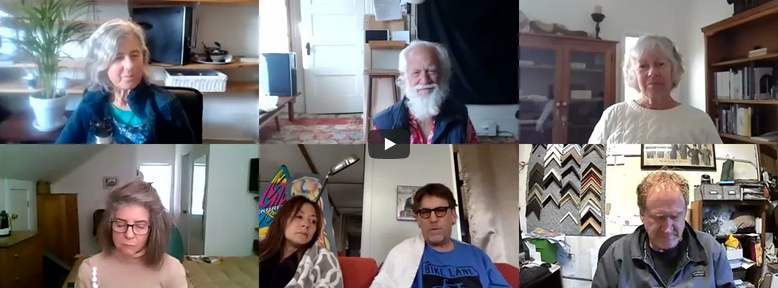 https://youtu.be/Y6YS14f2pNQ is the link to the Zoom video of this month’s Sunday meeting. The shorter first part of the meeting begins with a chapter reading followed by attendees’ commentary, if any. A little later on begins the longer open discussion part of the meeting when those who wish to discuss how the chapter relates to their personal experience.
Corrections?
None this time.
Reflections:
When the great way is abandoned, there exists benevolent justice.
This chapter is similar to the last half of chapter 38 (see below). Both of these chapters show the chain of events that spiral ‘downward’ when the way is lost. It helps to consider the lines, When the great way is abandoned (chapter 18) and Hence Virtue follows loss of way (chapter 38) as referring to your subjective sense of the way, and not any loss of the way in any objective sense. As chapter 73 reminds us, Nature’s net is vast and thin, yet never misses, or as D.C.Lau translates it, The net of heaven is cast wide. Though the mesh is not fine, yet nothing ever slips through.
When we are consumed with emotion, our subjective sense of the way is drowned-out. Fight or flight emotions take over. And, it doesn’t take all that much inner turmoil to overshadow our ability to feel connected… to feel the way. As chapter 14 puts this connection to the way, Hold the ancient way in order to manage today. The ability to know the ancient beginning; this is called the way’s discipline.
Note: The root word of discipline is discere, which means, “to learn”. In other words, cognitive diligence is necessary to hold the ancient way. Our mind is both a blessing and a curse. As chapter 71 cautions, Realizing I don’t’ know is better; not knowing this knowing is disease.
This “disease” obstructs our ability to know the ancient beginning. It is the blind certainty we have in what we think we know that is the disease, and so accepting uncertainty opens the mind to deep learning, i.e., an ability to know the ancient beginning. Being alive to uncertainty naturally pulls us into our moment at hand. Conversely, certainty allows us to leap ahead of ourselves in our anticipation of the next moment, as it were.
One way to be alive to uncertainty is to know the ancient beginning. While this is unattainable at first, learning the outline of history, from the big bang to the present can gradually help the mind take this leap of insight. By keeping one eye on the current moment and the other on the broadest sense of history you can manage, helps put the current situation in a much broader perspective. And this fosters a greater peace of mind.
The last half of chapter 38…
When the great way is abandoned, there exists benevolent justice speaks to how far we’ve traveled from who we were as a species as evidenced by the old ways of our distant ancestors (see The Tradeoff for a detailed account of this journey). Now, we feel blessed just to achieve a large serving of benevolent justice. Clearly, the benevolence, justice, and virtue that civilization exalts are mere “table scraps” compared to holding the ancient way.
When intelligence increases, there exists great falseness.
Just consider how highly civilized societies value intelligence. And we do anything to increase it, no less. When I look around, I see much of our problem stems from too much intelligence. Intelligence enables us to rationalize our action, our hypocrisy, and let ourselves play both sides of an issue, depending on what our own ulterior needs are. We are too intelligent to perceive our own ignorance. Again, as chapter 71 observes, Realizing I don’t’ know is better; not knowing this knowing is disease. Trusting and believing our own beliefs is the foundation of our ignorance.
When relationships lack coherence, there exists respectful kindness.
Most all of our relationships lack coherence, at least compared to the deep social connection that our distant ancestors experienced. This is a tradeoff our species made when replacing our traditional egalitarian way of life for a civilized one. To compensate for the loss of coherent relationships, society (religion) came up with rules of behavior, morality, etiquette. Sure, these work to an extent… perhaps enough to keep things just limping along, barely on the stable side of chaos.
When the country is confused and chaotic, there exist loyal officials.
Anyone who feels a sense of duty to their country, and is in a position of management, would be inclined to feel worried when the country was veering into chaos. They would feel pressure to ‘fix’ the problem, and work together to that end.
This follows a natural social dynamic: When a social group confronts a common enemy, that group unites and loyally strives to overcome the enemy. Here, confusion and chaos are the enemy threatening the country, which causes the officials to put aside their petty bickering and unite in common cause.
Chapter Archive https://youtu.be/6KTKKZtzEis
This is the complete video. It begins with blowing Zen followed by the meeting
Third Pass: Chapter of the Month
Corrections?
None this time
Reflections:
This chapter speaks to the cause and effect result of humanity’s move from its ancestral way of life to agriculture and civilization. Specifically, the hierarchical dynamics of civilization lies at the root cause of line 1’s, When the great way is abandoned. Our species did not evolve to live in the large organized populations that civilized life necessitates. Civilization, and its agrarian root, necessitates a hierarchical social structure to organize masses of people to function in an orderly way, on a massive scale.
Conversely, our ancestral hunt and gather way of life required no such hyper-organized social order to function efficiently. Egalitarian ways were sufficient and more importantly, offered the genuine social security that hominids evolved to depend upon. Civilization’s hierarchical dynamics hinder, if not outright oppose, egalitarian ways.
Kierkegaard (1) describes civilization’s condition well, allusion to God notwithstanding:
Deep within every human being there still lives the anxiety over the possibility of being alone in the world, forgotten by God, overlooked among the millions and millions in this enormous household. One keeps this anxiety at a distance by looking at the many round about who are related to him as kin and friends, but the anxiety is still there, nevertheless, and one hardly dares think of how he would feel if all this were taken away.
‘When intelligence increases’ is a direct result of civilizations focus on specialization and the role of experts required to run things. The over emphasis on expertise and intelligence skews values towards what works best for a hierarchical system at the expense of naturally evolved egalitarian values. Top down authority supplant the ancient virtue of ‘one for all and all for one’ of our ancestors.
‘When relationships lack coherence’ is a direct result of too many people obliged to share a common identity. A real deep sense of social connection can only occur with people with which you have ongoing personal contact. This happens in families still, at least to some extent, but not to the masses of strangers existing under a common ‘flag’, so to speak. To maintain civil order, civilizations compensate for this social disconnect by establishing rules of polite social conduct, respectful kindness.
‘When the country is confused and chaotic’ is a direct, albeit natural, result of the artificial (i.e. manmade) social structure required for a country to exist. People in this environment who have faith in civilization become the loyal officials that struggle to keep the wheels from falling off civilization’s bus.
(1) Existentialism in its currently recognizable form was inspired by the Danish philosopher Søren Kierkegaard and others (Heidegger, Sartre, Nietzsche) in the 1800’s. Existentialism and Buddhism — Points of Linkage briefly describe what existentialism shares with Taoist and Buddhist views, at least superficially. However, Western philosophies all appear to end up promoting the illusion of free will. That is probably understandable given how the West is just coming out of the Christian paradigm.
Stoicism, circa 300B.C. may be a little closer to Taoist and Buddhist points of view. See Stoicism in 6 Minutes and 10 Themes of Stoicism. You’ll notice that Stoicism also supports the notion of free will, although perhaps more implied than explicit.
The central problem with believing in any form of free will lies in how it separates you from your ‘original self’— that which you share with all life on earth. Judgment and pride depend on a sense of free will and that people have control over their lives. This hinders connection. Conversely, as belief in free will ebbs, a sense of deep connection to nature flows. To put it another way, the ideal of free will places the mind (cognition) in direct opposition to any true sense of oneness with nature. Who has free will when ‘I’ am nature (Tat Tvam Asi)? Who is in control? Who is to blame? It is none sense.
Merely realizing what is happening is enough to set your life in the direction you wish it to go. No free will, control or discipline is required. I suspect that survival instincts drive any ‘positive’ movement that occurs. Once you know, you cannot help but act accordingly. The weak link is, as Buddha said, Right Comprehension. ‘Right Comprehension’ means that which actually works. By contrast, ‘wrong’ comprehension would probably be in the realm of ideals, which are projections of what we desire to be so, not what is actually so. Such projections of our personal desires (and fears) easily blind us to what is actually and naturally so.
Naturally so: Consider the Chinese word for nature: zì rán (自然). Zì (自) = self; certainly. Rán (然) = correct; so. Accordingly, Nature = self-correct, self-so, certainly-so. In other words, reality is not duality! The magnified sense of duality we perceive results in the disconnection from Nature we feel. Note, it isn’t duality per se. After all, the nervous system’s neurons operate via a form of duality — on vs. off. Our problem lies in the magnification this undergoes by our attachment to names, thoughts and the ideals we generate via our underlying desires and worries (i.e., needs and fears… see Fear & Need Born in Nothing).
Second Pass: Work in Progress
Issues:
Currently I have line 1 translated as: When the great way is given up, there is benevolence and justice. I have also thought of putting it this way: When the great way is abandoned, there is benevolence and justice.
The ten-dollar character here is fèi (废) give up; abandon; abolish; abrogate; waste; useless; disused; disabled; maimed. I feel abandoned carries more meaning than the more neutral give up. Give up can have a very positive ‘giving’ quality to it, e.g., give up smoking. Abandoning my health by smoking is unequivocal.
Commentary:
So, I’ll exchange give up with abandon. The idea here is that the more I sense the great way in my life, the less I need to concern myself about the narrower issues of benevolence and justice. Sensing less than 100% great way leave me feeling life somewhat abandoned and wasted. And this motivates returning to the root cause.
There is a catch-22 to all this of course. Biologically, we can only fully appreciate something when it feels scarce. If it feels scarce, I “strive on diligently”. In striving toward it, I feel it less scarce—or at least I feel life more meaningful.
In other words, I need to feel hungry in order to really enjoy eating. Feeling full (100%) doesn’t offer the pleasurable sensory contrast that being hungry and “striving” for nourishment does. And, let’s be honest, it is the pleasure (less pain, less sorrow) of the great way than draws us to it. Abandoning the great way leaves me feeling life more painful, which drives me to seek symbolic substitutes, like benevolence and justice.
Notice how this is a catalog of consequences. Things are never what they seem—rather; they are symptoms of earlier causes. This is extremely useful to keep in mind if you wish to have any hope of seeing ‘out-side the box’ of your own personal agenda (desires and worries, fears and needs).
The great way is always here, naturally, but thinking helps disconnect us from feeling its ebb and flow. We seek to seize control and end up meddling, pushing our own view of how ‘it should be’ ideally. We loose the contemporaneous sense of being one-with-the-way. This loss is unsettling and drives us to do all sorts of ‘unnatural things’.
‘Unnatural’ meaning, in nature there is no benevolence or justice; there is only q balanced ‘flow’ into balance (i.e. dynamic balance). Our attempt to outwit and outsmart the natural course of things results in a long trail of unintended consequences.
Our intelligence enables us to be self-dishonest, telling ourselves the story that ‘proves’ the case for our own desires and worries. Again, things are not what they seem; peel away the curtain and you’ll see great falseness.
Children need stability above all else, and lacking that their allegiance is up for grabs. When family relations are chaotic, the children can be easily drawn to an ‘obedient social structure’ (joining a team, a band, a gang of some sort, for example). Likewise, when the county is confused and chaotic, people driven by hierarchical instinct (social-biology) look to others—their loyal officials—to lead the way. Alas, it usually (if not always) turns out to be a case of the blind leading the blind. 😉 When coming face to face with the unknown, people will follow their leader over the cliff.
Finally, each line 1-4 shows a flow from cause to effect. For example, abandoning the way results in ‘justice‘, the word and concept (i.e., justice is irrelevant in Nature). Striving for justice can never succeed in the long-run because this is dealing at the symptom level, not the cause. More often than not, we see symptoms as being causes in their own right, and rail and rally against them rather than dig to unveil the underlying causes. Not surprisingly, we usually end up going around in circles.
Just as a cold is the result-symptom of viruses, falseness is a result-symptom of intelligence. Sure, a cold causes us discomfort, but the source of our discomfort is not the cold really, but rather the virus that causes the cold. Likewise, falseness causes us discomfort, but the source is really our intelligence that makes falseness possible. Blaming the symptom rather than the cause gets us nowhere. Identifying the true cause is Right Understanding, as Buddha would call it. That deeper understanding helps us better cope, overall. It is not that identifying intelligence as the cause of falseness is going to relieve us of either one. The benefit lies in seeing the constant (i.e., the ‘whole big picture’ so to speak), and feeling more closely connected to the natural process. Chapter 16 puts it well:
Suggested Revision:
When the great way is abandoned, there is benevolence and justice;
When intelligence increase, there is great falseness;
When intimacy lacks harmony, there is mourning kindness;
When the country is confused and chaotic, there are loyal officials.
First Pass: Chapter of the Week
The great way is wasted when there is not enough faith. Faith in what? Faith in the shape that has no shape, which makes faith so hard to grasp and impossible to hold. Like breathing, faith is the returning to one’s roots moment to moment. Failing that, we cling to surrogates. So, for example, when the way is lost there is virtue; when virtue is lost there is benevolence; when benevolence is lost there is rectitude; when rectitude is lost there are the rites. Our ideals of benevolence and justice are merely symptoms of the insecurity felt by a lack of faith. And when benevolence and justice wane, we turn to rectitude and rites.
In his 3rd law of motion, Newton says, “for every action there is an equal and opposite reaction”. While not necessarily always ‘opposite’, I know of nothing that happens, that happens without consequences. A corollary to this is the view that ‘nature abhors a vacuum’. Create a vacuum and nature will fill it. We certainly (and understandably) have great difficulty seeing this bigger picture: the consequences, the vacuum ‘fillers’.
Intelligence begets great falseness, is one such unforeseen and unwanted consequences, or as chapter 18 puts it, when cleverness emerges there is great hypocrisy. Yet, few fully accept the connection between the two. Why? We value intelligence which blinds us to its ‘ugly’ side. And why do we value intelligence so highly? Intelligence is just another surrogate for the great way. Waste not, want not.
Our ideals of benevolence and justice also serves tribal purposes. Shared ideals offer seemingly trustworthy common ground upon which all the tribe’s member can stand. Mutual ‘faith’ abounds, provided everyone conforms to the current societal ideals of virtue. It works pretty well too, except for perhaps the stray heretic who suspects there’s more to it than meets the eye.
The great way is wasted in other ways too, similar to the wasting of a sunset, or the aroma of a rose. In not ‘smelling the roses along the way’, we are rushing past a deeper side to life. Such perceptual losses are wasted opportunities to know life more deeply; in quality of mind it is depth that matters. The great way is always here, now; yet it is wasted when we leap beyond here, now. Of course, this isn’t the whole view. For that, correlations can give a broader picture.