Translation
Cut off the sage, discard wisdom,
And the people benefit a hundred fold;
Cut off benevolence, discard justice,
And the people resume devout kindness;
Cut off cleverness, discard advantage,
And robbers will not exist;
These three, considering culture, are not enough.
For this reason, make something to belong to,
See simply, embrace the plain, and have few personal desires.
1) cut off (sever; exhausted) sage (holy; sacred) throw away (discard) wisdom (resourcefulness), 绝圣弃智,(jué shèng qì zhì,)
2) the people sharp (favorable; advantage; benefit) hundred (numerous) times (-fold); 民利百倍;(mín lì băi bèi;)
3) cut off (sever; exhausted) benevolence (kindheartedness; humanity) throw away (discard) justice (relationship; meaning), 绝仁弃义,(jué rén qì yì,)
4) the people duplicate (turn round; recover; resume) filial piety (mourning) kind (loving; mother); 民复孝慈;(mín fù xiào cí;)
5) cut off (sever; exhausted) skillful (clever; deceitful) throw away (discard) sharp (favorable; advantage; benefit), 绝巧弃利,(jué qiăo qì lì,)
6) robbers (bandits) nothing have (there is; exist); 盗贼无有;(dào zéi wú yŏu;)
7) this three (several) (者), think (believe; consider) language (culture; civil) no (not) foot (enough; ample). 此三者,以为文不足。(cĭ sān zhĕ, yĭ wéi wén bù zú.)
8) incident (cause; hence) command (decree; make; cause) have (there is; exist) what one belongs to, 故令有所属,(gù lìng yŏu suŏ shŭ,)
9) see (catch sight of) simple (quiet; vegetable) embrace (hug) simple (plain) few (little; lose) personal (secret) few (scant; tasteless) desire (wish; want). 见素抱朴少私寡欲。(jiàn sù bào pò shăo sī guă yù.)
Fourth Pass: Chapter of the Month
(Trump era)
Zoom on YouTube Recordings:
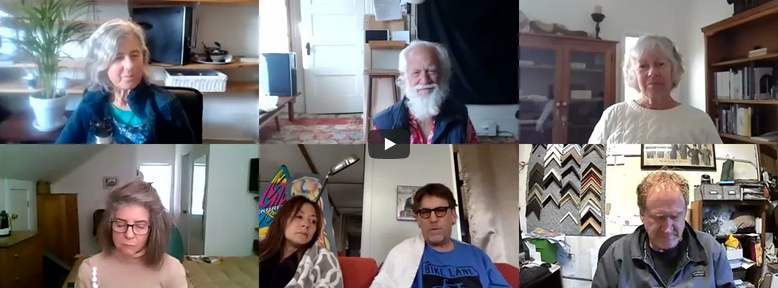
https://youtu.be/8KTgVsk3TKo is the link to the Zoom video of this month’s Sunday meeting. The shorter first part of the meeting begins with a chapter reading followed by attendees’ commentary, if any. A little later on begins the longer open discussion part of the meeting when those who wish to discuss how the chapter relates to their personal experience.
Corrections?
None this time.
Reflections:
Cut off the sage, discard wisdom,
And the people benefit hundred fold.
Cut off benevolence, throw away justice,
And the people resume mourning kindness.
Cut off cleverness, discard advantage,
And robbers will not exist.
These three lines come across as a cause and effect process. They imply that if you get rid of the sage, wisdom, benevolence, justice, cleverness and advantage, the people will all benefit and resume mourning kindness. This is clearly not the case, to which line 7 alludes.
Is this an example of chapter 40’s In the opposite direction, of the way moves? I mean, ‘common sense’ tells us that the cause and effect process laid out in the first 6 lines is correct, whether or not you agree with the result. I assume such ‘common sense’ is instinctive, and part of Nature’s hoodwink. We are biased to pay more attention to what is there than to what is missing. Nature, on the other hand, is powered by what is missing—the Great Nothing, so to speak. As chapters 40 and 11 observe, Having is born in nothing and Hence, of having what is thought favorable, of the nothing think as the useful.
It is because the people have lost mourning kindness, and natural benefit that these cultural ideals, i.e., wisdom, sage, benevolence, etc., arose. As chapter 18 observes, When the great way is abandoned, there exists benevolent justice. These lines from chapter 38 break this downward-spiral even better,
These three, considering culture, are not enough.
Cultures are deluded by believing that the sage, wisdom, justice, and such are the solution to societal dysfunction, if only they could be implemented better. This fantasy has persisted from the earliest days of civilization, going back thousands of years. Alas, as long as we continue to treat these symptoms of dysfunction as remedies we will get nowhere.
If society ever reaches the point where it can see these solutions as symptoms of our dysfunction instead, we may have a better chance of managing our dysfunction better. The only true “cure” would be to return to the old way of our hunter-gatherer ancestors, as chapter 80 proposed, i.e., Enable the people to again use the knotted rope and the rest. Now, there is no way that can ever happen! We would be biologically incapable of returning to that more perilous, uncomfortable, and arduous way of life. For more on our transition from our ancestral ways to civilization see The Tradeoff.
One reason culture holds onto its naive and futile solutions for the ills of civilization is probably due to the simple fact that those people old enough to begin to realize the real cause die off and are replaced by newborns—the next generation. Deep wisdom is acquired gradually through living many decades, and can’t be taught, i.e., We only understand what we already know. Of course, we can intellectually learn the principles, and aspire to integrate them into our daily life. However, it is only through experiencing the ups and downs over a lifetime that we can begin to verify them. And only after we verify them can we truly implement them. So, it isn’t surprising that humanity keeps repeating the same fruitless fixes. Obviously, this is completely natural. After all, we are just animals. Perhaps it would help if we faced that fact more honestly. But here again greater self-honesty comes with age. It is kind of a Catch-22, I suppose.
Acknowledging that there is truly NO SOLUTION to reversing the consequences of the tradeoff may sound awfully negative and fatalistic. That feels awful, which makes it all the more unpalatable. However, in my experience, facing up to the actual how and why of our circumstances allows me to deal with any situation much more effectively than when I used to believe in “solutions”. We don’t need “solutions” to our problems. Problems are here to stay. All we need is the most effective way to deal with them, and facing actual causes increases our chances of doing just that. Note: I do recognize that it may take another 10,000 years of stumbling along with failed “solutions” before we’re able to see the deeper forces at play.
For this reason, make something to belong to;
See simply, embrace the plain, and have few personal desires.
For this reason, make something to belong to brings us back to the essential cause for much of our social dysfunction. We are not able to feel the sense of connection to each other and to nature as deeply as our hunter-gatherer ancestors did. The only situations where we can see a deeper sense of connection is when we are faced with dire survival situations. Combat soldiers powerfully exemplify that bond in times of war. Not surprisingly, their return to “normal” civilian life can be a very difficult transition… trading a very intimate social bond for a looser one.
There is a society-wide need to have something to belong to. This need is the glue that holds religions and political parties together, with their respective ideologies and theologies trailing far behind. Indeed, the need for something to belong to is the core raison d’être (reason for existence) for clubs, sports teams, parades, social media, knitting circles, etc.
The question is, do these somethings to belong to actually work? Yes, to a certain degree, but in the end, nothing can replace the kind of social belonging—social security—that our ancestors experienced. We simply can’t have it both ways. We long ago opted for the increased personal independence, comfort and security made possible through civilization, i.e., hierarchical organization of people, in lieu of the egalitarian ways of our ancestors.
Thus, the last line, See simply, embrace the plain, and have few personal desires, suggests how the individual—at least—can turn the clock back, as it were. The ability to intuitively embody these qualities helps us return to the original self, the self we were born as, before culture trained us to be “good citizens”. In other words, when you can See simply, embrace the plain, and have few personal desires, you cease having a need for virtue, benevolence, justice, and the rest. The only thing left is nature… the way.
Note: See simply, embrace the plain, and have few personal desires is obviously easier said than done. One way to help this along is the ability to know the ancient beginning. While this maybe unattainable at first, learning the outlines of history, from the big bang to the present can gradually help the mind take this leap of insight. In particular, by keeping one eye on your current moment and the other on the broadest sense of history you can manage, helps put the current situation in a much broader perspective. See simply, embrace the plain naturally follows in due course. These, in turn, cultivate having fewer personal desires.
Chapter Archive https://youtu.be/Vke3HcP0Cb4
This is the complete video. It begins with blowing Zen followed by the meeting
Third Pass: Chapter of the Month
Corrections?
None this time
Reflections:
Cut off the sage, discard wisdom,
And the people benefit hundred fold.
Cut off benevolence, throw away justice,
And the people resume mourning kindness.
Cut off cleverness, discard advantage,
And robbers will not exist.
From a Symptoms Point Of View, I feel that the first two “cut offs” say something deeper: (1) The people, having lost much of their ancestral egalitarian sense of benefit, compel them to look to the sage and wisdom as externals that will benefit them. (2) The people, having lost much of their ability to feel a deeper sense of egalitarian mourning kindness, cause them to look to benevolence and justice to fill that void.
The third “cut off” sounds fine as it is. The hierarchical system sets up ‘haves’ and ‘have nots’ that naturally leave some people feeling left out of the ‘haves’ group and rob and steal their way to ‘have’. The hierarchical systems also leave people less connected in general, and so feel that their thievery is not much different than a fisherman catching fish — the stuff is there for the taking. They don’t feel they are robbing their kith and kin. In other words, folks of our ‘own-kind’ feel closest; they are extensions of ourselves. We ‘robbers’ don’t steal from ourselves; we steal from not-of-our-own-kind others, so to speak.
These three, considering culture, are not enough.
This line confirms the symptoms nature of the preceding ‘cut off’ lines. Considering culture (civilization) realistically means that merely removing symptoms does not remedy the causal hierarchical dynamics of civilization that causes the situation in the first place.
Accordingly, we see the root cause of the problem, the loss we experience, and now the impossibility to change the external circumstance enough to return us to anything approaching that idealistic ‘Garden of Eden’, so to speak. The only true lasting remedy lies within.
For this reason, make something to belong to;
This line parallels dharma in general and Buddha’s 4th Noble Truth in particular — especially, “There is salvation for him whose self disappears before truth, whose will is bent on what he ought to do, whose sole desire is the performance of his duty. He who is wise will enter this path and make an end to suffering”. The closer one gets to pulling that off, the more naturally the last line ensues…
See simply, embrace the plain, and have few personal desires.
The problem with these remedies comes down to our powerlessness over how we feel. This may not be readily apparent if you still believe in free will — that one can simply chose to live differently. Seeing simply, embracing the plain and especially having few personal desires sounds great in theory — but what about in practice. Even if you believe in free will, you will probably admit to the difficulty of putting this and the ‘make something to belong to’ into practice.
I find in the end, it comes down to how important — see simply, embrace the plain, and have few personal desires — feels to you. As Christ said, “Where your treasure is, there will your heart be also”. I’ve found in life that I always get what I truly and deeply want for my life, especially when it comes to deepest matters of personal character. Ultimately, the strongest need we feel drives us off in its direction. Again, you really do get out of life what you truly want.
Finally, simply knowing what is going on, how circumstances come to be the way they are, helps me remain sober and deep enough to remain more mindful of what I truly and deeply want out of life. When you see the ‘big picture’, seeing simply comes much more readily. For a glimpse of a bigger picture, see The Tradeoff, which sums it up well I hope.
Second Pass: Work in Progress
Issues:
One character in particular could use a little explanation. Xiào (孝) ostensibly means filial piety; mourning. I don’t think filial piety is a mainstream virtue in culture, as it once was when families really had to pull to together to survive. The other meaning, mourning, fits this chapter better considering the synonyms of mourning: sorrow, sadness, remembrance, respect, grief, bereavement. We feel such emotions most keenly following death among our filial relationships.
This character and its companion also appear in chapter 18 (i.e., xiàocí, 孝慈, which I translate both here and in chapter 18 as mourning kindness). Maybe it will help interpretation and understanding to review chapter 18:
I see chapter 18 pointing out natural consequences. First, line 1 of chapter 18 says, When the great way is abandoned there is benevolence and justice. Benevolence and justice serve as proxies or stand-ins for the great way. Line 2 says, When intelligence increase, there is great falseness which discloses the result of intelligence that we seldom admit; on the contrary, we glorify our intelligence (i.e., Homo ‘sapiens’). Line 3 of chapter 18 says, When intimacy lacks harmony, there is mourning kindness. I see this in the same light as Line 1; mourning kindness is a proxy for when intimacy lacks harmony.
Now in this chapter:
Cut off benevolence, throw away justice, And the people resume mourning kindness. Comparing this with chapter 18 leaves all this a bit murky, at least at first. It seems to suggest that mourning kindness is closer to the great way than benevolence and justice. I feel this is so, mainly because mourning kindness is more an organic emotion not something requiring intelligence or even life experience to know. Benevolence and justice are cultural paradigms and thus ‘in the eye of the beholder’, i.e., one person’s justice is another person’s injustice!
In a recent meeting there was a suggestion to replace mourning with mournful. Mournful does roll off the tongue a little better, but seems to miss the mark somewhat because it seems to lack the respect and remembrance angle.
Commentary:
I saw this chapter in somewhat of a new light today. This often is the case if I first ask myself how the issue, whatever it may be, plays out in nature generally. In nature, there is the wisdom of the old bass that has learned to avoid the hoodwinking hook. There is the benevolence of a mother mouse caring for her pups. There is the cleverness of the otter using stones to crack open shellfish. So what is the difference between nature in the wild and nature in the civilized context? For one thing, we don’t know when to stop, i.e. Knowing when to stop, never dangerous and Grasping and yet full of, not in harmony with oneself. The story we tell ourselves looms larger than the natural roots from which it springs, and we suffer the consequences of living a fictional existence to one degree or another. Fictional in that it is at odds with the nature’s understated balance.
Suggested Revision:
Cut off the sage, discard wisdom,
And the people benefit hundred fold.
Cut off benevolence, throw away justice,
And the people resume mourning kindness.
Cut off cleverness, discard advantage,
And robbers will not exist.
These three, considering culture, are not enough.
For this reason, make something to belong to;
See simply, embrace the plain, and have few personal desires.
First Pass: Chapter of the Week
I’ve always had a special fondness for this chapter. Exterminate the sage, benevolence, ingenuity turns civilization’s sacred cows on their ears. Seriously pondering these ideas (without any actual exterminate and ‘cut off‘) opens a possibility for thinking outside the box. Each of us, from birth onward, is indoctrinated into civilization’s story. Thus, seeing life from outside that story is no small task! Even rebellious anti-civilization points of view complement that story.
The main thing I see here is a report on a natural dynamic. How it works, not any prescription for what should be done (i.e., cut off benevolence, etc.). For example, it is due to the lack of devout kindness that civilization’s call for benevolence and justice arises. Why the lack? Civilization is un-natural, narrowly speaking anyway; we evolved to live in close knit tribal groups, not as anonymous cogs in multimillion people populations. We live this way now because civilization provides comfort and security (and the promises of more). Let’s face it, who really wants to return to the use of the knotted rope. A few weeks camping usually satisfies that urge!
However, the comfort and security come with a cost; believing in civilization’s story causes cognitive stress. The story’s highest ideals can never be realized, for those ideals are merely symptoms of underlying causes, not viable destinations. Robbers exist because people value cleverness and advantage. Only by giving up the ‘positives’ (cleverness and advantage) does one lose the ‘negatives’ (thieves). Believing in civilization’s story is basically wanting to have it both ways, i.e., I want the advantage, I don’t want the robbery. Wanting it both ways is a no-win stressful way to worry one’s life away.
A final irony: The more one believes in the story, the more one wants the story to be true, the further from ‘what is’ one gets. The further away one’s mind gets from ‘what is’, the more cognitive stress one feels. Although, I suspect most people take civilization’s story with a grain of salt, and only embrace it when they need it. Here we see the benefit of hypocrisy; otherwise most of us would be jumping off bridges!