Translation
The way constant is without name.
Simple though small, Nothing under heaven can subjugate it either.
Great men, if able to abide by it,
All things would take the role of guest.
Heaven and earth would join and let sweet dew fall,
The people, not ordered and yet self balanced.
Only when restricted, are there names.
Names already exist,
Man handles the realization to stop.
Knowing to stop [he] can be without danger.
Just as the way exists under heaven,
The river of a valley flows to the great river and the sea.
1) road (way, principle; speak; think) ordinary (normal; constant; often) nothing (without; not) name (fame; reputation). 道常无名。(dào cháng wú míng.)
2) simple (plain) though (even if) small (young) land under heaven no one (nothing; no; don’t) can (be able to) official (subject) also (either). 朴虽小天下莫能臣也。(pò suī xiăo tiān xià mò néng chén yĕ.)
3) a high official king (<frml> great) like (seem; as if > you) can (be able to) guard (observe; abide by) of, 侯王若能守之,(hóu wáng ruò néng shŏu zhī,)
4) ten thousand (myriad) matter (the outside world) support (take; bring; handle; be going to) self (oneself; certainly) guest. 万物将自宾。(wàn wù jiāng zì bīn.)
5) heaven and earth (universe) appearance (mutually) shut (join; combine) use (<v> take <p> according to; because of <adj> so as to <conj> and) fall (drop; lower) sweet (willingly, of one’s own accord) dew (manna), 天地相合以降甘露,(tiān dì xiāng hé yĭ jiàng gān lòu,)
6) the people (civilian) no one (nothing; none; no) of command (decree; make; cause) <conj.> and (yet, but) self (oneself; certainly) equal (even; without exception; all). 民莫之令而自均。(mín mò zhī lìng ér zì jūn.)
7) beginning (start; only then) make (formulate; restrict; control) have (there is; exist) name (fame; reputation), 始制有名,(shĭ zhì yŏu míng,)
8) name (fame; reputation) also (too) already (<conj.> since; both… and…) have (there is; exist), 名亦既有,(míng yì jì yŏu,)
9) husband (man) also (too) support (take; bring; take care of; do something; handle) know (realize; tell) stop (to; till; only), 夫亦将知止,(fū yì jiāng zhī zhĭ,)
10) know (realize; tell) stop (to; till; only) can (may) no (not) danger (nearly almost). 知止可以不殆。(zhī zhĭ kĕ yĭ bù dài.)
11) example (analogy) road (way, principle; speak; think) of exist (be living) land under heaven, 譬道之在天下,(pì dào zhī zài tiān xià.)
12) just as (like; still) river (plain) valley (gorge; cereal; grain) of in (at, to, from, by, than, out of) river sea (big lake). 犹川谷之于江海。(yóu chuān gŭ zhī yú jiāng hăi.)
Fourth Pass: Chapter of the Month
(Trump era)
Zoom on YouTube Recordings:
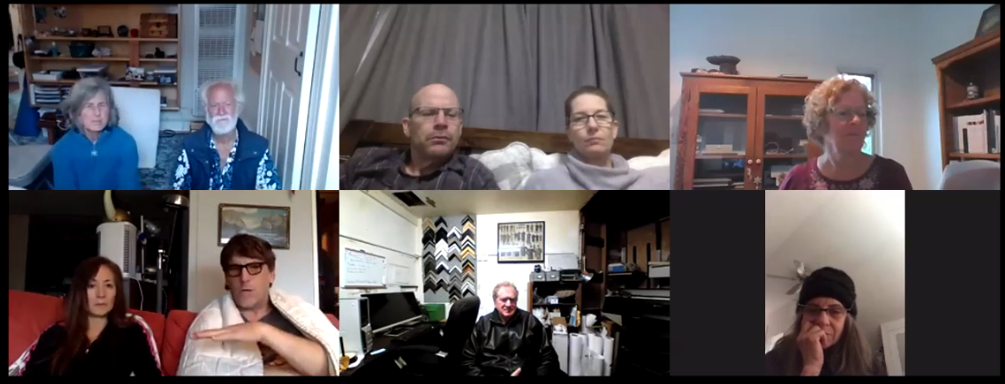
https://youtu.be/zmIafk5t2Io is the link to the Zoom video of this month’s Sunday meeting. The shorter first part of the meeting begins with a chapter reading followed by attendees’ commentary, if any. A little later on begins the longer open discussion part of the meeting when those who wish to discuss how the chapter relates to their personal experience.
Corrections?
None this time.
Reflections:
The way constant is without name.
Simple! Though small, nothing under heaven can subjugate it as well.
The way constant is without name reiterates chapter one’s opening disclaimer, The way possible to think, runs counter to the constant way. The name possible to express runs counter to the constant name. Few if any cultural traditions open with so direct a disclaimer about their own limitations; just the opposite! This simple fact can’t be overstated given how deeply embedded in the human brain words and stories are. On one hand, words easily complicate nature’s simple. On the other hand, their natural deeper function in our species parallels the social exchange that sniffing accomplishes for dogs and the nit picking that serves our primate brothers. This use of language is a healthy and natural means of social bonding, not to mention how deeply it benefits survival—at least up to a point.
We leave the healthy and natural behind when names and words dominate perception. Then, when backed with emotional certainty, names and words transform into a uniquely human disease. As chapter 71 cautions, Realizing I don’t know is better; not knowing this knowing is disease.
Great men, if able to observe it,
All things would take the role of guest.
Heaven and earth would join letting sweet dew fall,
The people, of none decree, yet self balanced.
Reading these first six lines had me a little stumped this morning. I initially interpreted this as a kind of objective result of observation, i.e., Great men, if able to observe it. That implies that a sage with rare insight can solve our yet unsolved problems. Surely, this is not different from any other human heroic ideal, like in how the second coming of Christ can solve humanity’s problems, or the more mundane expectation that the next President will be a “God send” for the nation. Both reflect a comfortable ignorance of nature as a whole.
These lines only make real practical sense if they describe how worldly circumstances might appear to any person whose mind is returning and resting in the honest Simple! As chapter 16 says, Returning to the root cause is called stillness; this means answering to one’s destiny. Answering to one’s destiny is called the constant; knowing the constant is called honest.
Our negative view of the world is essentially a reflection of our expectations of how we want the world to be. And our expectations are driven by fear and its offspring desire. Naturally, there is nothing wrong or mistaken with this—fear and need are fundamental to life (see Life’s Chain of Causation). However, the simple fact is, our expectations are the source of our suffering. Self balance is only possible when expectations match the reality of what is. Chapter 19 sums it up briefly, See simply, embrace the plain, and have few personal desires. Buddha sums this up in more detail in his two Noble Truths…
The Second Noble Truth is the cause of suffering. The cause of suffering is lust. The surrounding world affects sensation and begets a craving thirst that clamors for immediate satisfaction. The illusion of self originates and manifests itself in a cleaving to things. The desire to live for the enjoyment of self entangles us in the net of sorrows. Pleasures are the bait and the result is pain.
Of course, the popular interpretation of these lines is about non-interference (Wu Wei), where when a ruler does nothing, the people will self-balance because the natural equilibrium of the system isn’t being disrupted by ego-driven policies. Like “Peace on Earth and Good Will to all Men”, this is what the empathic emotions of humanity project onto their stories, including Taoist stories. History clearly demonstrates reality never conforms to our ideals long term, i.e., at least for more than a few fleeting historical moments. Nature ebbs and flows, never stagnating in the idealized state of harmony we wish for in our imagination.
Only when restricted, are there names.
Names already exist,
Man handles the realization to stop.
Knowing to stop [he] can be without danger.
“Only when restricted, are there names” points to the tradeoff we make by relying so exclusively on words, names, language, and the stories we get our minds locked onto. Names have enabled us to ‘divide and conquer’ nature, which has put us at the tip-top of the food web. The price we pay for this survival advantage lies in the way this boxes-in our mind. “Think outside the box” is a little absurd at its core—it is thinking that initially boxes us in.
Names already exist is just affirming the evolved nature of the human mind. Names for us are as natural as our feet are for walking. The trick lies in handling the realization to stop. Essentially, we have here a ‘too much of a good thing’ problem. The insidious aspect of language—and the stories we dwell upon—lies in how easily it becomes a self-reinforcing neurotic mental spiral that hampers handling the realization to stop. That is a Catch-22 if ever there was one.
Knowing to stop [he/she] can be without danger is easier said than done, of course. We might even say thoughts are addictive. The emotional stake we have in our thoughts makes us unable to turn off the mind’s spigot. So much of the danger we feel ourselves surrounded by is actually a product of our own making, again fear and need driving imagination’s narrative.
The modern world with its internet, social media and AI thrust us even more into the realm of the imagined, making it all the more difficult to see beyond the stories we’re locked into. Our connection to the actual ground—dirt and nature—is being replaced by the ease and comfort that technology affords us. Even more potent is how technological progress is accelerating exponentially. We did not evolve to handle the uncertainty, un-groundedness, and stresses that such a ramped up rate of change produces. And to top all this off is how we are convinced that the solution lies ahead.
Analogy: of the way’s existence under heaven,
Liken this to the river of the valley flowing to the great river and the sea.
In a way, this is a metaphor for entropy — the flow of gradients toward equilibrium, like a river emptying into the sea. In that sense, entropy resembles one visible tendency within the larger flow the Tao Te Ching points toward. Yet the sea does not remain still; its waters rise and return, and the river flows again. As chapter 40 hints at, reversal is the movement of the Way:
Or, as these chapters also hint at…
Dead, and yet not gone; This is longevity;
Soften its brightness, be the same as dust, This is called profound sameness.
The way of nature decreases surplus yet benefits the insufficient.
Of weakness and loss through death, superior to strength.
Chapter Archive https://youtu.be/oqERjLDWbZ0
This is the complete video. It begins with blowing Zen followed by the meeting
Third Pass: Chapter of the Month
Corrections?
Nothing this time.
YouTube Recordings:
https://youtu.be/Rd0VdWP1E-M is the link to the complete audio recording of our monthly Sunday meeting. For the nicely edited version, go to Kirk Garber’s YouTube channel. The edited version comes in two parts: The first and shorter Commentary part begins with a chapter reading followed by attendees’ commentary, if any. The second and longer Open Discussion part offers attendees’ observations on how the chapter relates to their personal experience.
Reflections:
The way constant is without name.
Simple! Though small, nothing under heaven can subjugate it as well.
This morning I felt simple to be like consciousness, the light, or rather the light of consciousness that illuminates the ‘presence of existence’. That is the only constant I’ve ever experienced and it has been constant for as long as I can remember. This is the simplest link that connects all the dots of my life, so to speak. This reminds me of D.C.Lau’s line in chapter 14, The ability to know the beginning of antiquity is called the thread running through the way.
Nothing under heaven can subjugate it because it lies at the foundation of everything. The literal translation of this line in chapter 14 puts it this way: The ability to know the ancient beginning, this is called the way’s discipline. The way’s discipline may describe the process better, for me anyway. Still, I do love the poetry of the thread running through the way. Discipline is a useful way to describe the ‘presence of existence’ that underpins everything — from the spin of an electron to the forces behind a galactic spiral. No wonder it’s without name.
By the way, quantum non-locality offers hints of proof that consciousness is universal and immortal, which sheds more light on why Nothing under heaven can subjugate it as well. The following are previous posts that delve into non-locality: Beyond Spooky, Seat of Consciousness, Consciousness Physics, and finally, You are Immortal, which probes into the ‘illusion of self’ clinging experience vis-à-vis consciousness.
Everyone experiences this sense of immortality in moments of emotional and mental tranquility. Yet, few would recognize it as immortal consciousness! It helps to know what you are looking for to find it, or in this case realize you found it. Invite ‘nature’ in, and then alone and still, breathe in and smell, look, touch, and ‘feel’ all living things past and present who have experienced the same. You will become them, not in your imagination, but because of diminishing whom you think you are. As the self-illusion wanes, the immortal Universal Self waxes, so to speak. Note: ‘nature’ is a state of mind, not a thing or place. Of course, biologically speaking, I suppose mirror neurons are involved. Still, they are only another aspect of ‘nature’.
These passages can help put you in the mood.
Have little thought of self and as few desires as possible. #19
See simply, embrace the plain, and have few personal desires. #19
This passage from chapter 47 above hints at what we’ll see as the illusion of self fades away. In other words, the illusion of self overshadows the larger reality within which the illusion exists. Chapter 4 points the way, Soften its brightness, be the same as its dust.
Consciousness expands
The excerpt below is from Enriched with Information, which was the final installment in a three-part Science News series Demystifying the Mind on the scientific struggle to explain consciousness. (See also my post Seat of Consciousness that draws on the information in this series.)
As the example of the animat suggests, integrated information may not be restricted to just objects in possession of a brain. Such a simple finding has a big implication: If Tononi is right, and integrated information actually is consciousness, then consciousness itself is no longer restricted to the inside of a head. As long as it has the right informational specs, any system, whether it’s made of nerve cells, silicon chips or light beams, could possess consciousness.
Such a realization alters the consciousness conversation. In a world full of objects that can move information around quickly — an octopus’s brain, a tree’s root system, the Internet — the discussion of whether an entity is conscious may lose its meaning. Instead, the question becomes, “How conscious is it?” Small systems with just a few bits of information may have a tiny sliver of consciousness, while large systems such as human brains have a whopping helping.
Expanding the umbrella of consciousness to include systems that don’t have brains, a view echoing that espoused by some ancient religions and more modern versions of panpsychism, is an uncomfortable stretch for many researchers. Seth, for one, believes the mathematical language of consciousness offers interesting descriptions but stops short of saying that integrated information is actually the thing itself. “The only systems that we know of in the universe that generate consciousness are biological,” he says.
Others have more unorthodox ideas. Koch says he might be wrong, but he believes that consciousness, like an electron’s charge, is something inherent in the fabric of reality that gives shape, structure and meaning to the world. “Consciousness is not an
emergent feature of the universe,” he says. “It’s a fundamental property.”
Whether consciousness is woven into the very nature of the cosmos is a grand question that, for now, remains unanswerable, Koch says. But that hasn’t hindered real progress on other questions about the mind. Systematic studies and leaps of insight have revealed what’s required of a conscious brain, traced a particular sight as it journeys into awareness and produced a crop of theories that hint at the true nature of consciousness.
“We make progress by looking where the light is bright,” Koch says. “But ultimately, we have to look farther and deeper.”
Guided by theoretical insights, scientists may someday escape the confusion that comes from being their own subjects, and see clearly into the minds of man. An understanding of what lies within the skull may then inspire scientists to shift their gazes outward, where an entirely new and mysterious world awaits.
Now, back to chapter 32…
Great men, if able to observe it,
All things would take the role of guest.
Heaven and earth would join letting sweet dew fall,
The people, of none decree, yet self balanced.
‘Great men, if able to observe it’ describes the moments when I am able to slough off names (labels) and savor the moment. At such times of cognitive stillness, I’m able to ‘bask’ in the light of the constant. At those moments, I do take the role of guest for then I have no agenda. I also feel, the people, of none decree, yet self balanced. I consider all perceptions truly be merely reflections and projections of ‘in here’ — my inner makeup. Everything ‘out there’ appears self balanced precisely and only in the moments when I am self balanced.
Only when restricted, are there names.
We are habituated to names and labels because doing so restricts the way constant. Holding onto these labels offers us a sense of connection and that makes us feel more secure. The fear and lonely isolation we experience in civilization’s paradigm drives us to knowledge. After all knowledge is power. And power at least promises to fill our self-security void. Of course, it can’t really because the insecurity is a result of social disconnection that civilization requires to function. (See The Tradeoff for background.)
There is always a tradeoff. Here, in restricting the way through naming we gain power, control, and the security of virtual knowing. We lose the connective experience that comes from non-differentiating consciousness — profound sameness, as chapter 56 puts it. This differentiating practice is increasing exponentially with technology. Just think, in little more than a century we’ve gone from horse and buggies to self-driving cars and moon landings. Yet, as a species, we cheer on these advancements completely oblivious to the tradeoff, the unintended ‘evil’ consequences, they naturally and inevitably incur.
We commonly regard murder, lying, war, and such to be against society’s best interest. Granted, we wouldn’t prevent the ‘evils’ of civilization by recognizing their deeper cause. Nevertheless, by honestly accepting the cause might make mitigation more straightforward. Once we mature enough as a species to admit the tradeoff we’ve made by pursuing unrelenting progress, we will at least enjoy the comfortable personal integrity of self-honesty. And who knows, this may help reduce some of our extremely rash actions. Chapter 16 bites into this…
Names already exist,
Man handles the realization to stop.
Knowing to stop [he/she] can be without danger.
Each person handles the responsibility to stop. Stop what, you may ask. This isn’t about stopping to name anything really, even if that were possible. The real damage of naming realities lies in how tightly you hang on to the names, and the broader definitions for the names. How you define words determines how tightly words trap your mind; it’s something like a self-fulfilling prophesy. The only meaning names have is the meaning you emotionally give them. Knowing to stop [he/she] can be without danger therefore begins at an emotional level. It’s deep! This means it’s an intuitive emotional knowing, not an intellectual one. It is more accurate to say, an intuitive un-knowing, or perhaps a recalibration. See Tools of Taoist Thought: Correlations if you want to try out a way to liberate your mind from Names.
Analogy: of the way’s existence under heaven,
Liken this to the river of the valley flowing to the great river and the sea.
Reality is ALL connected, like the waters of creeks flowing into streams, flowing into rivers, flowing into seas, evaporating and rising into the sky, falling as rain into the creeks. Names disconnect the All and reduce it to bite-sized cognitive pieces we can digest without becoming completely bewildered. We gain peace of mind and pay for that with the illusion of mortality, i.e., the ‘illusion of self’ evokes its opposite, the ‘illusion of mortality’. (See, Buddha’s 2nd Noble Truth, “… The illusion of self originates and manifests itself in a cleaving to things.”)
Second Pass: Work in Progress
Issues:
Line 2: Original Chinese is not big on punctuation, and so this line comes across a little odd. I inserted some punctuation to underscore the two related though distinct points being made here.
Line 3 through 6: Lines 4-6 stem from the condition expressed in line 3, “if able to observe it“. Observe is the key word here. Our experience of reality hinges on the nature of the observer, e.g., ‘beauty is in the eye of the beholder’. Whether one sees the universe, and all within it, as being ‘just perfect’ or not is fundamentally conditional upon the equanimity of the observer, i.e., if your angry and upset, the whole ‘out there’ feels crappy… and visa versa!
Line 7: “Only when restricted, are there names” infers that we label life in our need to restrict the infinity of it all. Restricting nature through labeling it give us the illusion of power and possession. With most everything named, one is able to ‘think that one knows‘. In other words, names are a symptom of the need to restrict the ‘big picture’—the mystery.
Line 8-10: These lines relate to the view that Realizing I don’t know is better; not knowing this knowing is dis-ease. I suppose handling the realization to stop is the way we avoid having the disease get the better of us.
Line 11-12: It works better to just use the literal meaning of the initial character— pì (譬) example; analogy.
Commentary:
Great men, if able to observe it (and so on), offers the view that No one in the world dare claim its allegiance. If we truly could observe it, history would not be the record of chaotic human stumbling that it is. Our ability to ignore history and cling to our ideals of what ‘should be’ rather than come to terms with nature is remarkable. Our claim to be a rational wise species (Homo sapiens), is more truthfully a reflection of wishful thinking than fact—a goal we seek, or think we ‘should be’. Distinguishing this ideal wish from fact seems almost impossible, so desperately do we cling to our narrative of superiority. That raises two question: (1) why?, and (2) so what?
In my view, Buddha’s 2nd Noble Truth tells us why in a slightly round about way, i.e., “… the illusion of self originates and manifests itself in a cleaving to things“. We cling to our story, our beliefs, our narrative because that creates and maintains our illusion of self—the ego. “I” am my story, my story is “me”. Each props up the other in a kind of self-fulfilling prophetic illusion. To let go of one’s story (beliefs, narrative) is tantamount to coming a kind of psychological suicide, and so the vicious circle continues to turn.
Let go; observe it, and change the world
The moral is this: When we cling to our partisan point-of-view, many aspect of the world look imperfect. It needs changing to live up to our ideal. Granted, the human condition embodies many extremely troubling aspects—war among the worst. How can this be viewed as anything close to Heaven and earth would join letting sweet dew fall, The people, of none decree, yet self balanced? No one said a Taoist view comes easy! Also, it helps to know that humanity’s impact is the long-standing, long-term result of our own hypocrisy (thinking and rationalizing self-interest to a fault).
It is thinking and rationalized self-interest that got us here, and yet this is the same process we use in our attempts to ‘fix’ it—fighting fire with fire, as it were. Even so, on a personal level, I feel no need to ‘fix’ anything, as long as I don’t judge our species based upon what we think we should be.
That’s the secret; don’t judge us by our own hypocritical standards. Viewed instead as simply one of ‘Gods’ myriad creatures soothes my outlook and contentment is closer at hand. This also helps the overall, if only in a small way. This is like grains of sand on a beach: each grain is insignificant, but in mass, the beach becomes ‘just right’.
The idea of ‘knowing to stop’
That view shows up in other chapters, such as ‘Knowing doesn’t speak; speaking doesn’t know‘ and How can it be that emptiness speaks! Complete sincerity returns. Knowing to stop is simply the recognition that it is restricted by names, and that we are not able to unwind that clock. However, it is possible to refrain from making mountains out of molehills if we can avoid trusting names and words. That happens naturally once one realizes they are not the reality they appear to represent.
Taking myself (self-illusion / ego) less seriously means taking my thoughts—my story—less seriously. Recognizing that names and words are a limited means of social connection (communication), and not accurate reflections of reality (what is truly ‘out there’) helps dim the self-illusion and softening the glow of the ego.
At best, word and names reflect the ‘in here’ of who we are, our desires and fears. Accepting this simple view can eliminate much misunderstanding. Of course, one could argue that part of the primary purpose of communication is actually miscommunication and misunderstanding. Miscommunication keeps the social pot stirred, so to speak. Otherwise, perhaps too much sweet dew might fall. 😉
Suggested Revision:
The way constant is without name.
Simple! Though small, nothing under heaven can subjugate it as well.
Great men, if able to observe it,
All things would take the role of guest.
Heaven and earth would join letting sweet dew fall,
The people, of none decree, yet self balanced.
Only when restricted, are there names.
Names already exist,
Man handles the realization to stop.
Knowing to stop [he] can be without danger.
Analogy: of the way’s existence under heaven,
Liken this to the river of the valley flowing to the great river and the sea.
First Pass: Chapter of the Week
This chapter points out what ‘should’ be obvious, namely that no one in the world dare claim its allegiance. If anyone truly had The Answer, The Secret, or the ‘ear of God’, human history would not be the record of chaotic stumbling missteps that it is. Our ability to ignore history and cling faithfully to our ideals is as remarkable as it is irrational. Clearly, claiming ourselves to be a rational species (homo sapiens) is more a reflection of wishful thinking than fact. Separating our wishes and ideals from what actuality is perhaps biologically impossible.
For example, long ago I realized and ‘accepted’ the irrationality of human nature, and yet I continue to be surprised by actions which reflect irrationality. The fact that I never seem to get used to the irrationality is a little surprising, frankly. Obviously I accept it as a fact, yet can’t accept it emotionally. Doesn’t this show just how irrational I am in some underlying innate hope for rationality?
Nevertheless, I can be free from danger as long as I remember that any judgments I make stem from what I irrationally feel ‘should’ be. ‘Names already exist’ is another way of saying that we are all trapped by words and names from infancy onward. While feeling a need for some things to be otherwise is innate (biological), linking words and names to that only serve to trap me there. Thus, ‘man handles the realization to stop. Knowing to stop [he] can be without danger’. If I stop needy feelings from driving what I think, I can be without danger, i.e., I can avoid the ‘to think that one knows’ problem.
Admittedly, that is a tall order! Alas, emotion drives thought. Nevertheless, improvement is possible as long as I remember!… remember!… remember! what I know! Then contentment becomes possible. I should add here that by ‘remember’ I don’t mean repeating a string of words. Remembering what I know is an intuitive experience along the lines of Buddha’s Right Understanding, Right Mindfulness, Right Attentiveness, and Right Concentration.
I think I once saw the idea of knowing when to stop, as a warning to stop using words. That is reinforced, naturally, by other passages, such as one who speaks does not know… Today I see this as saying, that yes, the nameless uncarved block is restricted by names, and yes, we can’t turn back that clock. Nevertheless, it is possible to avoid making mountains out of molehills if we realize and remember that names and words are never the reality they appear to represent. Then it is possible to know yet to think that one does not know.
Taking myself less seriously means taking my thoughts less seriously. Recognizing that names and words are a means of social connection – communication – and don’t actually mirror reality ‘out there’ helps calm mind and heart greatly. At best, word and names reflect the ‘in here’ of who I am, my desires and fears. Accepting that simple view can avoid much misunderstanding. Of course, one could argue that part of the underlying purpose of communication is actually misunderstanding via miscommunication. This helps keep the social pot stirred, so to speak. Otherwise, Heaven and earth would join and let [too much] sweet dew fall. Ah, but that’s another story.