Translation
The great way flows, such as it may left and right.
All things on earth depend on it for existence, and it never declines,
Meritorious accomplishment yet anonymous.
Clothes and supports all things on earth yet doesn’t master.
Always without desire befits the name small.
All things on earth return here, Why?
Not being their master befits the name great.
Because of its ultimate non-self, it becomes great.
Hence it can accomplish its greatness.
1) big (great) road (way, principle; speak; think) float (be suffused with; flood; inundate) ! , his (its, he, it, that; such) approve (befits, can, but; yet) the left [and] right sides (around; about). 大道泛兮,其可左右。(dà dào fàn xī, qí kĕ zuŏ yòu.)
2) all things on earth rely on (depend on) of use (<v> take <p> according to; because of <adj> so as to <conj> and) give birth to (existence) <conj.> and (yet, but) no (not) diction (take leave; decline; shirk), 万物恃之以生而不辞,(wàn wù shì zhī yĭ shēng ér bù cí,)
3) merit (achievement) accomplish (succeed; become) <conj.> and (yet, but) no (not) name (fame; reputation) have (exist). 功成而不名有。(gōng chéng ér bù míng yŏu.)
4) clothing support (raise; keep; grow; foster) all things on earth <conj.> and (yet, but) no (not) do (act as; be, mean; support) host (owner, master), 衣养万物而不为主,(yī yăng wàn wù ér bù wéi zhŭ,)
5) ordinary (normal; constant; often) nothing (without; not) desire (longing; wish; want; about to) approve (befits, can, but; yet) name (fame; reputation) at (in, from, to) small (little; for a while; young). 常无欲可名於小。(cháng wú yù kĕ míng yú xiăo.)
6) all things on earth go back to (return; give back to; come together) here (herein; (usu. neg question) how; why), 万物归焉,(wàn wù guī yān,)
7) <conj.> and (yet, but) no (not) do (act as; be, mean; support) host (owner), approve (befits, can, but; yet) name (fame; reputation) do (act as; be, mean; support) big (great). 而不为主,可名为大。(ér bù wéi zhŭ, kĕ míng wéi dà.)
8) use (<v> take <p> according to; because of <adj> so as to <conj> and) his (its, he, it, that; such) end (death; eventually; after all; whole; all) no (not) self (oneself; certainly) do (act as; be, mean; support) big (great), 以其终不自为大,(yĭ qí zhōng bù zì wéi dà,)
9) happening (reason; cause; on purpose; hence) can (be able to) accomplish (succeed; become) his (its, he, it, that; such) big (great). 故能成其大。(gù néng chéng qí dà.)
Fourth Pass: Chapter of the Month
(Trump era)
Zoom on YouTube Recordings:
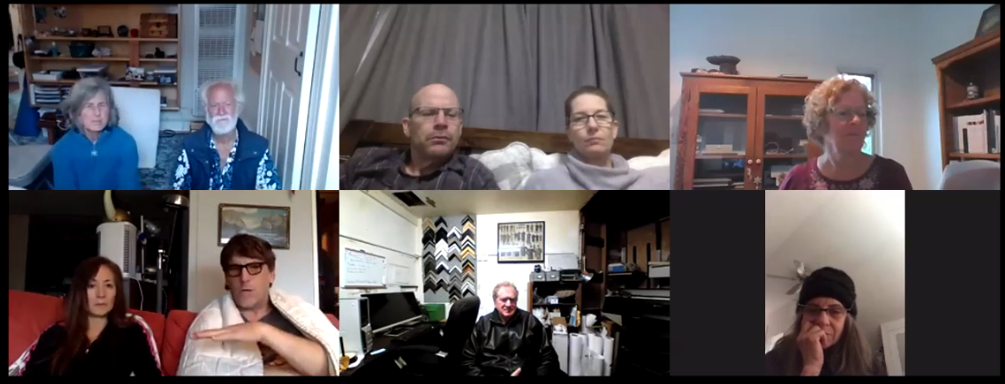
https://youtu.be/zmIafk5t2Io is the link to the Zoom video of this month’s Sunday meeting. The shorter first part of the meeting begins with a chapter reading followed by attendees’ commentary, if any. A little later on begins the longer open discussion part of the meeting when those who wish to discuss how the chapter relates to their personal experience.
Corrections?
None this time.
Reflections:
The great way flows, such as it may left and right.
All things on earth depend on it for existence, yet it never declines,
Meritorious accomplishment, yet anonymous.
Clothes and supports all things on earth, yet doesn’t act as master.
The great way flows, such as it may left and right should remind anyone not seeing life impartially of the evenhanded way of nature. Chapter 16 spells this out beautifully, especially the last half:
To get to the point of knowing the constant, one first needs to take the step the opening half of that chapter counsels:
It is not surprising that we see all the strife down here on earth. Our cognitive biology adds the “noise” of imagination to our perception of “what is so.” We end up leaning left or right, and worse, many feel “if you’re not with us you’re against us.”
Beyond that obvious left-vs-right matter, what struck me this morning in this chapter is how squarely it portrays the sense of awe, mystery, and unknown that haunts the human psyche. This is the unique aspect that separates us from the rest of life on earth, and not in a “good” way either, I dare say.
I suspect this disconnect with reality, or with “what is naturally so”, began as our use of words, language, and imagination took over cognition, splitting experience into opposing poles: left vs. right, life vs. death, happy vs. sad, beauty vs. ugly, and so on. As chapter 2 observes:
That psychological tension, I think, is the engine behind our creation myths. They ease our insecurity by filling in the void with a range of named “whys, hows, whens, and wheres”. This goes back tens of thousands of years, perhaps to Homo species earlier than our own. For most of that time, life was hard, immediate, and wild enough to keep us grounded. Then, with the exponential growth of tool use, written language, and institutional hierarchy, we lost that natural stabilizer. Nature abhors a vacuum, and thus religion arose to replace it with the one God of the West and the compassionate message of the Buddha.
What is striking about this chapter is how it addresses that same mystery without personalization, and in doing so stays true to the impartiality of chapter 16 described above. Meritorious accomplishment, yet anonymous and not being their master, befits the name great stands in stark contrast to God, or even the Enlightened Buddha, both of whom are the very opposite of anonymous! Because most people need something more tangible to hold onto, a named presence, a He, (or a She) the Tao Te Ching will always reach fewer people than a creation myth that spells out an origin story. For many, there is a deeper need to have something more personal to relate to than an omnipresent God. This, along with how we are socially, biologically wired to follow a group leader, makes Jesus, the personalizable saints of the Catholic Church, and Buddha, ideal. See The Tradeoff, which lays out the whole trajectory of this pre-historic to historic timeline.
Always without desire, befits the name small.
All things on earth return here, Why?
Not being their master, befits the name great.
Because of its ultimate non-self, it becomes great.
Hence, it can accomplish such greatness.
Not being their master, befits the name great and Because of its ultimate non-self, it becomes great have a somewhat paradoxical quality to them. The greatness here lies in not being great as we usually think of the word. That would fit right in with the “mission” of the Tao Te Ching, i.e., wean us away from our certainty and trust in words as accurate descriptions of reality.
On a personal note: I used this chapter (along with many more of course) for guidance in raising my two sons. The beauty of using the Tao Te Ching for guidance in parenting is that parenting became much smoother than when drawn into contending with your children. Of course, the same applies to dealing with other adults, but in child rearing, the intense intimacy of that situation benefits more profoundly than normal worldly life. I mean, just notice how well this parallels a parent’s role with their children:
All things (particularly one’s children) on earth depend on it for existence, yet it never declines,
Meritorious accomplishment, yet anonymous.
Clothes and supports all things on earth (particularly one’s children), yet doesn’t act as master.
These lines from chapters 8, 68, 73, and 81 also spoke directly to how I tried to show up as a father:
Nature’s ruthlessness, who knows its cause.
Nature’s way never contending, yet adept in victory.
Nature’s way benefits, and yet doesn’t harm.
The holy person’s way acts, and yet doesn’t contend.
Chapter Archive https://youtu.be/qpR2G3xphqw
This is the complete video. It begins with blowing Zen followed by the meeting
Third Pass: Chapter of the Month
Corrections?
Back to none again. Whew!
YouTube Recordings:
https://youtu.be/HkNQZbWQnCU is the link to the complete audio recording of our monthly Sunday meeting. For the nicely edited version, go to Kirk Garber’s YouTube channel. The edited version comes in two parts: The first and shorter Commentary part begins with a chapter reading followed by attendees’ commentary, if any. The second and longer Open Discussion part offers attendees’ observations on how the chapter relates to their personal experience.
Reflections:
The great way flows, such as it may left and right.
All things on earth depend on it for existence, yet it never declines,
Meritorious accomplishment, yet anonymous.
Anonymous! That is a clue to our problem in a nutshell. Reading this today I immediately felt the reason why we have names like God, The Way, or whatever we choose to name for the ’presence’ we sense and innately depend on for existence. We are so desperate to name everything that manifests in our awareness, beginning with naming ourselves. Bottom line: We abhor anonymous… unidentified, nameless, unknown. Why?
As always, I begin with asking why. This takes me immediately to look at the question from a Symptoms Point Of View. Everything that happens is a response to underlying circumstances. Peeling back the surface veil and exploring those deeper waters helps delay what often can be a knee-jerk response to how things appear initially. Sure, knee-jerk responses have enjoyable, stimulating and captivating aspects, but after awhile that becomes too much of a good thing, especially if we settle down to strive for a balanced life.
So again, why are we so desperate to name the content of our awareness, so to speak? I suspect it has much to do with our dipolar-like perception (see Yin Yang, Nature’s Hoodwink). Beginning in infancy, culture indoctrinates us, first with language and then it uses language to inculcate society’s paradigm. This almost certainly causes us to feel reality isn’t real unless we have a name for it. Naming imparts meaning to life, literally and figuratively.
Among the more unpleasant and insecure experiences for us is the unknown. That may be true to a degree in other animals, but for us, it is excruciating because we are completely hooked on language… naming life. Words and names mean something! The downside here is that naming blinds us to the ‘whole therfore natural’ big picture. It is anonymous when we can’t pin a name on ‘it’. Conversely, it isn’t the constant when we can pin a name on ‘it’… The name possible to express runs counter to the constant name. Chapter 16 sums it up.
This ‘Not knowing the constant’ is a direct consequence of our dipolar-like perception, which maintains the content of our knowledge, understanding and memory. In contrast to knowledge is knowing. Knowing is the deep intuitive sense all living things experience. Knowledge, understanding and memory are highly language (naming) dependant, and so are the predominant domains of humankind, see We only understand what we already know for more on this.
Clothes and supports all things on earth, yet doesn’t act as master.
Always without desire, befits the name small.
All things on earth return here, Why?
Not being their master, befits the name great.
Because of its ultimate non-self, it becomes great.
Hence, it can accomplish such greatness.
This second half is more about the self-centered way we approach life. Fear drives us to name the ‘presence we sense’ in our awareness something tangible, e.g., God, The Tao, Good and Evil, etc. When raising my two boys, this chapter offered a superb guiding light, by emphasizing ultimate non-self greatness over self-centered greatness. Evidently, I was ready to follow, i.e., We only understand what we already know. Had I fathered children in my youth and full of self, I would have been their master, and with desire project all my needs and fears onto them.
Allowing my life’s events — nature —to play out… to flow such as it may left and right is only possible if I am secure in my own right. That means, I have somewhat nearly risen beyond self, as chapter 16 wonderfully put it. The longer one lives, the more likely that is to occur. You might say, life experience is the only honest teacher. Everything else has an agenda.
‘Because of its ultimate non-self’ is worth a second look. Do you see how the self, ego, names, language and knowledge all interconnect? In his second truth, Buddha states, The illusion of self originates and manifests itself in a cleaving to things. Sure, “things” are the material stuff we cherish, but deeper and more insidious is our cleaving to intangible “things”: names and all the offspring that produces… beliefs, judgments, understanding, and knowledge.
All you need do to achieve ultimate non-self is let go of naming, knowledge, belief, and understanding. Oh, is that all? Okay, that is an impossibly tall order, but only if you are someone seeking perfect outcomes! If you can be content with a little progress toward ultimate non-self , then all you need to do is begin the journey. I found that knowing where to start the journey and its ultimate destination was enough to begin. As chapter 64 reminds,
A thousand mile journey begins below the feet.
Of doing we fail, Of holding on we lose.
All that remains is watching moment to moment ‘below the feet’, and let nature take care of the rest.
Oh, and speaking of perfection…
The way hides from view without name.
The way alone masters perfect forgiveness and accomplishment.
Second Pass: Work in Progress
Issues:
I only saw a need to change some punctuation and little else. I trust that portends the future in the years ahead as I review these chapters! This is looking more likely, for as time goes by I am increasingly accepting the real limitations of conveying any point-of-view. It all appears to come down to various degrees of a shared point-of-view. In other words, we only understand others from the perspective of our own point-of-view. It is a ‘birds of a feather flock together’ kind of thing. In this realm, it certainly isn’t an ‘opposites attract’ dynamic, unless it is ‘attract’ for going into battle (debate, argument, war). Either way, the meritorious accomplishment lies in the process—the interaction. The ends are the means, which is helpful to know.
Commentary:
This chapter points out a few differences between the human way and the way overall. The way represents meritorious accomplishment, yet anonymous. We, on the other hand, tout our own special status and our success at survival. We’re the top dog in the food chain / web. Naturally, that parochial, species’ centric peculiarity is also ‘of and by the way’… although it feels kind of like a detour at times. 😉
Suggested Revision:
The great way flows, such as it may left and right.
All things on earth depend on it for existence, yet it never declines,
Meritorious accomplishment, yet anonymous.
Clothes and supports all things on earth, yet doesn’t act as master.
Always without desire, befits the name small.
All things on earth return here, Why?
Not being their master, befits the name great.
Because of its ultimate non-self, it becomes great.
Hence, it can accomplish such greatness.
First Pass: Chapter of the Week
Left as well as right applies across the board: political, religious, moral issues, yin and yang, etc. Saying, ‘The great way flows, such as it may left and right‘ is simply another way to consider mysterious sameness. It is remarkable that we can even see this deeper aspect of Nature considering how unavoidably drawn we are to see reality in contrasting shades of color (or black and white if you’re color blind). It is differences that stimulates awareness; sameness just puts us to sleep.
‘Because of its ultimate non-self, it becomes great‘ is one more way to consider the illusion of self. What causes this illusion? Buddha nailed it with his ‘the illusion of self originate and manifests itself in a cleaving to things‘. Yet, perhaps there is something still more fundamental happening here.
Clearly, we cling (cleave) to ideas, things, memories, beliefs, kith and kin. Indeed, anything that can be clung to, someone will be found to be clinging. Meritorious accomplishment, clothes, mastery, desire, are just the tip of the iceberg. Why do we cling so? Let’s consider our powerful urge to cling as a symptom and see where that leads. For example, if you saw me clinging to a branch, you could assume I was hanging from a tree or off the edge of a cliff. I’d be clinging to stop myself plunging to death. The fear of falling drives me to cling(1).
The implication here: We cling to things and ideas in order to avoid plunging down into an abyss of stillness and emptiness. Our extreme reliance on words and names creates a highly structured field of awareness. Ensuing illusions of future, past, and present, along with the clear-cut differences we use to maintain those illusions, paints us into a perceptual corner. It feels safe there, but because the ‘safe there’ is only make believe, we also feel insecure there. We know the void is lurking just behind the veil of what we think that [we] know. No wonder we have difficulty.
(1) The irony in this example is that the self I’m protecting first originated and now manifests itself in a cleaving to things. The illusion of self I’ve created must now cling to that from which it originated, otherwise it fears it will plunge into a silent and void oblivion, a death of self. It is a vicious circle of sorts. Although, you could say all of existence is as well: It is on disaster that good fortune perches; It is beneath good fortune that disaster crouches. Okay, time to stop; I’ve done enough damage for one night. 😉