Translation
Brave certainty rules in killing
Brave hesitation rules in living
These both either benefit or harm
Nature’s ruthlessness, who knows its cause.
Nature’s way never contending, yet adept in victory.
Never speaking, yet adept in answering
Never sent for, yet there from the beginning.
Indulgent, yet adept in planning.
Nature’s net is vast and thin, yet never misses.
1) brave (valiant) in (at, to, from, by, than, out of) bold (dare; be certain) standard (norm; rule > imitate; follow) kill (weaken). 勇于敢则杀。(yŏng yú găn zé shā.)
2) brave (valiant) in (at, to, from, by, than, out of) no (not) bold (dare; be certain) standard (norm; rule > imitate; follow) live (alive; living). 勇于不敢则活。(yŏng yú bù găn zé huó.)
3) this two (both; either; some) (者) perhaps (or; either…or…; > someone) sharp (favorable; advantage; profit) perhaps (or; either…or…; > someone) evil (injurious; do harm to; impair; kill). 此两者或利或害。(cĭ liăng zhĕ huò lì huò hài.)
4) sky (heaven; day; season; nature; God) of place (indicate passive construction, agent of action) loathe (dislike; hate_fierce; ferocious) who (which, what) know (realize; inform; knowledge) his (her; its; that; such) reason (cause; on purpose; hence). 天之所恶孰知其故。(tiān zhī suŏ ĕ shú zhī qí gù.)
5) sky (heaven; day; season; nature; God) of road (way, principle; speak; think) no (not) contend (vie; strive; argue) <conj.> and (yet, but) good (satisfactory; be adept in) victory (success; surpass; be superior to). 天之道不争而善胜。(tiān zhī dào bù zhēng ér shàn shèng.)
6) no (not) speech (word; say; talk) <conj.> and (yet, but) good (satisfactory; be adept in) answer (respond; agree (to do something); should). 不言而善应。(bù yán ér shàn yīng.)
7) no (not) call together (convene; summon) <conj.> and (yet, but) from the beginning (in the first place; originally). 不召而自来。(bù shào ér zì lái.)
8) indulgent (generous) right (correct; so; like that) <conj.> and (yet, but, however) good (satisfactory; be adept in) stratagem (plan; scheme; plot). 繟然而善谋。(chăn rán ér shàn móu.)
9) sky (heaven; day; season; nature; God) net (network; catch with a net) extensive (vast) dredge (thin; sparse; distant) <conj.> and (yet, but) no (not) lose (miss; let slip; fail). 天网恢恢疏而不失。(tiān wăng huī huī shū ér bù shī.)
Fourth Pass: Chapter of the Month
(pandemic era)
Zoom on YouTube Recordings:
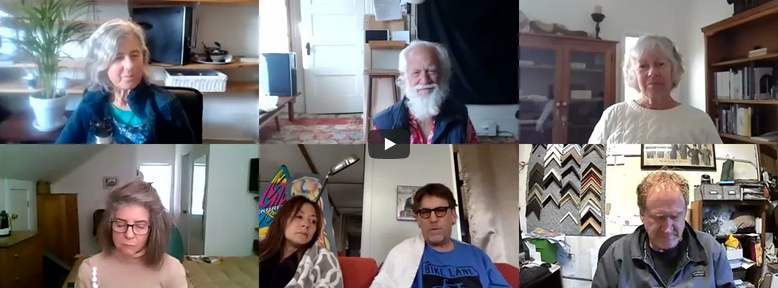
https://youtu.be/Gwu6lrEQvUM is the link to the Zoom video of this month’s Sunday meeting. The shorter first part of the meeting begins with a chapter reading followed by attendees’ commentary, if any. A little later on begins the longer open discussion part of the meeting when those who wish to discuss how the chapter relates to their personal experience.
Corrections?
None this time.
Reflections:
Brave certainty rules in killing
Brave hesitation rules in living
These both either benefit or harm
Brave certainty is a kind of total focus. For example, a hawk employs brave certainty when diving in for a kill. You can see this singular oneness of focused action in all wild animals. Of course, humans also experience this, but our ability to over think the moment’s reality often gets in the way. Perhaps that is why human culture greatly admires feats of focused action in sports, music, dance, and such. In fact, isn’t all action essentially a killing of sorts. Action displaces—kills—the status quo. Action creates space for change. This begs the question, what is non–brave certainty? A wanton arrogant kind of certainty, I suppose.
Perhaps inquiring into non-brave hesitation can tell us something. Non-brave hesitation feels to me like a complete submission to fear. Conversely, feeling fear yet facing it and moving forward in life, but not too quickly. feels akin to brave hesitation. Feeling the urge to act now, but waiting until the right moment would be brave patience—brave hesitation.
These both either benefit or harm
Feeling fear and yet facing it also draws on brave certainty. Mind you, I’m referring to the subtle constant fear—entropy—all living things experience (see Fear is the Bottom Line). Conversely, feeling the need to act now and yet waiting for the optimum moment to ‘strike’ draws on brave hesitation. Even so, like yin and yang, certainty and hesitation are the extremes. It is bravery that connects them. It’s the common denominator. Life is about finding the balance between the extremes. Greater balance results in more benefit. Less balance results in more harm.
So, I guess that begs the question, what is bravery… really? In a way, the idea of bravery smacks of free will, as though one can choose to be brave. Surely, that’s just not possible. See Free Will: Fact or Wishful Thinking? Inquiring deeply here feels problematic. Yet, any quandary resolves itself somewhat when I notice how wisdom is an important aspect of bravery. And ego is the main impediment to wisdom. Putting yourself first, above all else, is neither wise nor brave. And age has a lot to do with how intensely one puts themselves first above all else. The younger we are the more likely we are to put ourselves—our needs and fears—above all else. Thus, wisdom and bravery are both contingent upon life experience.
Nature’s ruthlessness, who knows its cause.
Nature’s way never contending, yet adept in victory.
Chapter 5 sheds another light on nature’s ruthlessness…
Chapter 5 doesn’t say anything about the causes, but it helps shed more light on the idea of never contending. Contending requires a need to win over a challenger, an opponent. Clearly, nature has no opponent… profound sameness rules.
The first three lines of this chapter offer a balanced view of the two main polls of life—certainty and hesitation. In reality, these share a profound sameness—they’re dynamically linked. Interestingly, the rest of the chapter feels somewhat biased toward the hesitation side of life’s coin. Surely, this is because our species is overly enamored by the brave certainty—heroic—side. Why?
Brave certainty counterbalances the outsized role fear plays in our response to circumstances. This role is a result of how fear influences imagination, which is not the case for any other animal. Other animals fear what they fear in the moment, contingent on the circumstances right ‘now’. Humans can, and do, carry around imagined uncertainties and fears all their lives, which has an artificially inhibiting role in life. Hence the glorification of brave certainty, and more particularly, the ideal that one can choose to be brave.
Brave hesitation, on the other hand, is more akin to never contending, yet adept in victory. Of the two, brave hesitation is more akin to the way of nature I feel.
Never speaking, yet adept in answering
Never sent for, yet there from the beginning.
Never speaking, never sent for, and never contending have a more anonymous and subtle quality to them. These all share much in common with brave hesitation. Certainly, nature employs both sides of reality’s coin, but the side we see easiest is the brave certainty—action—side of the equation. For humanity, the secret to increasing emotional balance lies in becoming more aware and respectful of the female brave hesitation side of life. That aspect truly rules in living.
Indulgent, yet adept in planning
Nature’s net is vast and thin, yet never misses.
These final two lines align closely with the brave hesitation side of nature. The remarkable thing about existence lies in how well it all seems to work out, yet there is no one in charge of planning. Nature doesn’t “personally” care, yet it all goes according to plan. Plan… what plan?
The question, ‘what plan?’ may explain the human need for a creator of sorts. If reality appears to run fairly smoothly, and we have the concept of planning vs. spontaneous, it is natural to imagine there is a planner in charge of the whole thing. We feel that it can’t just be random and spontaneous, for those words represent action without purpose. That is anathema to life. If nothing else, we feel the purpose of life is to not die, or at least not die before we’ve passed on our genetic information. Nature, on the other hand, has a more mysterious ‘plan’ as chapter 4 appears to suggest…
Nature’s net is vast and thin, yet never misses alludes to the extremely subtle influence nature has over the whole of life. In fact, it is so vast and thin—so subtle—that we are certain that we are individuals (the “illusion of self” as described in Buddha’s Four Noble Truths) and that we are in control of our life’s actions (free will). We only notice the circumstances that evoke emotions—fear and need—and little else. Simply put, emotions blind us to the vast and thin net that pervades ever facet of our life. Nature is much more profound than we can comprehend, and so we fall back on names and thought in order to feel we have it nailed down.
Exploring thought, the illusion of self and free will
All animals have an innate visceral sense of self. The human idea of self, or as Buddha called it, “the illusion of self” is simply an emergent property of this universal intuitive self-sense. Thought can’t help but imagine a self in charge of itself. Our sense of ‘free will’ is simply an offshoot of this ‘illusion of self’.
Obviously then, Buddha’s view “the illusion of self originates and manifests itself in a cleaving to things” is not the actual origin of this illusion. However, our cleaving to things certainly bolsters and sustains this illusion. Indeed, cleaving to a belief in an individual self becomes a kind of self-fulfilling prophecy. In other words, the reality I think I experience becomes my virtual reality. Only by realizing I don’t know, can I pop that bubble. As chapter 71 warns us, Realizing I don’t know is better; not knowing this knowing is disease.
Obviously, just like any animal, humans have an instinctive urge to be in command of their circumstances. Our belief in free choice—free will—is the natural outcome of our ability to think. In feeling quite certain that we “know”, the innate sense of self, which is common to all animals, naturally drives human thought to create stories about our unique ability to choose and thus be responsible for our actions. In sharp contrast to this is the general belief that no other animal, including young human children, have such agency. We believe free will to be a special feature of humanity. Dare I say, our free will belief is just one outcome of a disease unique to thinking animals, i.e., chapter 71’s words of warning. Deeply realizing I don’t know makes any notion of free will ludicrous. And yet…
Naturally the mind can’t help but create and /or take on stories. After all, deep-seated emotion drives cognition deeply. For example, when you feel angry, you think angry thoughts. Interestingly, the stories we embrace are the ones that suit (resonate best with) our emotional landscape. That landscape often changes as we mature through losses we incur over our lifetime. As chapter 40 notes so succinctly, Loss through death, of the way uses. As we mature, the story that resonates with our intuitive and emotional sense of life changes accordingly… yet it’s still just another story. Again, chapter 71 warns us to be wary of the plastic and relative nature of all thought’s stories. Essentially, believing our story to be True is a symptom of the disease chapter 71 refers to. Yet, the mind can’t help but abide the stories that suit one’s emotional landscape. What is one to do?
The answer is simple. Avoid putting all your emotional eggs in your preferred thought basket. This means not placing total trust in any belief what so ever. Always keep open the possibility of another story that may suit your current nature better. Do you notice the serious hitch here? If we have no free will, how can we choose to avoid putting all our emotional eggs in one basket?
Actually, it is not necessary to avoid anything in particular. We emotionally need the story we need—period. It really comes down to how much faith and trust you want to put in your story. Obviously, the less the better, which means this is a gradual process of realization. It is life’s journey to maturity.
Personally speaking, I embrace, albeit tentatively (i.e., chapter 71) the story that shows how both the ideas of ‘self’ and ‘free will’ are simply emergent cognitive properties of innate animal instinct—they are mirages of the mind. The benefit of embracing this story lies in how it minimizes my mind’s ability to make judgments about others or myself. I can’t play the blame game any longer. This is deeply liberating, although it does come with a cost. Namely, I can no longer claim any merit for the actions of others or myself… no credit and no blame. Clearly then, any need to assign merit to one’s self or others precludes the ability to bring free will’s credit vs. blame game to an end.
Chapter Archive https://youtu.be/DEhCLqB4rwo
This is the complete video. It begins with blowing Zen followed by the meeting
Third Pass: Chapter of the Month
Corrections?
Not a correction to be found. Oh shucks…
Reflections:
The line, Indulgent, yet adept in planning, brought it home for me today. Balance is the message I saw. Nature is nothing if not the active process of balancing. I see nature as an active process because it never reaches the ultimate, ‘perfect’ balance. That is, ‘perfect’ as beheld in the eyes of the human-centric ideal anyway. Yep, nature just doesn’t sit still long enough to suit our sensibilities. It is always changing. 😉 I suppose the yin-yang circle is as good a model as any of that natural flow. Dropping my human-centric ideal of balance for a moment allows me to feel a sort of meta-balance. (Correlations are really the best way I’ve found to delve into this ‘outside the box’ view.)
The problem I have with every translation I’ve seen is that they always succumb to human-centric ideals at some point. That is certainly not surprising; indeed, it is perfectly natural. Biology compels us to project our preferences onto reality. The beauty of the original Chinese lies in how deftly it avoids that. It’s brevity must play a large role in this, although that succinct and simple portrayal makes it difficult to understand. Why? That portrayal offers few detours for the mind to ‘have it both ways’. The solution: interpret it — more words — to say what we want to hear.
The first four lines are good examples. Compare these with D.C. Lau’s translation… one of the best I might add.
Word for Word
Brave certainty rules in killing
Brave hesitation rules in living
These both either benefit or harm
Nature’s ruthlessness, who knows its cause.
D.C. Lau
He who is fearless in being bold will meet with his death;
He who is fearless in being timid will stay alive.
Of the two, one leads to good, the other to harm.
Heaven hates what it hates, Who knows the reason why?
Therefore even the sage treats some things as difficult.
First, notice how D.C. Lau adds an extra line about the sage treating some things as difficult. That is good counsel, albeit an unnecessary extra. Perhaps he felt it essential given his translation of line 4: Heaven hates what it hates. By the way, line 4 is a good example of where translating begins to turn into interpreting.
More telling is D.C. Lau’s line 3: Of the two, one leads to good, the other to harm. This portrays our innate humanist ideal that beneficial is better than harmful. Naturally, we all have that biological bias. Another bio-hoodwink, as I call it where impartiality is understandably absent. However, without impartiality, a Taoist view is not viable and nearly rising beyond oneself is out of the question.
The original presents a more accurate picture of reality. Everything swings between benefit and harmful. Indeed, even those qualities are projected from the needs and fears of the observer. For example, a fisherman who succeeds feels benefit, yet the fish he hooks feels harm. Brave certainty rules in killing; Brave hesitation rules in living. Whether the result is beneficial or harmful depends on the observer and the circumstances.
Impartiality is crucial if one wishes to see reality (nature) as it truly is. The literal original maintains that neutrality best. Compare these excerpts from Word for Word and D.C. Lau.
Word for Word
Not knowing the constant, rash actions lead to ominous results.
Knowing the constant allows, allowing therefore impartial,
Impartial therefore whole, whole therefore natural,
Natural therefore the way.
The way therefore long enduring, nearly rising beyond oneself.
D.C. Lau
Woe to him who wilfully innovates, While ignorant of the constant,
But should one act from knowledge of the constant, One’s action will lead to impartiality,
Impartiality to kingliness, Kingliness to heaven,
Heaven to the way,
The way to perpetuity, And to the end of one’s days one will meet with no danger
Note: My point here is not to denigrate D.C. Lau’s translation. After all, I made superb use of it for nearly 50 years, and I still love the way he translates some parts… his artistic license and all. It is just helpful to dig deeper sometimes.
Second Pass: Work in Progress
Issues:
It is always satisfying to find mistakes. It is like looking for weeds or for treasure. If you don’t find any, the search feels meaningless. Fortunately, I can always find mistakes!
I changed a few verbs forms and deleted a few words I added that weren’t in the original to make it read smoother; I now figure these aren’t necessary. That what make poetry, or any other creative work, what it is; there is no precise ‘right way’. It is all in the eye of the beholders.
The juiciest error this week was in line 7. There are two character, zì (self) and lái (come) which I treated separately. However, read as one word, zìlái (自来), means: from the beginning; in the first place; originally. This works out much better: Never sent for, yet there from the beginning.
Commentary:
Brave certainty rules in killing, Brave hesitation rules in living is one of the more counter intuitive (i.e., counter bio-hoodwink) ditties in the Tao Te Ching. Loud and clear, emotions tell me just the opposite. It took life experience to teach me otherwise. Brave hesitation rules in living is merely patience, it turns out. Patience when deliberate and standing against the onrush of desire is what makes it brave. Absent that, it is just procrastination. It takes courage to be patient… Hold the ancient way in order to manage today. Procrastination is otherwise.
Nature’s way never contending, yet adept in victory reminds me of the non-violent approach of Gandhi and Martin Luther King. On earth, among living things, this only works within limits. I somehow doubt this would have worked for Hitler’s regime. Indeed, Neville Chamberlain’s “peace at all cost” Agreement with Germany in 1938 helped to guarantee war. Even so, I find that never contending, yet adept in victory to be surprisingly effective, if also completely counter intuitive in the beginning. We really do get in our own way much of the time. Why? Returning to chapter one: The way possible to think, runs counter to the constant way. The name possible to express runs counter to the constant name. There is no ‘one way’ that always works, so each newborn life must stumble and figure out how to manage its own way best. Coming to terms with that has to be one of the more difficult aspects of parenting.
Finally, line 4 is worth considering. D.C. Lau and others translate this as Heaven hates what it hates,
Who knows the reason why? I never liked this; how can Nature hate or love anything? To me, this is merely a projection of human emotion. You see this a lot in Judeo-Christian-Islam sentiment: God love us, is angry with us, punishes us… etc. Therefore, Nature’s ruthlessness, who knows its cause is the best way I can put it. The actual character (恶) has too meanings. One is è which means: fierce; ferocious; and the other is wù which means: loathe; dislike; hate. I chose the former. Equally viable would be Nature’s fierceness, or Nature’s ferociousness. However, ruthless really describes Nature best, because nature treats everything with the same impartiality:
Nature plays no favorites. That fact puzzles believers in God who imagine ‘he’ (or she) is on their side watching out over them. As Jesus apparently said, “My God, my God, why hast thou forsaken me?”
Suggested Revision:
Brave certainty rules in killing
Brave hesitation rules in living
These both either benefit or harm
Nature’s ruthlessness, who knows its cause.
Nature’s way never contending, yet (is) adept in victory.
Never speaking, yet adept in answering
Never sent for, yet there from the beginning.
Comes simple, yet adept in planning
Nature’s net is vast and thin, yet (it) never misses
no (not) call together (convene; summon) <conj.>and / but (not) from the beginning (in the first place; originally).
WfW Commentary – 07/16/2011
Nature’s ruthlessness, who know its cause brings to mind the Judeo Christian question, why does God cause innocents (like infants) to suffer? I remember how, in the wake of my ski accident’s torn ligament, I naively thought “Why me?”. Alas, heaven hates what it hates, who knows the reason why? Of course, looking at this more broadly, I see how one thing’s gain must be another thing’s loss (i.e., two sides of the same coin). In the flow of nature, gain and loss, good fortune and disaster follow each other; desiring life to go just one way is so utterly irrational, and yet so common. It is a testament (and a warning) to the power of emotion!
Nature’s approach is often opposite our initial inclinations; that’s not surprisingly for Nature isn’t concerned with survival. Life, on the other hand, is. And so we contend with our sights firmly held on victory. But victory is always short lived, and by contending, we set in motion unintended consequences that defeat accomplishing our private ends. Allowing events to play out requires patience (brave hesitation), and usually works to our long term advantage. On the other end we have, in action it is timeliness that matters which also plays a role. Hitler and WWII come to mind. A stitch in time saves nine million or so (deal with a thing while it is still nothing). The art of living comes down to maintaining a balance of the two.
No words—silence—are often the ‘loudest’ answering with which one can reply. I found this marvelously so in raising my two sons. A few days of shunning, with not a word spoken, brought home my answer to certain behavior (like lying) more effectively than could all the nagging in the world.
Simple certainly under-pins adeptness in victory, yet ironically the simplest approaches are the most difficult. ‘Easy’ approaches with their unforeseen complications are our first choice; haste makes waste is no empty saying. Only brave hesitation gives enough time to reflect until a simple, optimum approach takes shape. A good example of this is the time I wanted to put a bridge across a small pond. The simplest would be a plank, but I needed a gentle arch in the bridge. I easily envisioned various plans, but they all required problematic method of joining wood (e.g., screws, nails with the inevitable shrinkage and rust that would follow). I bravely hesitated building anything until a simple, elegant solution ‘bubbled up’. A year later, voila! I simply bent two 3/4″ pipes into gentle arcs, drilled holes in 3×4 lumber and threaded the lumber onto the pipe.
Decades of gardening also offers an example of comes simple, yet adept in planning. For the first 10 years I overdid everything. ‘Complex, and second-rate in planning’ would be a fair description of my gardening then. Over the years complexity gradually dropped away. Now, 30+ years later, simple, yet adept in planning is a fair description of my gardening. I do just enough to get the results I want, when I want. Nothing is wasted. My gardening comes closest to modeling nature, and it only took a couple of decades of that all essential ‘set it up’ (i.e., If you would have a thing shrink, you must first stretch it). This is another way of saying there are no short-cuts in life! Alas, we all have to learn the hard way. Therefore even the sage treats some things as difficult.(1)
(1) This line is in D.C.Lau’s translation of this chapter, but it’s not in the original Chinese. I run across this from time to time; why does he do that? Often I imagine he uses poetic license to make it more readable. Conversely, I take as little poetic license as possible, which often makes my translation much less readable. This is a win-win actually, as reading both versions can help fill out the big picture.