Translation
With great resentment must exist lingering resentment.
Such peace, passable, serves perfectly.
That is because the wise person holds this queer contract,
Yet doesn’t punish the people.
Having kindness takes charge of the contract,
Not having kindness takes charge of the penetration.
Nature’s way is without match,
Constantly helping the charitable person.
1) gentle (together with; and) big (large; great; major) resentment (blame; complain) certainly (must) have (exist) extra (surplus; remaining; after) resentment (blame; complain). 和大怨必有余怨。(hé dà yuàn bì yŏu yú yuàn.)
2) peaceful (quiet; calm) can (may <informal> passable; not bad) think (believe; consider that) good (satisfactory; be adept in, perfect). 安可以为善。(ān kĕ yĭ wéi shàn.)
3) <grm> is (yes <frml> this; that) use (<v> take <p> according to; because of <adj> so as to <conj> and) sage (holy; sacred) human (man; people) hold (manage; stick to, carry out; observe) left (east; heretical; wrong; different) engrave (carve; agree; contract), 是以圣人执左契,(shì yĭ shèng rén zhí zuŏ qì,)
4) <conj.> and (yet, but) no (not) duty (responsibility) in (at, to, from, by, than, out of) human (man; people). 而不责于人。(ér bù zé yú rén.)
5) have virtue (moral character; mind; kindness) take charge of (attend to; manage) engrave (carve; contract; deed; agree; get along well), 有德司契,(yŏu dé sī qì,)
6) nothing (nil; not have; without) virtue (moral character; heart; mind; kindness) take charge of (attend to; manage) thorough (penetrating). 无德司彻。(wú dé sī chè.)
7) sky (heaven, nature; God) road (way, path, speak) nothing (nil; without; not) parent (relative; match; intimate), 天道无亲, (tiān dào wú qīn,)
8) ordinary (normal; constant) give (offer; help; and, together with) philanthropist (charitable person; well doer). 常与善人。(cháng yú shàn rén.)
Fourth Pass: Chapter of the Month
(pandemic era)
Zoom on YouTube Recordings:
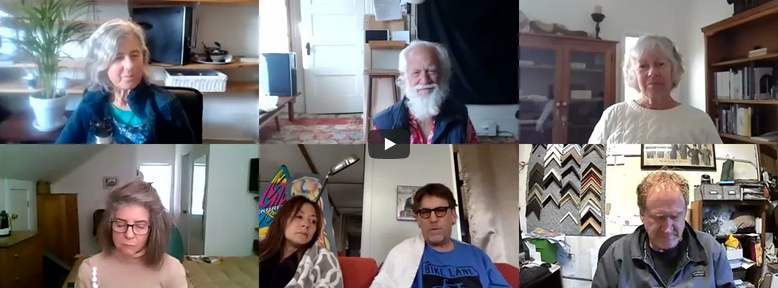
https://youtu.be/pEkK6oHT9Kk is the link to the Zoom video of this month’s Sunday meeting. The shorter first part of the meeting begins with a chapter reading followed by attendees’ commentary, if any. A little later on begins the longer open discussion part of the meeting when those who wish to discuss how the chapter relates to their personal experience.
Corrections?
None this time.
Reflections:
With great resentment must exist lingering resentment.
Such peace, passable, serves perfectly.
With great resentment must exist lingering resentment reminds us that nature discards not one thing. All extremes exist, and so resentment must include lingering resentment. It is an acceptance of reality in contrast to the ideality trap we are often ensnarled within. Stress becomes inevitable whenever we buy into any story of perfection, like the idea that it is possible to ‘choose’ to let go of lingering resentment, self-blame or regret. Such peace, passable, serves perfectly makes it clear that in the real world, lingering resentment is natural and unavoidable. Two paths arise from this de facto reality, as it were. One uses kindness to blunt any lingering resentment, the other just succumbs to the negative emotion, often seeking “justice”.
That is because the wise person holds this queer contract,
Yet doesn’t punish the people.
This describes the utility of empathy and kindness in the face of resentment. The wise person can’t help but feel lingering resentment at times, but is able to avoid having those emotions drive him/her to punish the people associated with the resentment. To hold both emotions—kindness and resentment— simultaneously is what make this [a] queer contract.
Emotions tend to run away with themselves. Thus, when feeling resentment, it is easy—“delicious” even—when such emotions consume awareness. Conversely, feeling kindness easily pushes emotion to the other extreme—benevolence. Extremes of resentment or kindness are both stressful, and left unchecked lead to unintended consequences. Staying in the balanced middle between these extremes is a tall order. Note how chapter 5 depicts the problematic side of benevolence…
The reference to ‘sacrificial lambs’ correlates with respect. Respecting the diverse and uneven nature of all creation is impossible when one is bestowing favor on any aspect of creation. As D.C. Lau translates, It is the way of heaven to show no favoritism. Clearly, showing favoritism sets up the emotional conditions for resentment, lingering or otherwise.
How can a person hold this queer contract of feeling kindness on one hand and yet harbor the lingering resentments that accompany everyone through life somewhat?
It can help to consider the cause of resentment first, and then how other animals deal with it. First, resentment is a natural result of not getting what one wants. In non-thinking animals, resentment is felt in the moment but soon passes as this moment passes on to the next. In humans, resentment emotions easily feed into a story that lingers in memory. Subsequent dwelling upon the story reignites the resentment emotions. This process can easily span generations as the story becomes part of a cultural narrative (e.g., Jews and Arabs vis-à-vis their claims to land).
Comparing humans to all other animals on Earth reveals the principle reason for our difficulty. Chapter 71 lays this out clearly, Realizing I don’t’ know is better; not knowing this knowing is disease. We believe what we think. This naive trust we have in our beliefs becomes the very proof of the belief itself. Our very self-identity and ego soon becomes entwined with our belief. This is a uniquely human disease.
Examined more closely, I can see how this trust in words begins in infancy as we begin to learn our native tongue. We can’t help but place trust in the meaning of the words we learn to use to communicate, both externally with others and internally with our selves. Placing such absolute trust in names and words unconsciously locks us into any story that garners our belief. In the end, we place more trust in our words and thoughts than in nature’s messy landscape—and hence our disease.
Chapter 56 suggests one way out of this word trap…
The word-trust problem begins with our innate bias on the side of differences over similarities. Differences feel more real, which in the wild would be a survival advantage, i.e., “Is that long narrow thing as stick or a snake?” It is safer to note the difference! However, that bias causes a persistence state of cognitive imbalance in us thinking animals. Overall, profound sameness strikes closer to the reality of nature. The clear difficulty for us lies in how deeply the perceptions of difference hold us. Simply put: words are creations of perceptual difference (hot vs. cold, old vs. new, open vs. closed, etc.), and when we build our beliefs out of words, the trust in differences become part and parcel of our beliefs.
The only way I find to mitigate this trust in word and thought is to challenge it at every turn… “Is it really hot? How hot? How cold? Truly cold, or just cool, or cooler than before?” Any way I can discount the certainty of word-meaning helps to Squeeze exchange, shut the gates, Subdue its sharpness, untie its tangles, Soften its brightness, be the same as dust. This is the prerequisite for perceiving profound sameness. See Tools of Taoist Thought: Correlations for a way to un-learn our deep trust in word meaning.
Having kindness takes charge of the contract,
Not having kindness takes charge of the penetration.
Simultaneously retaining a sense of kindness and lingering resentment I can take charge of the contract. Without kindness, I get drawn into acting upon my lingering resentment and naturally take charge of the penetration, which usually takes some form of passive aggression. Or I can internalize the whole issue, which means the penetration simply becomes me dwelling on the resentment. And this eats away at me as long as I trust my story.
Nature’s way is without match,
Constantly helping the charitable person.
I suppose this constantly helping the charitable person is another way of saying, “Kindness is its own reward”. Holding onto resentment, hate, and anger seems to come naturally, and as compelling as the emotions of want and worry (i.e., need and fear). Perhaps resentment is the result of the fear of not getting what you need! For non-thinking animals, any such emotional reaction subsides as soon as the conditions that triggered it end. For us, thought dwells on the event causing the resentment, which keeps us spiraling down into lingering resentment by re-triggering the initial emotion. (See Fear & Need Born in Nothing)
One major error we make in life that gives resentment such lasting power is our belief in free will. We are certain we and others have the power to choose our course of action. What we easily fail to realize is that the choices we make are driven by deep-seated needs and fears, of which we have no control over. I imagine that is very hard to accept, for we so desperately need to have the sense that we are in control. Trust in that story alone is enough to ensure one becoming entangled in a web of lingering resentment. (See Free Will: Fact or Wishful Thinking? and Belief: Are We Just Fooling Ourselves?)
Chapter Archive https://youtu.be/OjggoO8Rqs4
This is the complete video. It begins with blowing Zen followed by the meeting
Third Pass: Chapter of the Month
Corrections?
I finally broke the no corrections streak. I need to add an “s” to take.
Reflections:
There are two parts to my Reflections today. In the first part, I take a close look at how D.C. Lau’s choice of translation words compares to the literal Chinese. In part two, I poke into a key term ( qì 契 ) used in this chapter — Tally as D.C. Lau puts it, or Contract as I put it. Not surprisingly, neither word does nature justice. These connote a physical object or result, but the natural processes underpinning this are more fluid and plumb much deeper.
This is a central problem with language; it is not adequate in portraying nature qualitatively beyond a few thousand adjectives and adverbs (a ‘handful’). As a result, this becomes more the domain of art and religion. What makes the Tao Te Ching unique in my view is how well it uses language to portray nature qualitatively. Beginning as it does with its disclaimer in chapter one only adds to its legitimacy:
(By the way, art and religion are inadequate in portraying nature quantitatively; I’d say that is the domain of science and engineering.)
D.C. Lau vs. Word for Word
Translations of this chapter including D.C. Lau’s have always bothered me somewhat. Not that D.C. Lau’s translation is wrong; it is just too narrow in scope, in my view. A close look at the more literal rendition in Word for Word solves that, at least for me. I imagine his reason for narrowing the scope was to make it more palatable. That makes sense if you wish to reach more people. ‘Fortunately’ I don’t care about that; all I want is to translate it as close to the literal as possible. I’ve found that holds more depth in the long-term. This is why I suggest using whatever favorite translation you use along side the literal Word for Word. That way, you can have your cake and eat it too. 😉
In the following comparison, I give D.C. Lau’s translation first, next my reflections, then my attempt at a more literal rendition. Finally, at the bottom of the page, you can inspect the actual characters, their translation along with their main synonyms. This is most important to gain the deepest insight.
Lines 1 – 4
It is much farther reaching than simply great enemies. Certainly, there is great resentment toward enemies, but resentment doesn’t end there. How about the resentment that lies in losing that which you cherish? The greatness of which hinges on the degree it is cherished. What is a great enemy but a threat to what you cherish dearly? As long as one holds on to anything, resentment always waits in the wings to rear its angry head when the inevitable loss arrives, as it always does… entropy is eternal.
The process of nature is an ebb and flow, from gain to loss to gain to loss… and so on. Peace is not the end of this process, but rather a cognitive acceptance of nature’s process: war & peace; success & failure; life & death; joy & sorrow… perfect & faulty… and so on. Buddha’s 8th Step parallels this with his “Right State of Peaceful Mind”. The only true perfect in this process is the faulty that it accommodates. If this feels odd, see Straight and honest words seem inside out and what is called profound sameness.
D.C. Lau’s wording helps make this sound like some form of permanent peace arrives eventually, after the enmity is finally dispelled. For me, the literal Such peace, passable, serves perfectly is less prone to that subtext, and points more toward Buddha’s “Right State of Peaceful Mind”.
1) With great resentment must exist lingering resentment.
2) Such peace, passable, serves perfectly.
3) That is because the wise person holds this queer contract,
4) Yet doesn’t punish the people.
Lines 5, 6
The man of virtue takes charge of the tally;
The man of no virtue takes charge of exaction.
The main issue I take here is with the phrase, man of virtue. The problem is that the word virtue is just too vague in meaning, too broad somehow. This is due in part to the Western culture’s contextual meanings it carries. Kindness is much more specific, and actually conveys something that is easy to relate to in daily life. We all know when we encounter kind folks, or when we ourselves lack kindness. I don’t feel the same can be said about virtue.
5) Having kindness takes charge of the contract,
6) Not having kindness takes charge of the penetration.
Lines 7, 8
It is the way of heaven to show no favoritism.
It is forever on the side of the good man.
The good man carries the same issues for me as does the man of virtue. Both terms are too fuzzy, and don’t really say much.
In addition, calling something good only reflects the preferences of the observer. It is a circular definition, i.e., “I like what is good; good is what I like”. This is just sloppy circular thinking.
Other definitions for the characters D.C. Lau translates as good man (善人) are “philanthropist; charitable person; well doer, virtuous person, kind person”. Some of these offer more definition, especially charitable and kind person. These say something deeper about the behavior of people… and of us personally.
7) Nature’s way is without match,
8) Constantly helping the charitable person.
~~~Additional Commentary~~~
The Contract a.k.a. engrave; carve; deed; agree; get along well
I would have used the primary meaning ‘engrave’ or ‘carve’ instead of contract, but that would have really been hard to relate to as a reader without a deeper explanation. That would just end up turning the chapter away from whatever poetry I’ve managed to lay down. Besides, there would be no guarantee that an explanation would work anyway. Nevertheless, here goes nothing…
Consider these lines, 3 and 5:
That is because the wise person holds this queer contract,
Having kindness takes charge of the contract,
The contract that nature engraves within her domain is the process of ebb and flow depicted in the yang / yin symbol. There is no preference given — no favoritism — as who accrues what degree of either side. In society, impartial people having no personal agenda are ideally in charge of contracts — judges and priests come to mind. Alas, you can’t judge a book by its cover… or the robes worn.
Having kindness is the deeper quality of character that permits one to engage with nature’s process more impartially than a person who ‘needs’ or ‘fears’ something. Both of these emotions work to bias one to favor one side or the other, and so feeling them means that one is in no position to hold this queer contract — the way of nature overshadows any agenda (a.k.a., biases).
Next, consider the last two lines:
Nature’s way is without match,
Constantly helping the charitable person.
You might wonder whether nature herself isn’t being biased by Constantly helping the charitable person. Nature isn’t personal in this. In other words, as part of the natural process, kindness is its own reward. It feels pleasant and peaceful, whereas, cruelty feels painful and stressful. Indeed, that is the upshot of all desire. The pain of desire, and its cousin worry, drives us to ‘fix’ the situation. Such fixing means pressing our own agenda to a satisfactory conclusion, as we perceive it. In the dynamics of this ‘fixing’ one is often cruel in the process of pressing the ‘fix’ to its conclusion.
Now, this is a lot easier to understand when considered from a symptoms point of view. Kindness and charitable attitudes spring from one who feels content and impartial. Such a person can afford to be genuinely kind and charitable. Such true kindness is more likely to be anonymous with the quality of wéi wú wéi — doing without doing (为无为). Cruelty on the other hand springs forth from one who feels discontent and biased.
I’ve just scratched the surface and look at all the words… and the lack of poetry… and does it make any sense, or have I just moved words around? Okay, I’ll quit while I’m ‘ahead’.
Second Pass: Work in Progress
Issues:
I made some minor changes this time, swapping synonyms I guess you could say. I don’t know if they really qualify as true synonyms though. More likely, it is the difference in character meaning depending on context. In my admittedly unorthodox approach, I seek to find the best word that parallels my ‘taoist’ knowing. Now, doesn’t that sounds. Nevertheless, knowing comes first, then so called understanding… the words and thoughts. Now to the damage I did today…
On line 2, I translated Shàn (善) as satisfactory. It also means: good; make a success of; perfect; kind; friendly; be good at; be expert in; be adept in; properly; be apt to. Satisfactory can imply that perhaps it could be better, which is what I haven’t found to be the case in nature. Sure, I can imagine a ‘better’ outcome, but nature’s outcome in my view is perfect. So, I changed line 2 to read: Such peace, passable, serves perfectly. Notice I dropped the words and different? That is because some how they crept in… probably in the middle of the night.
On line 3, I translated zuǒ (左) as different. Now, I don’t feel that conveys the feeling well enough. Zuǒ also means: the left side; the left; east; the Left; queer; unorthodox; heretical; wrong; incorrect; contrary; opposite. Obviously, the cultural aversion to ‘left’ spans East and West. As handedness is genetic, I expect there is a universal bias against left. Here, I see this referring to the queer feelings that linger even after peace is restored.
On line 8, I’m changing the word kind person to charitable person. The actual Chinese is Shànrén (善人) which is a two-character word made up from Shàn (善) in line 2 above, and rén (人) which means person. Now a days, this translates as philanthropist, charitable person, well doer. I don’t know… they all sound fine to me. I also like well doer. The implication of giving without ulterior motive is the focus, as I see it. There are a few issues regarding the original Chinese versions, and this chapter exemplifies them. For example, some Chinese versions of chapter 79 have the following line inserted right after line 1 (and before line 2): Reply to resentment using kindness, (报怨以德). I like it; it rings of Christ’s courageous suggestion to “turn the other cheek”. Another oddity occurs in the Mawangdui text (the oldest versions, ‘A’ and ‘B’, 168 BC). After line 1, instead of line 2, we see, how can serve perfectly (焉可以为善). All the characters are the same here except for peace (安) which is omitted and replace by how (焉). That’s not all. Version ‘A’ has: the wise person, the right, situated between (圣右介); version ‘B’ has: the wise person holding the left mustard (圣人执左芥).
Needless to say, I’m sticking with what I have. There is no way to figure out objectively what’s going on. Perhaps the scribe dozed off. Besides, this is way back when… a few thousand years ago. Heck, we have great trouble figuring out what is going on currently. I figure we’re lucky to have as straightforward original(s) as we do.
In any case, the actual differences are trifling, because you can pretty much interpret it any way you want. That is the beauty and the curse of rational thought. As I’ve said repeatedly, my view is that we only understand what we know. Chuang Tzu eludes to this stark truth in The Writings of Chuang Tzu (see No. 13 The Way of Heaven, page 49, #10) in his conversation with the Duke Hwan, “what you, my Ruler, are reading are only the dregs and sediments of those old men.”
Commentary:
I’ve had to translate this chapter, more than most, by my own gut sense of ‘taoist’ reality. That means keeping consistent with the context of the Tao Te Ching as a whole. The natural reality is that, With great resentment must exist lingering resentment. The ‘can’t we all just get along’ ideal is just that, an ideal. The reality is, we can’t; it’s not natural in any deep and permanent way. To paraphrase chapter 2, Hence war and peace give birth to each other. Thus, Such peace, passable, serves perfectly. Chapter 45 hints at this too, Great accomplishment seems incomplete, its use doesn’t harm.
It follows that only the wise person [can] hold this queer contract and not punish the people. Those of us not having kindness take charge of the penetration (anger and settling of scores). Finally, Nature’s way is without match… Constantly helping the charitable person, or to put is more simply, ‘kindness is its own reward’. To me, the charitable person, is a giving person, although not material giving by any means. For example, I see compassion as a much deeper mode of giving. Science backs up the way nature is constantly helping the charitable person… or animal. A few tangential examples may be, A Brother is a Brother, Why God?, and Wandering Mind Is Unhappy Mind.
Suggested Revision:
With great resentment must exist lingering resentment.
Such peace, passable, serves perfectly
That is because the wise person holds this queer contract,
Yet doesn’t punish the people.
Having kindness takes charge of the contract,
Not having kindness take charge of the penetration.
Nature’s way is without match.
Constantly helping the charitable person.
First Pass: Chapter of the Week
I’ve always had an issue with the way D.C. Lau’s translated the end of this chapter: It is the way of heaven to show no favoritism. It is forever on the side of the good man. How can nature on one hand “show no favoritism” and on the other hand “be on the side of the good man”?
One of the Chinese characters involved here helps me resolve this. This character, shan (善) means: satisfactory; good; make a success of; perfect; kind; friendly; be adept in; properly. This word, shan, is the “good” at the end of this chapter. It is also the “perfect” at the beginning of the chapter (i.e. How can this be considered perfect?).
My difficulty comes from having this translated as “good” or “perfect”. As I see it, there is no “bad” or “imperfect” in nature. We are so partaking of the ‘Tai Lao’ offering in our notions of ‘good and bad‘. Good and bad are human values which simply mirror what we generally like and dislike, and our preferences for comfort and security, e.g., we dislike death, it’s “bad”; we like life, it’s “good”.
This inconsistency clears right up when I use some of the other meanings of shan, i.e., satisfactory, be adept in, make a success of… are all preferable to perfect and good. Nature is adept in all she does. Nature makes a success of all she does. Nature is always satisfactory. Nature is always on the side of adeptness; after all, that is evolution, plain and simple.
As to nature showing no favoritism, favoritism has nothing to do with being adept. Favoritism is giving your son the job even though he is not adept. Ulterior motives drive favoritism. Nature has no ulterior motives, which I can see anyway.
The wise person is the one not driven by their agenda (desires, needs, fears), so it takes a lot more to trigger their fairness instinct. It is much easier to be impartial, and not punish people or exact ‘fairness’ when you have little thought of self and as few desires as possible.