Translation
Small country, few people.
Enable the existence of various tools, yet never need them.
Enable the people attach importance to death, yet not travel around.
Although there exists boats and carriages, there is no place to ride them.
Although there exists weapons, there is no place to deploy them.
Enable the people to again use the knotted rope.
Find their food sweet, their clothes beautiful.
Peaceful in their lives, happy in their customs.
Neighboring countries mutually seen in the distance,
Of chicken and dog sounds mutually heard.
People until death not mutually come and go.
1) small (little; minor) country (state, nation) few (scant; tasteless; widowed) people. 小国寡民。(xiăo guó guă mín.)
2) send (employ; enable) have (exist) assorted (varied, miscellaneous; ten) eldest brother (uncle) of tool (ware; capacity) <conj.> and (yet, but) not need. 使有什伯之器而不用。(shĭ yŏu shén bó zhī qì ér bù yòng.)
3) send (employ; enable) people heavy (important; value; deep; heavy; attach importance to) death <conj.> and (yet, but) no (not) far (distant) move from one place to another. 使民重死而不远徙。(shĭ mín chóng sĭ ér bù yuăn xĭ.)
4) although have (exist) boat carriage (territory; public) nil (without) place ride (take advantage of <frml> multiply) of. 虽有舟舆无所乘之。(suī yŏu zhōu yú wú suŏ chéng zhī.)
5) although have (exist) first (armor) weapons nil (without) place lay out (put on display) of. 虽有甲兵无所陈之。(suī yŏu jiă bīng wú suŏ chén zhī.)
6) send (employ; enable) people duplicate (recover; resume; again) tie (knit; knot) rope <conj.> and (yet, but) use of. 使民复结绳而用之。(shĭ mín fù jiē shéng ér yòng zhī.)
7) sweet their food, beautiful (good) their clothes (dress). 甘其食、美其服、(gān qí shí, mĕi qí fú,)
8) peaceful (quiet; tranquil; calm) their dwell (live, residence), happy (enjoy) their custom (convention; common; secular). 安其居、乐其俗。(ān qí jū, lè qí sú.)
9) neighbor (neighboring; near; adjacent) country (state, nation) each other (mutually) gaze into the distance (look over; call on; visit), 邻国相望,(lín guó xiāng wàng,)
10) chicken dog of sound (voice; make a sound) each other (mutually) hear (news; story; well-known). 鸡犬之声相闻。(jī quăn zhī shēng xiāng wén.)
11) people to (until; extremely; most) old (of long standing; tough; always) die (extremely; implacable) no (not) each other (mutually) come and go (contact; dealings; intercourse). 民至老死不相往来。(mín zhì lăo sĭ bù xiāng wăng lái.)
Fourth Pass: Chapter of the Month
(pandemic era)
Zoom on YouTube Recordings:
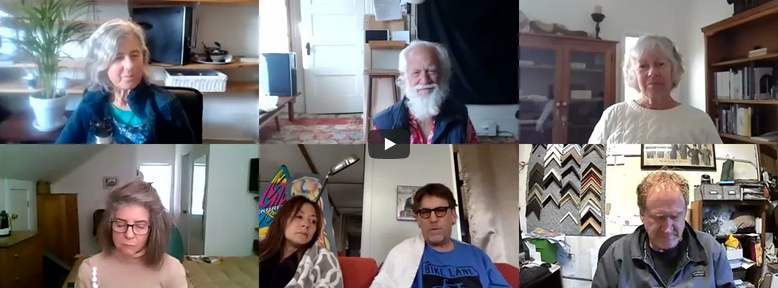
https://youtu.be/VzgRtG7EZyE is the link to the Zoom video of this month’s Sunday meeting. The shorter first part of the meeting begins with a chapter reading followed by attendees’ commentary, if any. A little later on begins the longer open discussion part of the meeting when those who wish to discuss how the chapter relates to their personal experience.
Corrections?
None this time.
Reflections:
Small country, few people.
Enable the existence of various tools, yet never need them.
Enable the people attach importance to death, yet not travel around.
I believe I’ve always interpreted this chapter to be a recommendation for how to fix humanity’s problem. For example, when it says Enable the existence of various tools, yet never need them sounds like something someone in charge of people should Enable. Seen as such, this always felt to be an unrealistic ideal that would be impossible to implement, although, I suppose if the situation was Small country, few people some of the suggestions that follow might be achievable to a limited degree. Still, it comes across as just too pie in the sky. Isn’t the power over people (society) what religion and politics always attempts to do… and always fails in the end?
Today I see this as offering a much more realistic and practical way to resolve our personal difficulty rather than some society-wide solution. Here, the suggestion to Enable the existence of various tools, yet never need them would mean for me personally to take inventory of my life, and at least question why I am drawn to using various tools.
Enable the people attach importance to death, yet not travel around still feels a bit odd. Enabling [my self to] attach importance to death has always helped me broaden my perspective. Indeed, it is the contrast between life and death that makes life a more vivid, albeit mysterious, experience. That is certainly one sobering benefit of a close call with death. Unfortunately, that effect wears off all too quickly.
The odd part of this is the yet not travel around aspect. However, I do notice that the more fully engaged with life I feel, the less push I feel to travel around. I assume travel around affords some promise of enhanced life meaning. When I’m fully engaged in the ‘here and now’, the need for life meaning is satisfied.
Here though, it seems to imply that attaching importance to death creates an itch to travel around. Perhaps this is referring to FOMO (the ‘Fear Of Missing Out’). Such fear might result from a keen awareness of one’s mortality.
Although there exists boats and carriages, there is no place to ride them.
Although there exists weapons, there is no place to deploy them.
Enable the people to again use the knotted rope.
Find their food sweet, their clothes beautiful.
Peaceful in their lives, happy in their customs.
Although there exists boats and carriages, there is no place to ride them follows the same line of thought that I commented on above. These suggestions can either be seen as an idealistic prescription for action on the part of some great ruler, or more realistically, as a way of pondering one’s own approach to life.
The opportunities to act using technology— boats, carriages, weapons… and you name it—all depend on one essential factor—motivation. Need and fear drive us to leave a ‘so-so here’ to go to a ‘better there’. New technologies arise to outperform old technologies, i.e., the computer works better than the abacus, the abacus works better than the knotted rope.
The question to ponder is this: was the person using the knotted rope any more content than the person later on using the abacus, or more content than the person even much later using the computer? Most of what technology does is enable us to get a task done faster, which then frees up time to tackle another task sooner. Yet, does the ability to increase the rate of getting things done in life make for a better or happier life? This is the false promise of all progress really. Yes, times change, but the eternal moment does not. The more we chase after ‘next’ the less presence of mind we have for ‘now’. Chapter 2 implies this more peaceful pace of life, Considering this, the wise person manages without doing anything. And chapter 48 brings it home…
In pondering ‘next’ versus ‘now’ it is intuitively obvious that contentment and happiness can only exist in ‘now’… never in ‘next’. The only thing ‘next’ promises is the possibility of a happier moment later on when ‘next’ comes to pass. The irony here is that when ‘next’ comes to pass, ‘now’ takes its place, followed by a yearning for the next ‘next’. It is a vicious cycle ruling our life until we take a deeper inventory of what actually makes life meaningful. If we seek progress and improvement, the journey never ends. Conversely, if we seek integrity and appreciation, the journey turns back on itself. As chapter 16 says, Returning to the root cause is called stillness; this means answering to one’s destiny. And again in chapter 40, In the opposite direction, of the way moves.
Neighboring countries mutually seen in the distance,
Of chicken and dog sounds mutually heard.
People until death not mutually come and go.
I feel much of this chapter describes the subjective process of aging. Indeed, my new and more inward way of seeing this chapter is happening as I experience my 81st year. I am becoming Lao Tzu, as will most people approaching the end of life, at least subconsciously. Only through traveling this journey for a while can one see the forest amidst the trees. Naturally, as with everything in nature, this conforms to a bell curve of sorts—some see deeper sooner; some see deeper later. However, the trajectory for all living things follows this path. To grasp this intuitively, simply ponder ‘the young puppy versus the old dog’ reality.
Chapter Archive https://youtu.be/GAD9IAc–js
This is the complete video. It begins with blowing Zen followed by the meeting
Third Pass: Chapter of the Month
Corrections?
All seems well this time around (:>)
Reflections:
This chapter harkens back to humanity’s old way (1), before the Agricultural Revolution brought about civilization. I’ve found that very few people appear to appreciate the extensive period of humanity’s prehistory. This goes back some hundred’s of thousands of years for our particular hominid branch, but some millions of years for bipedal tool making hominids overall.
We are generally quite ignorant of this era, even though it is the overwhelming reality of humanity’s existence. A solid familiarity with our prehistory offers invaluable insight. After all, prehistory is where our genetic makeup evolved and took shape, and shapes our reaction to this day. Knowing our prehistoric reality gives context to the issues of today.
The instinctive base that shapes our reactions today evolved under the very different circumstances of the old ways. Therefore, it is not surprising that we have such trouble managing current human affairs. Yet, people always seem somewhat baffled when ‘evil’ strikes. Any bewilderment I’ve experienced over this largely dissipated once I began to realize the systemic causes.
It is no coincidence that the Tao Te Ching also recognizes these systemic causes: thought (words and names) and civilization, to which this chapter speaks. These causes are nearly self-evident, based on common sense reasoning and observation, and yet so unrecognized and unappreciated. Why? Probably because they don’t lend themselves to being use as scapegoats or as a route to quick fix illusions.
Remember, the Agricultural Revolution of merely ten thousand years ago kicked off civilized existence… and all the problems that come with our struggle to manage its unintended consequences. The fact that all the sophisticated religions of civilization arise out of civilization is no coincidence either, but rather a symptom of our struggle to cope with the consequences. In other words, humans didn’t all of a sudden become a more brilliant animal and progress to civilization. Civilization is an adaptive process put together over time to deal with the difficulties of organizing large populations needed to manage agriculture. Seen within that context, the imperfections of modern life make total sense.
It is not that we are actually going to ever Enable the people to again use the knotted rope, or the rest. That train has left the station. Evolution, both genetic and cultural continues onward. The value of looking back to our stable and extensive prehistory lies in how well this answers questions about modern issues (2). Of course, this works best if surveyed from a symptom’s point of view (See Symptoms Point Of View). That means, (1) identify an issue, and (2) see how the loss of the old way makes the current issue inevitable.
Now, this doesn’t mean we need throw up our hand and sigh in despair! The benefit lies in knowing a truer cause of the problem. Knowing the truer cause means that whatever remedial measures we take will less likely to be ‘blind shots in the dark’. Much of what we do now is respond emotionally, swinging from one extreme ‘cure’ to another. Ignorance is not bliss when it comes to managing serious problems that plague our lives!
(1) See my series of posts Who are you? for background. Also, see The !Kung of Nyae Nyae, The Harmless People and The old way: a story of the first people for more specific research on the hunter-gatherer way of life.
(2) Why for example did the nightclub shooter Omar Mateen kill those people in Orlando? That is what I hear people are having a lot of trouble understanding, in depth anyway. The answer is obvious once you consider the shooter from a symptom’s point of view and seen in an ancestral context. This also provides insight into the raison d’être that drives young disconnected males (mostly) to eagerly join ‘tribal’ groups — terrorist or otherwise. Any solution, as muddled as it may be, hinges upon knowing these deeper causes… period!
Second Pass: Work in Progress
Issues:
It always amazes me to see how easy it is to overlook the obvious. Frankly though, nothing is truly obvious. I mean, seeing one thing in the midst of Everything is like seeing that needle in the haystack. In this chapter, I found that needle in line 11. Somehow, an extra lái (来… come; arrive; take place; future; next) crept in. I also neglected to recognize the dual character word wǎnglái (往来… come and go; contact; dealings; intercourse) and treated them as separate characters which made for a more awkward reading. Finally, the ‘stupid’ spell checker doesn’t know “their” from “there”. Of course, it has an excuse; I have none.
Commentary:
This chapter is straightforward. Whether or not it hints at some distant future is the question I enjoy pondering. I think it does, but only very distant… within the next 10,000 years perhaps? It is not that anyone can or will bring this about; it will be the consequence of the human population surpassing a median age well over 100 years old (thanks to future medical breakthroughs), and a much lower world population. So low, if fact, government will subsidize parents having children. That my guess, and that’s my commentary.
Next, I was looking for the correct word for ‘dual character’ Chinese words and Google stumbled me into this: On the dual characters of Chinese traditional thinking modes and difficulty of changing them.
It succinctly addresses a noticeable difference in the way East and West view reality. Also, just look at all the citations these authors used. My word, the attention to detail it takes to be an academic. Detail on the one hand, the big picture on the other hand. The ‘middle way’ compromise approach (described below) is the only way I’ve found to make the best of both worlds. So, I certainly owe a debt of gratitude to the academics.
I’ll paste the Abstract here. It paints the picture well enough that I didn’t bother figuring out how to get the rest of the article. If anyone does, however, post a link to it, if possible.
Culture, dialectics, and reasoning about contradiction
by Kaiping Peng, Richard E. Nisbett – American Psychologist , 1999
Chinese ways of dealing with seeming contradictions result in a dialectical or compromise approach—retaining basic elements of opposing perspectives by seeking a “middle way.” European-American ways, on the other hand, deriving from a lay version of Aristotelian logic, result in a differentiation model that polarizes contradictory perspectives in an effort to determine which fact or position is correct. Empirical studies showed that dialectical thinking is a form of folk wisdom in Chinese culture: Chinese preferred dialectical proverbs containing seeming contradictions more than did Americans. Chinese were also found to prefer dialectical resolutions to social conflicts, and to prefer dialectical arguments over classical Western logical arguments.
Furthermore, when two apparently contradictory propositions were presented, Americans polarized their views and Chinese were moderately accepting of both propositions. Origins of these cultural differences and their implications for human reasoning in general are discussed.
Consider the following statements about recent scientific discoveries: Statement A. Two mathematicians have discovered that the activities of a butterfly in Beijing, China, noticeably affect the temperature in the San Francisco Bay Area. Statement B. Two meteorologists have found that the activities of a local butterfly in the San Francisco Bay Area have nothing to do with temperature changes in the same San Francisco Bay Area. What would be your intuitive reaction to these statements? Do you see an implicit contradiction between the two pieces of information? What strategy would you use to deal with such contradictions? What is the rationale for using such a strategy? Does your cultural background affect your reasoning and judgments about contradicti…
Suggested Revision:
Small country, few people.
Enable the existence of various tools, yet never need them.
Enable the people attach importance to death, yet not travel around.
Although there exists boats and carriages, there is no place to ride them.
Although there exists weapons, there is no place to deploy them.
Enable the people to again use the knotted rope.
Find their food sweet, their clothes beautiful.
Peaceful in their lives, happy in their customs.
Neighboring states mutually seen in the distance,
Of chicken and dog sounds mutually heard.
People until death not mutually come and go.
First Pass: Chapter of the Week
Bring it about that the people will return to the use of the knotted rope sure puts a free will slant on this chapter. And how in the heck is one supposed to ensure they will not use tools of war? The Chinese word for “bring it about” and “ensure” as used here is shi (使) which translates as: send; tell somebody to do something; use; employ; apply; make; cause; enable; envoy; messenger; if; supposing. That is quite a string of meanings, with some conveying a stronger sense of free will than others, although none as strongly as “ensure” does, I suppose.
Making or causing someone to feel content is a tall order. Societies have struggled to do that for ages. That is one of the goals of religion, although without great success, as I see it. Truth be told, isn’t religion merely a symptom of feeling disconnected and the unhappiness that causes. This endemic sense of disconnection is a byproduct of civilization and thinking, and religion is the palliative civilization and thinking creates to treats that symptom. My, what a clear example of how Nature balances herself in straightforward ways, if I do say so myself.
Chapter 33 says, He who knows contentment is rich. I dare say it would be far, far easier to make or cause a person to become rich money-wise than contentment-wise. At best, a better phrasing here might be ‘help the people‘. To be fair, religion does supply some helpful tools (prayer, meditation, devotional rites, etc.), but it is up to the individual ‘craftsman’ (us individually) to use them religiously. Hah! That sounds like a catch-22 (i.e., a no-win, double bind situation).
This chapter makes more sense to me if seen as a commentary on what makes life run smooth. These tips are really symptoms of personal contentment. The more content I feel, the more peaceful in my life, and happy in my customs. Travel is always a symptom of some degree of discontent. Even a trip to the toilet arises out of physical discontent. Thirst and hunger are similar symptoms of elemental discontent, and evoke the need to travel somewhere for food and water. In ancient hunger-gatherer times that would amount to scrounging around until the need was satiated and contentment returned. Now a days for many that amounts to just a short trip to the kitchen.
So, what happens with all the extra free time and energy civilized living affords me? Various desires, stemming from elemental need, arise to fill the void (1). The only way I can enable the existence of various tools, yet never need them is by acknowledging the need I feel, yet forgoing the impulse to satiate it impulsively (if at all). Feel it, but cease to act upon it. This is an aspect of action-less action, (为无为 act without act) spoken of in chapter 3. D.C. Lau translated this as: Do that which consists in taking no action, and order will prevail.
(1) It is empty without being exhausted brings to my mind an interesting thought: When one reaches a point approaching full contentment, biological dynamics stir and spawn elemental need. That restlessness gets us off our butts and on to the next ‘project’. Naturally it is not only us; this must be true for all life! Within us, however, need whips up imagination and voilà… a fresh batch of desires are born (i.e., need + thinking = desire).