Translation
True speech isn’t beautiful,
Beautiful speech isn’t true.
Expertise doesn’t debate,
Debate isn’t expertise.
Knowing isn’t wealth,
Wealth doesn’t know.
The holy person doesn’t accumulate.
Already, considers people’s personal healing his own.
Already, so as to support people’s personal healing more.
Nature’s way benefits, and yet doesn’t harm.
The holy person’s way acts, and yet doesn’t contend.
1) true (trust; word) speech (word) no (not) beautiful (pretty; good). 信言不美。(xìn yán bù mĕi.)
2) beautiful (pretty; good) speech (word) no (not) true (trust; word). 美言不信。(mĕi yán bù xìn.)
3) good (kind; be expert in; be adept in) (者) no (not) argue (dispute; debate). 善者不辩。(shàn zhĕ bù biàn.)
4) argue (dispute; debate) (者) no (not) good (kind; be expert in; be adept in). 辩者不善。(biàn zhĕ bù shàn.)
5) know (realize; be aware of) (者) no (not) rich (abundant; plentiful; win; gain). 知者不博。(zhī zhĕ bù bó.)
6) rich (abundant; plentiful; win; gain) (者) no (not) know (realize; be aware of). 博者不知。(bó zhĕ bù zhī.)
7) sage (holy; sacred) human (man; people) (者) no (not) amass (store up; accumulate). 圣人不积。(shèng rén bù jī.)
8) already (<conj.> since; both… and…) think (consider) human (man; people) oneself (personal) heal (recover; become; well; better) have (exist). 既以为人己愈有。(jì yĭ wéi rén jĭ yù yŏu.)
9) already (<conj.> since; both… and…) use (<v> take <p> according to; because of <adj> so as to <conj> and) <conj.> give (get along with; support <conj.> and; together with) human (man; people) oneself (personal) heal (recover; become; well; better) more (excessive). 既以与人己愈多。(jì yĭ yú rén jĭ yù duō.)
10) sky (heaven; weather; nature) of way sharp (benefit, advantage, profit) <conj.> and (yet, but) no (not) evil (harm; destructive). 天之道利而不害。(tiān zhī dào lì ér bù hài.)
11) sage (holy; sacred) human (man; people) of way do (act; serve as; be, mean; support) <conj.> and (yet, but) no (not) contend (argue). 圣人之道为而不争。(shèng rén zhī dào wéi ér bù zhēng.)
Fourth Pass: Chapter of the Month
(pandemic era)
Zoom on YouTube Recordings:
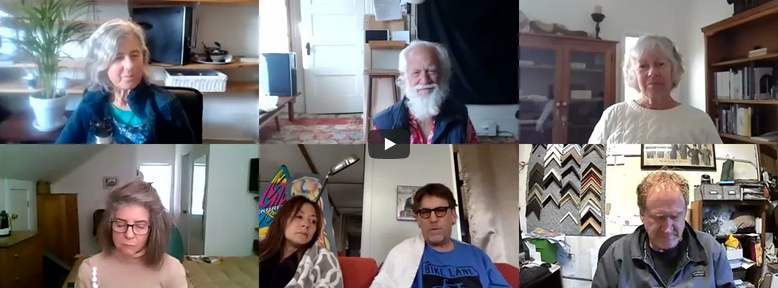
https://youtu.be/COITe243ug8 is the link to the Zoom video of this month’s Sunday meeting. The shorter first part of the meeting begins with a chapter reading followed by attendees’ commentary, if any. A little later on begins the longer open discussion part of the meeting when those who wish to discuss how the chapter relates to their personal experience.
Corrections?
None this time.
Reflections:
True speech isn’t beautiful.
Beautiful speech isn’t true,
These first 6 lines challenge me to contemplate the actual meaning of the words juxtaposed here, i.e., true vs. beautiful; expertise vs. debate; knowing vs. wealth. The unbridled faith we place on word meaning inhibits any deeper cognitive journey we may wish to take. Of course, this faith took root in our earliest childhood, and so it’s not surprising that we take whatever meaning we see in a word as being a kind of object truth outside ourselves. Alas for us, nothing could be further from the truth. Hence, the cognitive disease that chapter 71 outlines.
We innately tend to place more weight on beautiful speech. This is akin to how we also tend to place more importance on body shape, size, age, and so forth. I’d call this a kind of built-in organic bias. This bias certainly would have had an evolutionary benefit for our prehistoric ancestors. Such biases now have a pronounced cultural side, which seems more problematic than beneficial.
True speech often offends or threatens the listener’s own cultural biases. We are deaf to any element of truth that threatens our sacred cows. Simply put, we want out biases supported, not challenged or overturned by any deeper, impartial points of view.
Finally, beautiful requires one to hold an esthetic “reality”, which is essentially oxymoronic. Reality—nature—is neither beautiful nor ugly. Beautiful is simply an emotional bias that pulls us in, and vice versa for ugly. This zero-sum nonsense harkens back to chapter 2…
Expertise doesn’t debate.
Debate isn’t expertise,
Debate occurs between two opposing points of view, like ‘left’ vs. ‘right’. Each side feels they are correct and that truth is on their side, and they will use beautiful speech as a way to persuade. Seen deeper, the energy of debate arises from the insecurity and fear experienced from not intuitively knowing the interconnectedness of all things. As chapter 56 puts it, This is called profound sameness.
The way of nature plays out just the opposite, each side without the need to win, or the fear of losing. Opposing forces compete and what survives from that process is true expertise. I’d call this evolutionary expertise. Expertise is the result of opposing forces coming together and producing an outcome that resolves the conflict. As such, expertise is silent and invisible; silent and invisible especially if one is seeking a particular outcome. Chapter 25 gives us a hint…
In expertise, the process is the sacred vehicle, the result is the perfect death of the process, i.e., nothing more needs to be, nor can be, done. Here, Doing without doing, following without exception rules.
Knowing isn’t wealth.
Wealth doesn’t know,
We innately feel that wealthy people may know something that we don’t, and that is one reason they are wealthy. This is often true, at least on the surface. An insider tip on the stock market can bring wealth, for example. Pondered deeper, I must ask myself what is knowing truly?
Realizing I don’t’ know is better; not knowing this knowing is disease is quite different from the worldly practical type of knowledge knowing. Worldly knowing increases as the wheels of civilization turn… mostly through science and technology, which affords us the tools to deepen our knowledge of all aspects of life. From this worldly knowing, wealth increases. For example, the knowledge and application of electricity has made us all incredibly wealthy. We’ve replaced the human slaves that used fans to cool rich people on hot days with electric fan ‘slaves’ that do the same for us all.
In contrast to such worldly knowing that increases day by day, year by year, century by century, millennia by millennia, is the deeper knowing, the knowing that I don’t know. I expect this can only result through relying less and less on worldly knowing. Chapter 48 seems to point the way…
The holy person doesn’t accumulate.
Already, considers people’s personal healing his own.
Already, so as to support people’s personal healing more.
The holy person doesn’t accumulate parallels Buddha’s 2nd Truth’s “The illusion of self originates and manifests itself in a cleaving to things”, with “things” being both material (stuff), emotional (fears and needs), and conceptual (ideals). The more robust the illusion of self (ego) is, the less able we are to consider people’s personal healing his own. Additionally—and ironically—the stronger the ego, the more likely we will be compelled to act and “help” others with their personal healing rather than simply allowing nature to play out. As the saying goes, “The road to hell is paved with good intentions”. The more we identify personally with something, the more “good” intentions drive our actions.
Nature’s way benefits, and yet doesn’t harm.
The holy person’s way acts, and yet doesn’t contend.
Nature’s way benefits, and yet doesn’t harm can be more deeply understood by contemplating the interconnected meaning of both benefits and harms. On the surface, these feel very different. Of course, that simply reflects one’s own preference for benefit over harm. Similar is our preference for life over death. Considered from just one side of nature’s equation gets us nowhere.
One way I look at this is remember that every benefit and gain I accrue comes with a equal and opposite harm and loss to something out there… and vice versa. Benefit and harm, gain and loss, good and evil, are intertwined sides of the same whole.
However, we’ve evolved to distinguish one separate from the other in a kind of life vs. death framework. We, and perhaps all living creatures, have evolved to notice the hard edges of difference more keenly than the soft edges of similarity. It serves survival well, even if it sets us up with a distorted view of the ‘whole’. In the wild, this functions well as a tool of evolution. Human cognition has turned this natural bias into a knife that cuts off our connection with the cosmic unity of existence. Chapter 56 depicts our predicament nicely…
The Bhagavad Gita 2:28 speaks nicely to the life vs. death side of such profound sameness… “Invisible before birth are all beings and after death invisible again. They are seen between two unseens. Why in this truth find sorrow?”
Chapter 56 goes on to say…
We are innately compelled to ‘open exchange, open the gates, enhance the sharpness, tie the tangles, raise the brightness, and shake off the dust’. Thus, For this reason, Unobtainable yet intimate, and so on down the line. Unobtainable is due to having evolved to survive via a bias favoring the perception of differences. The yet intimate and the rest speak to our being connected at our core to the profound sameness of existence. We feel this, but only as a passive background sense; we can’t act on it.
The holy person’s way acts, and yet doesn’t contend depersonalizes actions that life compels us to take. ‘All-in’ contending only comes about when contending becomes a personal issue, bolstered by the self-righteousness of thought.
The trick is to jump into life, to contend and yet not contend. The Bhagavad Gita speaks to this when Krishna attempts to teach Arjuna that life is action, and that refraining from action is not an option. Note: It may help to interpret word definition loosely. Unlike the Tao Te Ching, the Bhagavad Gita states matters very concretely. Such explicitness about inexplicable matters leads to misunderstanding. In other words, the Bhagavad Gita is written as a very explicit story concerning life and death. Its very explicitness skews the truth. As chapter 1 reminds, The way possible to think, runs counter to the constant way. The name possible to express runs counter to the constant name. Thus, try reading the following verses between the lines…
2:9 When Arjuna the great warrior had thus unburdened his heart. ‘I will not fight Krishna.’ he said, and then fell silent.
2:10 Krishna smiled and spoke to Arjuna there between the two armies the voice of God spoke these words:
KRISHNA
2:11 Thy tears are for those beyond tears; and are thy words of wisdom? The wise grieve not for those who live; and they grieve not for those who die ‑ for life and death shall pass away.
2:12 Because we all have been for all time: I, and thou, and those kings of men. And we all shall be for all time, we all for ever and ever.
2:13 As the Spirit of our mortal body wanders on in childhood, and youth and old age, the Spirit wanders on to a new body: of this the sage has no doubts.
2:14 From the world of the senses, Arjuna, comes heat and comes cold, and pleasure and pain. They come and they go: they are transient. Arise above them, strong soul.
2:15 The man whom these cannot move, whose soul is one, beyond pleasure and pain, is worthy of life in Eternity.
2:16 The unreal never is: the Real never is not. This truth indeed has been seen by those who can see the true.
2:17 Interwoven in his creation, the Spirit is beyond destruction. No one can bring to an end the Spirit which is everlasting.
2:18 For beyond time he dwells in these bodies, though these bodies have an end in their time: but he remains immeasurable immortal. Therefore. great warrior, carry on thy fight.
2:19 If any man thinks he slays, and if another thinks he is slain, neither knows the ways of truth. The Eternal in man cannot kill: the Eternal in man cannot die.
2:20 He is never born, and he never dies. He is in Eternity : he is for evermore. Never‑born and eternal, beyond times gone or to come, he does not die when the body dies.
2:21 When a man knows him as never‑born, everlasting, never changing, beyond all destruction, how can that man kill a man, or cause another to kill?
2:22 As a man leaves an old garment and puts on one that is new, the Spirit leaves his mortal body and then puts on one that is new.
2:23 Weapons cannot hurt the Spirit and fire can never burn him. Untouched is he by drenching waters, untouched is he by parching winds.
2:24 Beyond the power of sword and fire, beyond the power of waters and winds, the Spirit is everlasting, omnipresent, never‑changing, never‑moving, ever One.
2:25 Invisible is he to mortal eyes, beyond thought and beyond change. Know that he is, and cease from sorrow.
2:26 But if he were born again and again, and again and again he were to die, even then, victorious man, cease thou from sorrow.
2:27 For all things born in truth must die, and out of death in truth comes life. Face to face with what must be, cease thou from sorrow.
2:28 Invisible before birth are all beings and after death invisible again. They are seen between two unseens. Why in this truth find sorrow?
Chapter Archive https://youtu.be/YNVQmgHbJaE
This is the complete video. It begins with blowing Zen followed by the meeting
Third Pass: Chapter of the Month
Corrections?
I decided to change the periods to commas in lines 2, 4, & 6 as the preceding line for each is closely related. I had actually overlooked a few of the periods so this corrects two issues.
Next, there are a few terms that you might wish to change (i.e., ‘correct’), even though they are terms with which I am perfectly content… so far. Overall, this exemplifies the value of holding more loosely to word meaning in order to see ‘the big picture’ better. Our steadfast cleaving to word meaning is one way we bolster our illusion of self. As Buddha pointed out, our cleaving to things creates and maintains that ego illusion. Cleaving to particular word meaning is one of those “things”. This explains why chapter 71’s Realizing I don’t’ know is better, delivers such a challenge; accepting I don’t know diminishes the illusion of self and so threatens the ego. This is a little like ego suicide.
Line 3 & 4: Expertise doesn’t debate, Debate isn’t expertise. Does expertise actually not debate? The character here is 善 (shàn) — good; satisfactory; make a success of; perfect; kind; friendly; be good at; be expert in; be adept in; properly. “Kind” and “friendly” are the furthest away in meaning from expertise I suppose. Saying, Kindness doesn’t debate, certainly isn’t wrong, but that meaning doesn’t plunge deep enough, for me personally.
Line 5 & 6: Knowing isn’t wealth, Wealth doesn’t know. Why doesn’t wealth know? The character for wealth here is 博 (bó) — rich; abundant; plentiful; win; gain. All of these are rare in nature, at least in realms of the living. Abundant, rich, plentiful circumstances are only possible if whatever is abundant is skimmed off the common ground and amassed. Gains for a few usually, if not always, require losses for many. Naturally, such winning narrows focus. If knowing has anything to do with seeing the ‘big picture’, then catching glimpses of it are less likely as winnings accumulate. Similarly, Knowing isn’t wealth. Wealth is narrow, not the ‘big picture’, not the knowing. (Of course, ‘big picture’ knowing contains within it wealth, just as ‘big picture’ perfection and balance contain within them imperfection and imbalance.)
Line 7 & 11: The holy person… The character here is 圣 (shèng) — sage; saint; holy; sacred; emperor. Sage conveys particular elitist meanings for me, so I chose holy. On Sunday, someone felt that holy conveys an elitist meaning, where as sage doesn’t. This goes to show what a huge impact our personal take on word meaning has upon understanding… or misunderstanding. Therefore, it is important to take word meaning with a grain of salt. Always be alive to the biases your life’s background brings to words if you want to plumb the depths of the Tao Te Ching. This is why considering the various synonym-like meaning for the original Chinese character help illuminate.
Line 8 & 9: Already, considers people’s personal healing his own. Already, so as to support people’s personal healing more. The character here is 愈 (yù) — heal; recover; become; well; better. I’m almost tempted to change healing to well being… maybe next time around. I hope that you see the importance of avoiding hard and fast definitions. Words are like clouds in the sky — more show than substance. Imparting rock-solid meaning to words and names only ends up hoodwinking you, the eye of the beholder.
Reflections:
True speech isn’t beautiful. Beautiful speech isn’t true. Naturally, this immediately evokes chapter two: All under heaven realizing beauty as beauty, wickedness already. All realizing goodness as goodness, no goodness already. Attempting to beautify anything, speech or things, is by its very nature biased. These attempts arise from a focused need to transform what is naturally so into what one imagines being better.
As chapter 25 puts it: And the way follows that which is natural and free from affectation. The Word for Word here is: road (way, principle; speak; think) method (follow; model after) natural (free from affectation). 道法自然。(dào fă zì rán.)
Here it helps to break down the meaning of the duel character zì rán (自然).
Zì (自) = self; one’s own; certainly; of course.
Rán (然) = right; correct; so; like that
Of course, there is no harm in attempting to make things better. It is completely natural, but also completely biased. Truth if nothing else must be impartial and come as close to the ‘big picture’ as possible. The last half of chapter 16 speaks to this nicely:
Chapter 81 also harkens back to humanity’s old way, before the Agricultural Revolution brought about civilization. Considering the differences can shed light on problems we face under civilization. Not that we’re ever going to return to the old way, but having a better grasp of all this may help manage our new way better. One of the most disconcerting things in life is not knowing why ‘bad things happen’, so to speak.
Here are some ways I see this chapter relative to the old way (1)
First, Expertise doesn’t debate. Debate isn’t expertise. Expertise is a very prominent feature of civilization’s hierarchical social system. The experts are at the top of the pyramid, the ignorant at the bottom. Although, Taoist expertise may be a bit different, as it embodies what is called profound sameness. Different and yet profoundly the same? No wonder Knowing doesn’t speak; speaking doesn’t know. Debate from this angle becomes impossible.
Next, Knowing isn’t wealth. Wealth doesn’t know and The holy person doesn’t accumulate. There was no wealth in hunter-gatherer times. There were times of plenty followed by times of scarcity. No one accumulated things, either materially or intellectually. (Note: Hunter-gatherers were illiterate and literacy makes intellectual accumulation much less possible.)
Then, Already, considers people’s personal healing his own. Already, so as to support people’s personal healing more. The hunter-gatherers were interdependent by survival necessity. Another’s well being greatly influenced one’s own well being. That depth of connection is only experience now by people whose life and death survival are intertwined — soldiers in combat and disaster situations in general come to mind (2).
Finally, The holy person’s way acts, and yet doesn’t contend. The hunter-gatherers acted very much in tune with nature. They had to cooperate with nature, unlike modern people who have the where-with-all to contend with Mother Nature and bend her to their desires and expectations.
(1) See my series of posts Who are you? for background. Also, see The !Kung of Nyae Nyae, The Harmless People and The old way: a story of the first people for more specific research on the hunter-gatherer way of life.
(2) The short NPR clip, Sebastian Junger Examines Veteran Life After Leaving ‘Tribe’, offers deeper insight into the disconnection problems we face — a problems that was unheard of in the hunter-gatherer old way. Without exaggeration, I see ALL the social problems we face as being the unintended consequence of civilization. I do mean All, but that doesn’t mean to say hunter-gatherers didn’t experience their own interpersonal discord at times, just as all other animals in nature experience. The problems were interpersonal not societal as is the case now.
Second Pass: Work in Progress
Issues:
Nothing much this time; just replacing not with doesn’t to help the flow.
Commentary:
True speech isn’t beautiful can be viewed as saying what ever strikes you as not beautiful in speech, or anything for that matter, is telling you something hidden about yourself. D.C. Lau’s translation of chapter 2 puts this in another context: The whole world recognizes the beautiful as the beautiful, yet this is only the ugly, or as in the more literal: All under heaven realize beauty as beauty, There is wickedness already. The “wickedness” in the literal doesn’t express it as tight and clear as the antonym “ugly” of D.C. Lau’s does.
Beautiful speech isn’t true because the emotions involved in regarding something beautiful (e.g., “how beautiful!”) skew perception. The reason something feels beautiful is that it conveys what you want to hear. The trapping aspect of that attraction is the bait of the hoodwink. Of course, this is a healthy reaction throughout nature; in the wild, it would for us as well (at least more than in civilized circumstances).
Thought + emotion allow our species to go overboard and we’ve ended up with having ‘splintered’ sense of reality—a spintered sense of the beautiful here, offset by a spintered sense of the ugly there. Thought divides the whole into contrasting piece. We live out our days bouncing between the beautiful and the ugly without any chance of finding the peaceful reconciliation and unity for which we deeply long. In an odd kind of way, we want to have it both ways: we want to hang on to the beautiful, avoid the ugliness, and find peace and unity.
The truth isn’t beautiful or ugly. However, we are ‘attracted to’ regarding the beautiful as closer to the truth than the ugly. That is why we need to say, Beautiful speech isn’t true. It is not that ugly speech is true; it is more that ugly speech challenges our perception of what is true. If you accept the challenge and seek to see the beauty behind / within the ugly, you will come closer to impartiality. Chapter 16 puts it well,
‘Expertise doesn’t debate, Debate isn’t expertise’ helps point out how debate is less about what one knows, and more about what one feels. Debate is emotion—even in the calmest modes of debate. Chapter 56 puts this well,
‘Knowing isn’t wealth, Wealth doesn’t know’ offers insight on the ‘knowledge is power’ maxim. It helps put some daylight between the words knowing and ‘knowledge’. Knowing to me feels like peering into a bottomless well. Seeing the utter bottomless-ness of ‘it’ is the knowing. Knowledge, on the other hand, it that small piece of the pie that has been carved out and identified, named, categorized. Chapter 10 puts this well,
‘The holy person doesn’t accumulate’ begs the question, why does a person accumulate in the first place? Buddha’s 2nd Noble Truth addresses that most succinctly: The illusion of self originates and manifests itself in a cleaving to things. This illusion building process seems so obvious to me now, and yet, it took me some decades to appreciate fully how deeply it went. I suppose it took me as long as it did because my illusion of self overshadowed its very source. It feels odd, but that is probably a natural result of letting go of what one knows in order to know.
Accumulation then, is really a symptom of the struggle “to be”. Therefore, I don’t think there is any question, “to be or not to be”. “To be” is survival. As thinking, labeling and naming animals, we have an ability to associate external object with our instinctive sense of self (a sense common to all things). We are our stuff, our stuff is us. Not only material stuff, but the stuff of thought, dreams, ideals and ‘learning’. We hang on to all of it, because hanging on allows us to create and maintain an expanded sense of self.
‘The holy person doesn’t accumulate’ because he doesn’t feel a need to “to be” more than he is. That frees up emotion and mind to consider and support other people and things all the more. That frees up emotion to sit loose to life. Most importantly, I don’t see this as something that we can choose. The driving force “to be” is fear of death; something which we have no choice over. This is the ‘engine’ that drives life. As chapter 40 puts it,
We are all traveling the way; we are all on a thousand mile journey [that] begins below our feet.
Suggested Revision:
True speech isn’t beautiful.
Beautiful speech isn’t true.
Expertise doesn’t debate.
Debate isn’t expertise.
Knowing isn’t wealth
Wealth doesn’t know.
The holy person doesn’t accumulate.
Already, considers people’s personal healing his own.
Already, so as to support people’s personal healing more.
Nature’s way benefits, and yet doesn’t harm.
The holy person’s way acts, and yet doesn’t contend.
First Pass: Chapter of the Week
I have to wonder what kind of words could qualify as “truthful words”? True speech would be that which presents the whole picture, both sides of the coin, the pros and cons. Words that only voice what we want to hear, and avoid voicing what we fear or dislike would be less true.
Hearing words we want to hear easily persuades us. Skilled politicians and salesmen know and use this hoodwink deftly. This also is what makes truth so illusive. Not that it is rare or hidden; truth is omnipresent. It just isn’t what we want to perceive – it’s not beautiful enough. True truth lacks contrast. Perhaps that is an odd thing to say; let’s take a closer look: Chapter 2 pries into this when it says, The whole world recognizes the beautiful as the beautiful, yet this is only the ugly; the whole world recognizes the good as the good, yet this is only the bad.
Beautiful and good are only cognitively perceptible in contrast to an awareness of ugliness and bad. Such perceptions are simply reflections of what we like and dislike; of what we want and don’t want; of what we are attracted towards and from which repelled. It is simple neurology, a biological hoodwink—a bio-hoodwink, as I like to call it. The same applies to truth vs. false doesn’t it? True truth must transcend the contrast of opposites. (Herein lies the benefit of the teaching that uses no words.)
So now, ask yourself: is there good or bad in nature? Does nature play favorites; does nature love some things more than other things? In nature’s book, are some things more beautiful than other things? In my view, the answer is a resounding no. Thus, if speech is to reflect that which is naturally so, it can’t be both beautiful and true. I hate to resort to the word transcendent, but here I must… One requirement of true truth, in the transcendent sense of the word, is impartiality. How can any perception that pulls you in (beauty) or push you away (ugly) be transcendently true?
“The sage does not hoard”
In thinking over “The sage does not hoard”, I reflect back upon times I’ve hoarded. Really though, accumulate is a better description; it is less pejorative. Also correlated to accumulate is holding on, clinging, seeking, grasping. While never really hoarding stuff, I sure sought after and clung to what I felt precious at the time. I don’t do this much any more. Also, I now recognize the obvious—seeking after or clinging to things (or ideas) are simply symptoms of that for which I feel or felt deficient. What has changed? I simply feel an approaching enough now. Indeed, why would anyone seek that for which he or she felt enough? They would not. So, what did I feel lacking?
In general, I lacked a deep enough sense of life-meaning. Looking back, I can see how powerfully that drove what I did. I clung to what promised me life-meaning at the time. For example, while living in Singapore, I had an English girlfriend who worked at the Changi Air Base. We’d ride the bus from Singapore to the base on Sunday night. I clung to the last moments we’d share before taking the bus back alone to Singapore. I really was dependent on that relationship for life-meaning, and so I clung to it. Over time, I realized the poverty of this approach… poverty because I felt incomplete. That is why we say, “He who knows contentment is rich“, and similarly, wealth doesn’t know contentment. In fact, wealth can be very problematic as Jesus alluded to when he said, “It is easier for a camel to go through the eye of a needle, than for a rich man to enter into the kingdom of God”.
We put many of our happiness eggs in the money basket despite it being very easy to understand that money does not buy happiness. Not only does money not buy happiness, it easily detracts from happiness. On the other hand, money does buy us comfort and security! Then the bio-hoodwink lures us in by equating happiness with more comfort and security. Naturally, this linkage would be largely true in wilderness circumstances. The human ability to circumvent natural boundaries allows technological innovations to increase comfort and security exponentially. Evolution didn’t ‘plan’ on that. Without natural limits, increasing comfort and security leads to physiological and psychological imbalance, and overall happiness actually decreases. We become neurotic and fall into a vicious cycle: decreasing contentment drives us to pursue comfort and security, which creates more imbalances, which makes us even less happy. The bio-hoodwink works in mysterious ways. Well, perhaps not so mysterious once you are willing to see life straightforwardly. In my view, an ongoing awareness of these dynamics can actually help moderate them… if you so desire, and that, as we know, is the hitch!
When is enough, enough?
One of the main errors we make in society is thinking we can change life from the outside in. Meaning for example, we think that we can chose to be less selfish—more giving. A true sense of giving is the natural result of feeling enough. Without that root, any ostensible giving correlates more to rites, rectitude and benevolence. Yes, this can help glue the fabric of society, but unintended consequences always ensue. It is messy, but then that’s life. I suppose this all ties in with the ‘wandering mind is unhappy mind‘. Accumulating, or simply holding on, focuses the mind (emotions actually) and supplies us with a sense of self-meaning. Of course, Buddha pointed that out in his second truth, “the illusion of self originates and manifests itself in a cleaving to things”.
Healing the Imbalance
Nature’s way benefits, and yet not harms. The holy person’s way acts, and yet not contends. Normally, benefit accrued for one comes at a loss for another. Likewise, life’s actions normally involve contending with opposing forces. To have stopped in time, before harm or contending occurs is a very fine line. Nature has no difficulty maintaining the impartiality this requires. Unlike non-thinking animals, we haul around a personal agenda (too many desires) and often end up crossing that balance line. We seek healing from the difficulties caused by this imbalance. When you begin to feel that this is our common cause, considers people’s personal healing his own begins to happen naturally. This is why the way has none of the prescribed morality found in all other religions. Morality is an ideal easily touted, impossible to practice; the highest virtue is a reality hard to describe, easy to practice—unavoidable even—once you see that of which you would rather otherwise remain ignorant.
Having bestowed all he has on others, he has yet more; Having given all he has to others, he is richer still clearly deviates somewhat from the original, in my view, in order to promote a pseudo virtuous moral ideal. Again, much of civilization relies on such ideals to hold together large populations. The fear is that otherwise society would break apart into a barbaric every-man-for-himself chaos. It just may be that we are far more barbaric (nukes, pollution, famine and war) in our ostentatious morality than if we lived more in tune with our selves as we truly are rather than as we wish we were—honesty is the best policy.