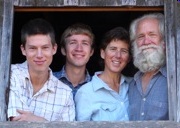
 My kids have been after me to write my autobiography for some time —well, actually that was some twenty years ago. I’ve procrastinated long enough. What has finally emerged turns out to be less autobiography than auto-bio-philosophi-graphy: the memories that come most easily are those that left a philosophical impression. For now I’ll lay down the bare facts as I recall them.
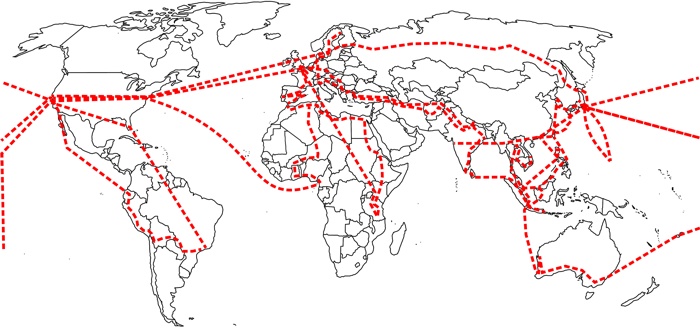
Just looking for a home…
1943 and on
I was born in Tucson, Arizona, in 1943. Despite a normal childhood, I never really felt connected to the mainstream culture around me —music, sports, dating, and the rest —for as far back as I can remember. This became more obvious with the onset of puberty, which is almost certainly why I ended up drawn to yoga and Buddhism as a teenager, and later to the Tao Te Ching. None of this was a rejection of or rebellion against the American mainstream; the culture simply never spoke to me. If I believed in reincarnation, I’d think I had simply been reincarnated from East Asia.
I dropped out of high school and joined the Air National Guard. The Cuban Missile Crisis of the early ‘60s changed my destiny. I was plugging away at night college and working full-time at an electronics firm when I was called up. My unit was to be sent to Germany —cannon fodder, people said half-jokingly. I had to drop out of college and pack my bags. The situation soon cooled, the mission was called off, and I was left without a vacation to Germany or a way to resume college immediately.
My life was up in the air. I felt I had to go somewhere. WWII vets at work talked up Australia as a great place. On the other hand, I had adapted the NASA Gemini telemetry technology I was working on for use in consumer products —a personal pager system for doctors and radio-controlled toys. What should I do? Stay and develop these inventions, which might make me a pile of cash, or go to Australia?
1963 and on
I immigrated to Australia in 1963 and found work at a NASA satellite tracking station in Western Australia. Initially I planned to work there for a year and then return to America. Hearing tales from people who had traveled overland to Australia from Europe stirred my urge for adventure. My new plan was to spend six months hitchhiking to Europe and then return home. Plans, plans, plans. I ended up staying many years in Asia, wandering, working, and wondering —in other words, growing up.
I spent my first three years in Southeast Asia, a region I grew to love dearly. While working for a Chinese electronics firm in Bangkok, I received a telegram informing me of my brother’s death. I spent the next few months racking my brain trying to understand death — what it truly meant. Up until then, death had been an objective fact. Creatures were alive and then at some point dead. But I didn’t really have an intuitive, subjective comprehension of what this “death thing” actually was. My brother had been alive most of my waking life, and now he was gone. Day and night my conscious — and surely my subconscious — were scanning the full realm of my mental existence. I just had to know what this mystery of death truly was, beside just “not living anymore.” Then one day, while riding the bus back from work, it struck me: life and death were the same reality. I actually felt sure that I’d been enlightened. Fortunately, as the years went by and wisdom deepened, I knew that wasn’t so. Yet perhaps, for just a moment, it was.
Following this I moved to Yasothon in Eastern Thailand to open a small bakery. Business was slow. It turned out the locals weren’t fond of my éclairs and pies; they simply wanted my plain sponge cakes.
When the war stepped up in Vietnam I went back there hoping to find a high-paying job to save money and try again in Thailand. I found work in Chu Lai for RMK-BRJ, first as a warehouseman, then as a surveyor, and later as a translator. I learned to speak functional market Vietnamese. The sponge-like capacity of a young early-twenties brain.
Eventually I was fired from my RMK-BRJ job for attempting to organize the Filipino and Korean workers to ask for better living conditions that the American workers already enjoyed. This was the third time I had been fired: first from a job in Los Angeles for coming in late too often (even though I worked late into the night); second from my AWA job at the tracking station for attempting to organize those workers to demand better conditions that AWA had previously promised. These experiences taught me that a successful leader doesn’t actually lead —he must essentially follow the people he leads.
After being fired in Vietnam I felt the urge to make my way to Japan to continue my Karate training. On the way I stopped off in Singapore for six months, where I met and fell in love with an English girl, Muriel, who was stationed at the RAF base in Changi. Her tour of duty would be up in a few years, so we decided to meet back in England at that time. With that settled, it was off to Japan —though I had to check out the Philippines, Hong Kong, and Korea first. By chance I met a beautiful girl in Korea who nearly enticed me to settle there for a while. But I felt I just had to get to Japan. Perhaps I knew by then that a while easily turned into years. And what about Muriel?
1968 and on
After a year in Japan I got itchy feet and decided to finally finish that overland trip to Europe I’d planned way back in Australia. I also had a love goal pulling me, which forestalled the detours I might otherwise have made. I spent the next few years traveling through India, the Middle East, Europe, and North and West Africa —hitchhiking, trains, boats, planes, buses, killing time.
Part of that period was spent hitchhiking across North Africa and down the East Coast to Tanzania before flying back to England. As it happened, the spark of love had dimmed for Muriel and me by then. Distance and time don’t always make the heart grow fonder. Given my zigzagging history, this was hardly surprising.
I’d enjoyed East Africa a lot, so after we broke up I headed back down through Europe planning to travel the West African coast toward South Africa. I stopped for a few months in Mallorca, where while dancing on a beach I lured in a young Swedish girl, Ingela, who was there on vacation. We got on well, so I changed course and went to Sweden, where I spent the summer picking twenty thousand eggs a day and enjoying life in the Swedish countryside. We got on so well that in the fall we left together —across North Africa, then down through the Sahara, and along Africa’s west coast. I contracted hepatitis A somewhere in the Sahara, and after reaching Cameroon I decided it would be a good time to return to America for a while —to recuperate, to finally visit my parents, and to save up some money.
By the way, traveling on a dollar a day certainly risks exposure to diseases no longer common in the developed world. Somehow I missed malaria and most of the rest, catching only dysentery in Vietnam, typhoid fever in Nepal, and that hepatitis in Africa. Luckily all were treatable. A Swedish friend I traveled with in Thailand wasn’t so lucky and picked up elephantiasis, probably on his way through India.
1971 and on
Ingela and I spent about six months in California before she had enough of me and went back to Sweden. Clearly at that age I wasn’t the best catch in the sea. After a period of mourning I decided to bicycle down through South America. Shortly before my departure she called and said she wanted to make a go of our relationship after all. Happy me —I was soon on a plane for Sweden.
We were married that fall and spent most of the year in Sweden working and saving money for our planned trip to Japan. I worked as a postal worker this time, a step up from egg picker. That fall we took the Trans-Siberian Railway through Russia, two weeks of jolly cozy time. A long train trip is very similar to a slow ocean voyage; time has a way of vanishing as you let someone else steer the course of life for a while.
We settled down in Tokyo. I got work teaching English, and Ingela found a great job as a high-class hostess in Ginza, keeping tired Japanese businessmen awake. I went back to the dojo to train in Karate, and Ingela took up pottery. By this time I had lost interest in Karate but happened to stumble across the shakuhachi, a bamboo flute. I spent the next few years learning to make and play it —in particular Suizen (blowing Zen), which had come to Japan from China around the sixth century. Switching from Karate to Suizen proved a wise move, especially now in my elder years. Tai Chi has also become a priceless practice for this old man.
1976 and on
We saved up quite a batch of money during our stay in Japan, mostly because we lived exceptionally frugal lives — an easy thing for a hitchhiker to do. We headed back overland to Europe, stopping in Pune, India, to study yoga at the Ramamani Iyengar Memorial Yoga Institute. We had been following Mr. Iyengar’s Light on Yoga for three years, so we were well-prepared for hands-on training.
We spent the winter in Sweden, where I tore a leg ligament skiing — for the first and last time. Once I’d healed we left for America and settled for a year in California, teaching yoga and shakuhachi. We moved up to Bellingham, Washington, where I began welding airtight stoves while Ingela taught yoga. We soon reached a point of irreconcilable differences. She stayed in Washington State and I moved back to California, where I began teaching yoga again and struggled to figure my life out. I finally settled on a plan: move to Brazil and work on a farm there for a while and see where it would go.
Yet, would going to Brazil repair my broken heart? Ingela and I had been together for nearly ten years, had great plans laid out for the future, and then it was all over. I initially thought that if this “perfect” relationship went south, what chance did I have in any relationship. After digging deeply within, I realized that I was innately — genetically perhaps, but by virtue of personality certainly — destined to live in a relationship. Whether it turned out well or not was up to fate, and ultimately up to the vow that would come later. How to find one was the question.
I actually wrote a Dear Woman letter and sent it out to a hundred yoga teachers listed in a yoga magazine. Curiously, nothing came of it directly — but while composing the letter I gave it to a yoga student of mine to proofread. He took it home to show his wife and two friends of theirs. One got very angry, and my student invited me to dinner to sort it out. Long story short, we sorted out the misunderstanding and in the process I met my future, and present, wife. Making a move — any move — gets the ball rolling, and where it lands nobody knows. But opportunity almost invariably knocks.
The one demand I made at the beginning of this new relationship was that we would each commit to owning the expectations we projected onto the other — that we would take responsibility for the pain we felt from unrealized expectations. That vow has seen us through thick and thin. It is the ultimate peacemaker, if both parties can sincerely hold it true.
1979 and on
I still planned on Brazil, but now with Leslie to share the adventure. We set off in the fall, flying to Ecuador and then hitching and camping our way down the West Coast of South America, over to Brazil, and eventually Rio. The plan was to work on that farm and then make our way over to South Africa to save money for a return trip to Japan. I do feel at home in Japan — I should have known by now the futility of making plans. Though without expectations, there is no real downside to making them, is there?
Leslie found herself very homesick and wanted to return to the U.S. That was actually fine by me — surprisingly so, at first. By this time, everywhere on the planet was the same deep down where I was looking. Profound Sameness had taken firm hold of my mind.
1981 and on to the present
We settled in Santa Cruz, raised children, and founded Center Tao. Now, at eighty-three, I am finally outlining my history. So many details —odd, interesting, dangerous, harrowing, exciting, and boring —could be included in a full autobiography, if only I possessed the storytelling gift for such a project. But for now, this will have to do.
Having largely finished putting my insights onto paper, perhaps I’ll see if I can tap into any latent storytelling ability — with some profoundly unexpected help from artificial intelligence. I would have been less surprised by aliens arriving on Earth than by this arrival of AI. It is, in a real sense, the mind of humanity made accessible to everyone. Most useful for me is how, as a collaborator, AI is capable of inhabiting multiple readers’ minds in ways I cannot do for myself — not even a single other mind. All I need as a mere mortal is to learn how to use it well. I dare say AI is as significant as was our harnessing of fire. AI is a harnessing of human knowledge. This new tool, in partnership with the intuitive subjective knowing that only lived experience can provide, bodes well for humanity’s future. For now, I’m going to employ this remarkable tool to edit my posts on CenterTao and my dense 700-page Taoist Thought book into something people will be able to hold in one hand and perhaps actually enjoy reading. Who would have thought?
Looking back on those early years from 1943 to 1981 —especially the era from ‘63 to ‘81 —everything feels chock-full of experience. As I wrote, scores of memories crossed my mind. Curiously, the period from ‘81 to now, 2026, covers more time than this entire biography, yet my memories of these years are a fuzzy blend. Where has the time gone? These settled years have been marked only by the milestones of my children’s lives, my mother’s death, and inevitable health issues —skin cancer, hernia, prostate cancer, total knee replacements —just the normal stuff that comes with aging.
Honestly, aging has a real upside, starting with the natural decay I began noticing as I traveled through my seventies. Key among these was being invited to transition from talking the talk to walking the walk. Now I truly needed to be careful, mindful, watchful —to compensate for decline in strength and balance. I was also invited by circumstance to embody a more humble approach to life. Aging increases life’s physical challenges, but the deepening of humility and the somewhat transcendent perspective that approaching death awakens is a true blessing. I would not trade that for any recovery of youthful vigor.
Being settled in one place seems to smooth over the passage of time. It’s not a fog of war; it’s a fog of constancy. As the first line of the Tao Te Ching hints, The way possible to think runs counter to the constant way. It reminds me of that two-week Trans-Siberian train journey, or the time I hitched a ride on a timber boat from Taiwan to Borneo. The boat traveled at walking speed; time stood still as I sat on the bow every day watching the waves go by. I had brought a stack of books to read, but I never cracked even one.
In retrospect
The latter half of the twentieth century was a Goldilocks zone for a hitchhiking-and-sleeping-wherever manner of travel. Prior to the twentieth century such a journey would have taken a whole lifetime: the world was too disconnected and dangerous for laid-back wandering. You weren’t a hitchhiker; you were an explorer, and the stakes were much more life and death.
On the other hand, the instability and exponential explosion of technology in the twenty-first century would make such a journey much less organic and inviting —for me anyway. The internet homogenizes so much, and the rising civil strife doesn’t help. In some ways, modern circumstances —hyper-civilization —would make such a journey too easy, and paradoxically more difficult. Though perhaps that’s just my times-were-better-back-when old-man mind speaking.
One thing is for sure: life is a true novel that takes a whole lifetime to read —and if one is lucky enough, to remain fully awake to read to the very end. Fascinating.
Note: “Times of Yore” is the tag ( Autobiographical ) I’ve used for posts that refer to something in my past. To continue reading, see 1981 and on to the present