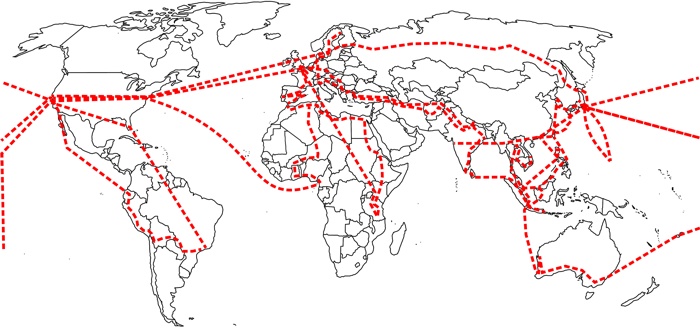
They say a picture is worth 1000 words, so I’ll start with this map-drawing roughly outlining fifteen of my early years wondering, wandering, and working all over our world.
Now, I add in a few words to fill in the picture with a few details.
Born in Tucson, Arizona, in 1943, I have spent the last eight decades first intensely exploring the outer world—between the ages of 20 and 35—and, since then, mostly the inner world.
While my childhood was conventional, I felt an early, visceral detachment from mainstream culture. This sense of being an outlier drew me toward Yoga and Buddhism as a teenager, and the Tao Te Ching as a young man, sparking a lifelong quest to dig down to the “bottom line”—roughly, the essence of life.
That journey took me from from dropping out of high school to joining the Air National Guard and, eventually, immigrating to Australia. From there, I spent years wandering through East Asia, India, Europe, and Africa. Along the way, I worked as a NASA telemetry tech in Australia, a baker in Thailand, a surveyor in Vietnam, a postal worker in Sweden, a junkyard worker in England, and an English teacher in Tokyo. It was during my years in Japan that I transitioned from the physical discipline of Karate to the meditative practice of Suizen (吹禅 “blowing Zen”).
After fifteen years abroad, I grew weary of being ‘the foreigner.’ Outwardly, I blended in well enough in Sweden and England, but I never truly felt at home. I was ready to return to America. But why return to a place I had felt no deep connection to?
The Further One Goes…
The Taoist adage, “The further one goes, the less one knows” became increasingly apparent to me as my years on the road stacked up. Certainly, this doesn’t mean that by going further, one knows less; rather, it is only when one expects to know more by going further, that one ends up knowing less. Expectation is the problem!
The idea that “without stirring abroad one can know the whole world” also became obvious as I felt the profound sameness underlying the world’s surface differences. Wherever I went, there I was. What I was seeing “out there” was simply a reflection of the “in here”—my own needs and fears. I realized I could never know anything “out there” more deeply than I knew my “in here.” And what was the best way to know my “in here”? Self-honesty was, and still is, the only path I’ve found to that clarity.
And the other reason…
After I settled down, I eventually realized that I may have merely been looking for a home all along. I had set down roots several times in various countries, but my lifelong detachment from any cultural mainstream meant that no place on Earth would ever feel home. I discovered that true home is a subjective state of mind—a sense of blending in. That was the trick!
Today, I live in Santa Cruz with my wife, Leslie. Together, we raised a family and founded Center Tao, where I continue to dig downward toward that ever-elusive bottom line. Fortunately, I have a large garden to dig around in as well, which keeps me grounded and sane.
For those interested in more personal reflections, you can explore the Autobiographical category, or visit The Further One Goes, The Less One Knows, for a more detailed sketch of my years gone by.
On blending in
Genuine blending-in is not found in the outer trappings we adopt to feel connected—the “wrapping ourselves” in styles of clothing, religion, or politics, or you name it. While those work up to a point, our fundamental sense of disconnection—caused by humanity’s trade off—leaves us wanting (see Who are You Series). Adding to this are likely genetic factors affecting the real outliers among us. Chapter 56 speaks to this deep, subjective blending-in:
