 I was looking out the window this bright sunny morning watching all the birds dining at our bird feeder. They were busy going about doing their thing, which at the moment was eating sunflower seeds. Next, I thought of the role they serve in nature by eating seeds. Presumably, they deposit some of those seeds elsewhere and some eventually sprout. Of course, they are not aware of the vital propagation role they play in nature. They simply follow their needs or fears of the moment.
This pondering instilled in me a sense of awesome underlying unity throughout nature, or as chapter 56 puts it, This is called profound sameness. To be sure, I’ve always regarded our place in nature as being essentially no different from other animals. We simply follow our needs or fears of the moment, unaware of our fundamental role in nature. The trick is to maintain a deep sense of this connection, this “profound sameness”, as much as possible. It is all too easy to become blinded by moments of need or fear—effectively no different from the birds I was watching. The only slight difference is the human imagination’s ability to perceive outside the subjective box of need and fear. Alas, life constantly pulls me back into the ‘game’, and emotionally skews imagination in the process.
The New Science of Practical Wisdom
My pondering this morning leads me to add this postscript to the book, to round out the story. Pushing 80, I’ve said most of what I had to say. Wrapping things up actually began with The Tradeoff (p.549), which concisely summarized my views of how our species got to where we are, and where we may be headed.
Briefly, humanity is truly in the early days of civilization. It’s only been some 10,000 years, which evolutionarily speaking, is only the end of the beginning, if that. Much of civilization’s processes are at odds with humanity’s innate emotional needs. Indeed, most of the problems in the world we see are a result of this mismatch. Naturally, civilization will evolve over the coming millennia to a point where it is less problematic. In part, that will happen due to extending the human lifespan. You know, “Older and wiser”. Of course, as Oscar Wilde noted, ‘With age comes wisdom, but sometimes age comes alone.’ Certainly, we all have known some unwise older adults, but overall aging does bring wisdom. Consider these few excerpts from The New Science of Practical Wisdom.
Google [The New Science of Practical Wisdom – NCBI – NIH]
When reviewing the relationship between aging and wisdom, it is worth considering how the biological machinery of wisdom changes over the life course. From a peek under the neural hood, does the aging process result in a tuning of the engine, or a rusting of the gears?
In this respect, neurodevelopmental trajectories may be pertinent both in youth and in older age. Reward motivation and emotional circuits develop faster than pre-frontal control circuits, resulting in greater emotional reactivity, reward-seeking behaviors, impulsivity, and risk-taking in youth, with subsequent reductions in such activities with enhancement of prefrontal inhibitory control, leading to a higher level of practical wisdom.
This indicates that although deficits in sensory processing increase with aging, the brain may be bringing online regions highlighted above as being associated with wisdom. Essentially, cognitive and sensory deficits associated with aging may be accompanied by an uptick in the use of the wiser parts of the brain.
Finally, as the brain ages it also changes in how it responds to emotions. Central to the processing of emotions is the amygdala, and recent research has shown that its sensitivity to emotional stimuli changes across the lifetime. The amygdala in younger people shows heightened activity in response to both positive and negative visual images in comparison with neutral images. In older adults, negative images no longer trigger heightened amygdala activity, but positive images continue to do so. This age-related ‘Positivity Effect’ may underlie the calmer and more positive behaviour in older age.
Wisdom is associated with greater subjective well-being in older adults. This suggests that, while the aging process may well help facilitate the development of wisdom, the resulting wisdom may, in turn, help in navigating the inevitable challenges that all humans face – those of aging and dying well.
We humans are not the only animals that face the “inevitable challenges that all humans face – those of aging and dying well”. The work of living is a reality all animals endure. In addition, we also deal with an existential stress resulting in part from our cognitive “disease”, as chapter 71 calls it, i.e., Realizing I don’t’ know is better; not knowing this knowing is disease. All the same, each generation of a species must learn through living how to balance the instinctive forces within. This is why I feel much of Buddha’s Four Truths apply to all animals (see Buddha’s Truths Pertain To All Life, p.545). It is essentially on-the-job training for us all. As animals, we try, we stumble, we adjust, and we get a little better at the skill of living as we age—increasing wisdom is an inextricable result of aging. This postscript is my brief summary of how I view and deal with this existential aspect of life. I’ll begin…
Nature’s Bell Curve
A bell curve is a type of normal probability distribution for a variable in nature. The top of the curve shows the mean and median of the data. Its standard deviation depicts the bell curve’s relative width around the mean.
Undoubtedly, I’m using the bell curve distribution less rigorously than a professional would. But hey, this is taoist thought after all. 🙂
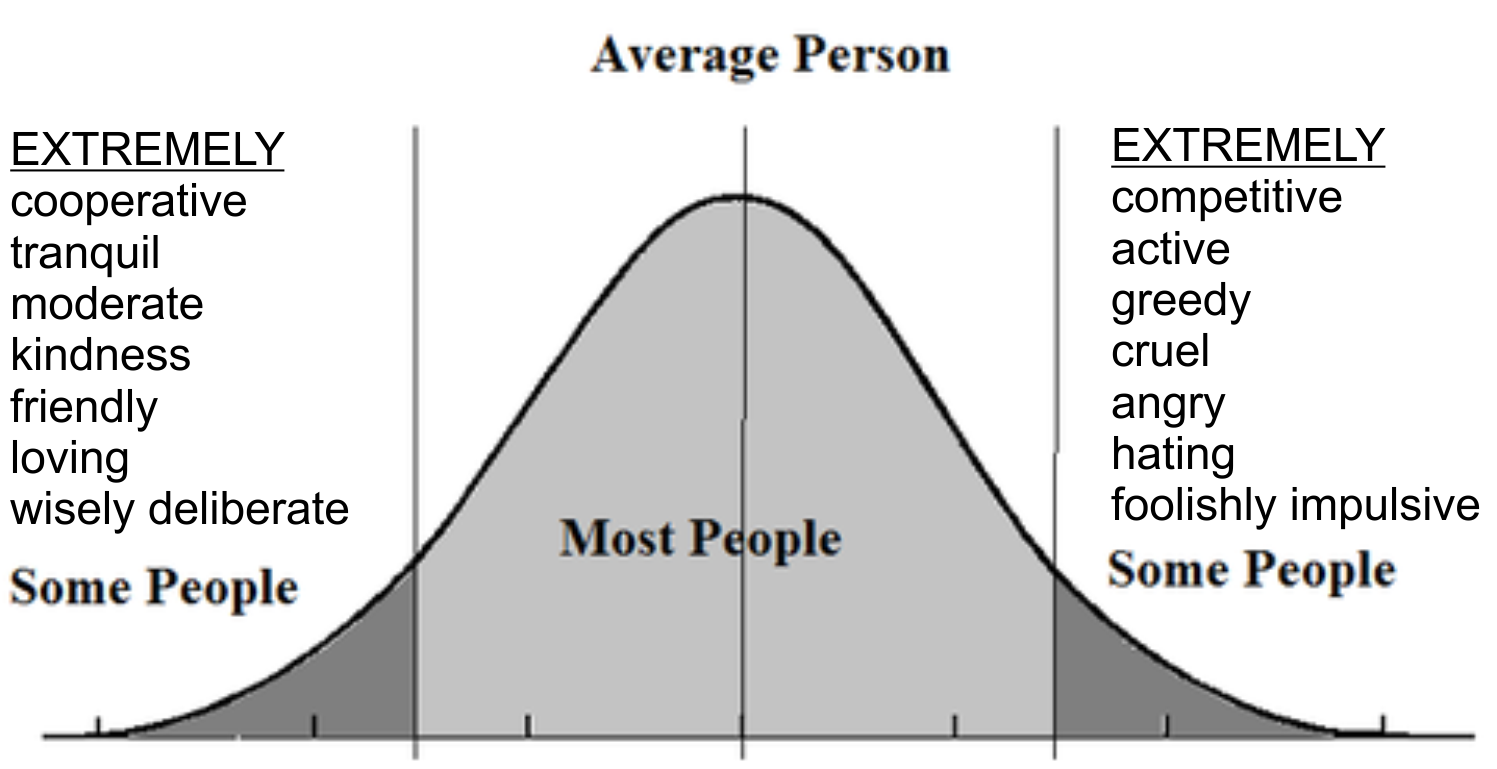
Nature plays out on a bell curve of possibility. You could see this loosely as the extreme ‘yin’ on one end and the extreme ‘yang’ on the other. We innately have both poles within us, a bell curve spanning the whole of human (a.k.a. animal) nature. Ponder this listing of a few of these poles:
Cooperative vs. competitive; tranquil vs. active; moderate vs. greedy; kindness vs. cruelty; friendly vs. angry; love vs. hate; wisely deliberate vs. foolishly impulsive; and so on down the line of temperament responses .
The chart shows the probability of some temperament extremes. Some people will be extremely kind, others extremely cruel, and most of us a blend of both but not usually to the extreme. However, this chart can also represent the range of extremes within each person that can sometimes play out, even if rarely, depending on circumstance and such.
We are biologically social animals and this means we are innately predisposed toward kindness and cooperation. The Biblical sentiment, “on earth peace, good will toward men”, speaks to our social instinct for cooperation, kindness, love. This instinctive selfless sentiment is like the glue that binds us together as a social species.
The other side of this curve, the innate impulsive, competitive, active, greedy, cruel, angry, and hateful characteristics are the self-protective responses that help glue the individual ‘selfish’ self together, so to speak. These ‘yang’ emotions can overtake us when circumstances threaten our expectations, whether imagined or biologically innate. This threat triggers fear, including innate fear of loss, pain, failure, and death. Fear then fires up pressing needs that demand urgent satisfaction.
Survival is the primary aim of life, with pleasure and pain pulling or pushing our selfless and selfish emotions in ways that we intuitively feel will fulfill that innate goal. Which pole emerges to express itself, which emotion plays out at any given moment, is a function of circumstances and temperament—never one of ‘free’ choice, despite our belief to the contrary. We are but spectators in this game of life. Oh, but how we believe otherwise, wishing and struggling to control our moment. The final line of chapter 3 gives a most helpful hint on how to deal with this, Doing without doing, following without exception rules.
At it happens, we usually maintain a happy middle point on this bell curve of reaction, but circumstances can change that instantly. Clearly, we wish we had the ability to manage our reactions better, and wish even more that others would. In fact, our wish for free will is so deep, even instinctive, that it is natural to believe we truly have free will. Granted, we do have a moderate ability to make choices, to guide our actions, and to moderate our reactions, even to sit still and meditate. However, our innate temperament, over which we have zero control, determines our ability to do even this. In fact, chemistry (alcohol, drugs, food) is our only easy way to briefly influence temperament and the rest.
Nature is a package deal
The observations I make on how we are emotion driven animals is an abstract scientific reality that is intellectually comfortable enough for me. However, I find that emotionally facing the ruthless reality of that to be extremely heart sinking at times. The real-world facts can be very uncomfortable for anyone who is not sociopathic. I feel a visceral deep-seated need for us to get along, be kind, honest, fair… but reality simply crushes this wish. To be sure, we humans have our moments of kindness and the like, but the bottom line is how easily we can turn on a dime and revert to our innate selfish instincts, which are merely the complementary side of our selfless ones. The fact is, nature is a package deal. Yet, I innately feel a continuous urge to increase the ‘good’ and decrease the ‘bad’. Surely, this urge must be one of the driving forces behind religion, e.g., “Glory to God in the highest, and on earth peace, good will toward men”.
I find the first step towards leaving some of this naive ‘good’ positive baggage behind and “nearly rising beyond oneself” is openly recognizing these poles within me. They are all there in one degree or another, depending upon personal temperament and circumstance. Naturally, I am more inclined to notice the ‘good’ aspects of my character and turn a blind eye toward the ‘bad’. Yet, the ‘bad’ always lurks in the background. ‘Good’ and ‘bad’ are two sides of the profound sameness coin. In seeking or in avoiding one always creates the other. As the beginning of chapter 2 cautions,
It takes self-honesty to peek behind my curtains of self-rationalization. Yet, even here, I’m stuck with honesty (good) vs. prevarication (bad). Certainly, finding a pathway through one’s own limitations must count as life’s ultimate challenge.
Resolving the problem of injustice
The Tradeoff went a long way toward resolving my deep urge to ‘solve the world’s problems’, as they say. When I witness hurtful and unfair human behavior, I am able to diffuse much of my angst by chalking it up to being a natural consequence of hierarchical civilization. Humanity simply traded the egalitarian old way of the hunter-gatherer for the increased comfort and security of civilization, and we all must pay a price for that. Nature won’t allow us to have it both ways!
Yet, still, I feel the instinctive distress of witnessing injustice and the like. I may be civilized on the outside, but deep down, I’m still a hunter-gatherer hominid. We all are! We just do our hunting and gathering in different ways now, yet moved by the same instincts as our ancestors. Those ancient egalitarian social instincts still tug on my heart, your heart, our hearts. What to do? Chapter 65 offers me a hint…
Accordingly, the only solution I’ve found is to maintain a rather continuous awareness that this inner sorrow I feel is (1) natural and (2) impossible to escape. It is part of life. It is a cross we all bear, whether we can acknowledge it or not. I have no choice but to conform to nature’s way. Chapter 63 suggests a way, with the last lines summing it up well, Accordingly, the wise man, still of difficulty, For this reason, in the end, without difficulty. Now from the top…
Just allow myself to be, to strive on diligently. ‘Then, and only then, reaching great conformity’ as chapter 65 put it.
The bell curve in natural phenomena
While I’ve been discussing the bell curve vis-à-vis emotional temperament responses, the bell curve distribution can also offer insight on a wide range of natural phenomena. For example, the Trump presidency has baffled me for a while. How could so many people, half the country, support someone of such low noble character? Finally, the bell curve offers me a clue. Briefly, just as some folks innately prefer chocolate and some vanilla, so too do some innately prefer a dictatorship and some a more egalitarian form of government. That would explain the rise to power of many a tyrant—Stalin, Hitler, and Mao in particular; kings and warlords in general. It is a visceral choice, not a rational one, and certainly not a free choice one. Circumstances undoubtedly play a large role in this choice. In other words, current circumstances play a major role in the bell curve’s distribution of variables. In trying times, more will support the supposed strong man. See also, Democracy as Myth, p.177.
Additionally, our very social nature as a species exacerbates these matters. Our tribal instinct easily overrides any evidence that threatens group solidarity. The resulting social groupthink means we are more ‘monkey see, monkey do’ animals than we’d like to admit. The self-image we have of ourselves, our species, is very out of sync with the reality… We are 99% emotional and 1% rationale, but we view ourselves just the opposite. The only mitigation factor is the slight increase in wisdom that comes with a long life, as the science on wisdom is now revealing. Individuals simply have to live long enough to outgrow some of their childlike groupthink inclinations. Indeed, the younger we are, the more certain we feel that our beliefs (whatever they are) are true. We feel that our take on the world is accurate. It is we, in our beliefs, not ostriches who stick their heads in the sand. The odds of doing that can only decrease as life experience pushes back on the ‘disease’ to which chapter 71 refers. Viewed as a bell curve, youthful characteristics are on one end, old-age characteristics are on the opposite end. As the median age of the population increases, the median characteristics of old age become the new normal.
Homo sapian asapian?
I must say though, that this Trump era has been a truly sobering experience. It bears out much of what I write about. We are animals, through and through. Yet we have a story that paints us in a higher light, a wiser light. Take how we name ourselves, Homo sapian sapian . Sapian comes from a Latin word meaning “one who knows” (Latin: sapere = to know). Thus, Homo sapian sapian = the human who knows that he knows. But as chapter 71 observes, this is our ‘disease’. The true game changer will occur when our species finally realizes this and changes its name. Perhaps to Homo sapian asapian, or something to reflect our realization that we don’t know. (‘a’ is the Latin prefix for not, as in asocial, amoral, asexual, and so on.)
Still, it is always heart sinking for me to see how far from being sapient we are, which in itself is odd. Honestly, that must be just part of my ‘disease’… i.e., chapter 71’s Realizing I don’t’ know is better; not knowing this knowing is disease. Even while I do realize I don’t know, I still think; the dipolar nature of that alone is an act of thinking that I know, as Correlations (p.565) demonstrate. There is no escaping being human, eh?
The dipolar mind: A dipole is a term in physics that refers to a pair of separated electric charges or magnetic poles, of equal magnitude but of opposite polarity, i.e., negative (–) vs. positive (+) or N. vs. S. Life has adopted this natural dynamic to perceive its surroundings in a way that promotes survival in a competitive environment. In life forms with a nervous system, neurons communicate through an electrochemical process… (–) vs. (+). Given this, it is not surprising we see reality in a (–) vs. (+) mode. This (–) vs. (+) dynamic influences how humans label their perceptions: yes vs. no, good vs. bad, yin vs. yang, life vs. death, active vs. passive, go vs. stop, hot vs. cold, before vs. after, hard vs. soft, heaven vs. hell, male vs. female, white vs. black, and so on. Thus, I see language is the emergent property of a fundamental negative (–) vs. positive (+). See Tao As Emergent Property, p.121.
Naturally, such dipolar-like perception is essential for survival in the wild. It boils choices down to the simplest level — yes (+) vs. no (–). However, the human ability to think and remember makes this both a blessing and a curse. Chapter 1’s, These two are the same coming out, yet differ in name hints at the curse. Not only do we see life through simplistic dipolar names; this dipolar thought locks the illusion into memory. For us, dipolar-like perception hinders recognizing that all this is simply, albeit profoundly, two sides of the same coin. Chapter 56 is forthright about this…
See Yin Yang, Nature’s Hoodwink, p.35, and for even more, see also, Seat of Consciousness, p271, What Shapes How You Think?, p.124, and What is ‘the Tao’ actually?,p.39.
It fascinates me how disappointing it all feels for me, given my deep realization that humans are not different from other animals. It is as if a species-centric ‘we are better than that’ story lingers in my deep subconscious. It must lie at an innate visceral level. My emotions can’t accept what my mind’s eye clearly observes. I imagine all this results from how my brain’s empathy inducing mirror neurons naturally pull me into expecting better behavior from us all. Still, the mystery lingers.
Speaking of Mirror Neurons
The extraordinary human capacity for empathy is a result of mirror neurons. Empathy, like any other emotion, greatly influences thought. This creates an interesting, perhaps unique, quandary for humans. On one hand, this empathy (+) thought imparts an ability in humans to feel a profound sense of connection to nature and the universe beyond the narrower instinctive self-interests that usually drive life. Indeed, it bestows on us a sense and idea of spirituality, of god. Conversely, thought (–) empathy might only magnify narrow instinctive self-interests which profoundly disconnects us from what is naturally so—from nature itself. For every benefit comes a cost.
I suspect that empathy, even more than intelligence, is what makes us unique. Empathy is humanity’s most powerful instinct. Not that other animals lack empathy by any means. It is just that we may have evolved an extra helping. What’s more, I presume this abundance of empathy was a major factor in the evolution of human intelligence, although, both might have evolved together. Language has a divide and conquer effect on nature. That disconnect is offset by empathy, i.e., empathy is a connective instinct. (See Alone with Thought, p. 459)
Pondering my ‘intelligence’ I notice that the ability to connect my mind with any aspect of the external world that catches my interest is the foundation of my ‘intelligence’. Without that connection, I’d be much more limited in the scope of my awareness, and thought would be much more isolating and self-centered… not good for a social species! I imagine all this plausibly evolved like this:
Empathy is a survival advantage for social animals. In humans, empathetic connection enabled intelligence; intelligence enabled language; language disconnected us from nature’s singularity. This disconnection stimulated the evolution of greater empathy to compensate for the disconnection caused by language.
As a result, empathy is the secret sauce driving the human mind to zero in on its ‘beloved object’, be that an astronomer’s stars, a fashion designer’s fabrics, an accountant’s numbers, a gardener’s plants, and so on ad infinitum.
Mirror Neurons, Profound Sameness, Ghosts and Gods
This morning after daily tai chi at the beach, I looked at the seagulls next to me, then out over the ocean and realized how together it all felt. Emergent properties came to mind as the inevitable link between every facet of existence… “I” am the universe emergent, and it is “me”. Life is the natural and inevitable consequence of favorable conditions. Life must emerge and evolve if the conditions are suitable. This means the universe is conscious, and all the parts serve as the whole… profound sameness as chapter 56 would say.
Then, looking out over the horizon, my mind’s eye felt the photons streaming from the Sun to Earth that were producing the sky’s morning glow. Actually, my mirror neurons where allowing me to feel empathy for the photons, and in that spiritual union, I felt the strong sense of connection to something beyond my self. Then I thought, “How is that any different from a person whose mind’s eye feels the presence of ghosts, spirits, God, or any other intangible?” Of course, it’s the same. Both impart feeling a sense of connection—even to the point of profound sameness.
The trouble, the schism, begins when we get obsessed with naming this feeling in an attempt to possess it. Chapter 14 suitably describes what we are trying to hold on to.
The naming then becomes the answer to some aspect of our life. This makes mountains of spiritual unity into molehills of belief which easily blind us to the without of shape form, the without of matter shape all around us. We put all our spiritual eggs in one basket. From there it is just a short step into institutionalizing ‘a God’, rallying around ‘Him or Her’, and going to war on ‘His or Her’ behalf… or if not war, at least claiming we have a corner on the ‘Truth’. (See Do you believe in angels?, p.25)
Hunger and our ‘disease’
Our need for the answer plays a core role in our disease. And the connection between food and this need for answers reveals why. For a hungry empty stomach, food is the ‘answer’. For a questioning empty mind, answers are the food it seeks. The promise of food, and by extension answers, attracts us like moths to light. Biology biases us to favor answers over questions, food over hunger. Indeed, questions are the unknown that can quickly terrify us and push us to grasp for any answer that fulfills. This naturally produces the disease that chapter 71 reveals.
We grasp for any answer to fill our mind’s space, especially if we lack a sufficient sense of intuitive connection. Much of our intuitive sense of connection in the world deepens as we mature, (i.e., We only understand what we intuitively know, p.254). This is one reason why children soak up experience and why it’s harder to teach old dogs new tricks. In addition, the deep intimate social connection common in ancestral times is not sufficient in civilized circumstances, making us all the hungrier for friends, both literally and figuratively… yes, answers are among our dearest friends.
Where does desire fit into all this? Desire is the hungry urge to fill up the emptiness, whether food to satiate hunger, friends to satiate loneliness, or answers to satiate uncertainty. Desire drives the journey from empty to full, question to answer, problem to solution. Fasting and meditation are two spiritual practices that help push back on the incessant urge to fill the space. As chapter 16 begins, Devote effort to emptiness, sincerely watch stillness. Done with some consistency, chapter 16 ends with this desired result: The way therefore long enduring, nearly rising beyond oneself. In a sense, we learn to sit with the unknown… even embrace it.
Hunger and the ‘more is better’ instinct
I’ve long felt that our inclination of feeling ‘more is better’ was instinctive. Google [People systematically overlook subtractive changes] for recent research that proves this is the case. This ties up a few loose ends when you think about it. What is desire, for example, but the urge for more? In the wild, hunger drives us to get food, and the urge to get more of it would be a beneficial instinct. Only in civilization can we get to accumulate more and more without apparent end. Thus, only in civilization is the idea ‘less is more’ or devote effort to emptiness make any sense. In a way, the main thrust of the Tao Te Ching is a push back on this ‘more is better’ instinct now run amuck.
A final word on fear
Need stood out this morning as the driving force behind those birds, us, and every creature in between. If you’ve read this book, you know fear and need are the fundamental principles underlying many of my observations. In the case of Homo sapiens, need + thought = desire and fear + thought = worry. Those two, need and fear, are the driving forces directing the actions of all living things. Thus, this morning’s ‘insight’ is not very surprising. While need and fear are the common denominators between all life, fear is fundamental. Fear is the primary life force within all living creatures. Fear drives survival. Accordingly, need itself is only a manifestation of underlying fear.
Fear spans the full spectrum of experience, from ‘yin’ to ‘yang’, so to speak. For example, one can be fearful of being noticed by people, and one can be fearful of not being noticed by people. Many of the manifestations of primal fear are subtle and too difficult to discern. Thus, fear is really an inadequate word to pin on this fundamental force of nature. For one thing, “fear” has a lot of cultural baggage tied to the word and so it easily misleads. Perhaps chapter 40 puts forward the deeper meaning I’m attempting to convey by the word “fear”.
Having is born in nothing suggests how need arises out of fear. So it helps to think of this as need ≅ something, born, having and fear ≅ nothing, death, loss. Entropy (i.e., the natural tendency of things to lose order) also helps encapsulate fear. You could say fear is the innate sense of entropy within all creatures, i.e., entropy threatens life’s survival.
On the surface, it appears that need and fear are two discrete entities—need attracts; fear repels. And they are, yet one is also the mother of the other, just as nothing is the source of something. Think: Nothingness gave birth to the Big Bang. Such re-purposing exemplifies how nature is profoundly efficient and wastes nothing, not even nothing.
One difficulty we have in comprehending this is because our brain evolved to perceive reality in a mostly linear, black and white way. There is no survival advantage in perceiving the deeper entangled nature of reality. Chapter 1 suggests this unity of opposites—need and fear, These two are the same coming out, yet differ in name. The same, meaning dark and mysterious.
Fight or flight
Fear fuels life’s actions and results in either fight or flight. Think: Nature abhors a vacuum. Less clear is exactly what determines in which direction fear pushes—fight or flight. An innate sense of survival must play a role. Perhaps the promise of imminent and beneficial gain pushes me to fight. Here, a fear of missing the gain sways me. Conversely, the promise of imminent and serious loss pulls me to flight. Here, a fear of loosing what I have sways me. Pleasure and pain also support this analysis. Generally, imminent gain is pleasurable and pleasures attract me (fight). On the other hand, imminent loss is painful and pain repels me (flight).
When an impending pleasure for something, for having, is strongest, the underlying fear pulls me into fight. Fight also fuels a will to live, grit and anger. You could say these are offshoots of need. On the other hand, when impending pain, loss, and death is strongest, fear pushes me into flight, and I naturally try to escape.
Now, if in flight, I’m cornered, there’s a good chance flight will turn into fight—need often tinged with anger. On the other hand, when escape is impossible and all hope is lost, submission overtakes me and I retreat into total nothingness. Is this a factor in suicide? And, doesn’t a flip flopping back and forth between fight and flight sound like a manic-depressive syndrome?
At this point, you may wonder if I’m saying we are continually either in a fight or a flight mode. Yes we are, but in very roundabout ways. For example, on the surface, cooperation and traits such as kindness that support cooperation don’t appear to be either one. However, scratch the surface and I see this: Entropy is the foremost threat to survival of life. The sense of fear is biology’s way of fighting entropy. Grouping together—cooperating—is a social species tactic for fighting entropy. Thus, in this case, cooperation and kindness are part of the fight mode, not between members of the group, but between the group and possible external threats.
As you see, this fear based fight vs. flight dynamic is subtler and more involved than the basic outline I offer here. Various factors feed back and forth at different levels. Suffice it to say; merely being mindful of these life forces at work below the surface deepens perspective significantly. It helps see life from 40,000 feet, as they say.
Sustaining a ‘proper sense of awe’
Fear embraces us all… ALL life. Therefore, a deep awareness of the universality of fear is the thread that deepens my sense of connection to all life. There is also a practical benefit when I heed chapter 72’s warning: When the people don’t fear power, normally great power arrives. D.C. Lau put this a little more poetically, When the people lack a proper sense of awe, then some awful visitation will descend upon them.
One impediment to sustaining a ‘proper sense of awe’ is my innate ignorance of life’s bottom line (see How the Hoodwink Hooks, p.100). In addition, fear induces thinking apes like us to compound this blindness by seeking scapegoats, rationalizations, validations, and solutions. All are dead ends eventually, and rob me of a deeper sense of nature’s sober reality.
Buddha offers a bottom line
There are a few things I hold dear in my attempt to sustain a ‘proper sense of awe’. Especially helpful are Buddha’s Four Truths, particularly the fourth one, “There is salvation for him whose self disappears before truth, whose will is bent on what he ought to do, whose sole desire is the performance of his duty”.
Duty is what in my heart of hearts feels to be my life purpose, what gives life meaning, and what action facilitates that meaning and purpose.
Desire is primarily the fusion of need + thought. Innate fear drives the need side of desire which puts need outside my control. Thought is the only feasible gateway I have to influence desire, albeit just barely. Only when emotion is calm, can thought focus on how I truly want my life to play out, long-term. This shapes my duty and helps me launch practical ways for carrying it out. Now, all that remains is remembering what I truly want.
A practical breakthrough occurred when I realized that I truly never regretted doing my duty, and conversely, that I often regretted not doing it. Then it became only a simple matter of remembering that fact. Now, my near constant awareness of that alone is usually enough for me to follow without exception.
Note here how closely Buddha’s Fourth Truth aligns with chapter 3’s, Doing without doing, following without exception rules. ‘Doing without doing’ is innate action, the kind of ‘duty’ all animals perform. Only humans imagine clever desirous scenarios that promise a favorable future free of charge, so to speak. Following without exception occurs when my sole desire is the performance of my duty. When my will is bent on what I ought to do, I am most in accord with my innate nature. (See Buddha’s Truths Pertain To All Life, p.545).
Diligence is the secret sauce of life
If doing my duty feels more pleasurable than not doing it, I can’t help but fight to do it. Conversely, when doing my duty feels to be more of a loss than a gain, I can’t bring myself to do it. Flight from my duty is inevitable.
Deprived of the pleasure of doing my duty, my need of sensory pleasures begins filling the nothingness. Here, the pleasures I pursue are merely fleeting sensory experiences. Naturally, this is fine, but a little goes a long way. Without the duty-derived pleasures in life, life becomes less meaningful, less balanced and thus less enjoyable.
Buddha’s final words are enlightening, “All things are impermanent. Work out your own salvation with diligence”. Diligence is a key word here. To me, diligence feels like a balanced form of will, grit, and anger. In contrast, pursuing sensory pleasures feels like fleeing from languor (a.k.a., a need for stimuli) that requires no diligence, and so impart little, if any, life meaning… let alone salvation.
Note here that I’m just referring to circumstances of civilization. In the wild, nature forces balance on animals by always requiring them to earn their benefits through diligent effort. On the other hand, the underlying, albeit natural, aim of civilization is to maximize benefit and minimize cost. Any animal, given such ability would do the same. We can and we do, and so unwittingly upsets our natural balance, which leads to the troubles we witness throughout society.
There is no conquering fear
When I remember that fear (sense of entropy, loss, failure, death) is at play in everything I do, I know that fear is at play in every living creature as well. Then I know there is no ‘conquering fear’. Fear works both sides of life’s equation… fear spawns both courage and cowardice.
It’s worth noting that all belief—from ‘crazy’ conspiracy and flat-earth stories to mainstream religious and political stories—arises from fear born mostly from a sense of disconnection. We’re all just trying to return ‘home’, to belong, and belief promises that. In addition, our disease often makes matters worse. You could say that humanity is stumbling—evolving—through life coping with a disease that it doesn’t even know it has… yet anyway.
The benefit of knowing all this helps greatly in dealing with others (or myself) when the offshoots of fear—need, anger, worry—override reason. By recognizing the source of intense emotion, any resulting drama has a harder time drawing me into its game… as long as I remember to keep at least one eye on reality.
Additionally, knowing there is no escape, futile quests to gain fleeting advantages begin to fade away. This helps liberate me from most of life’s second-guessing, hypocrisies, and double standards. Without such baggage, life becomes simpler and more universal (see You are Immortal! p.391), with all its pleasure and pain going along for the ride, so to speak. Surrendering to reality allows me to feel natural and nearly return to my original self. Then, Doing without doing, following without exception rules.
When all is said and done
At this point, I feel I’ve said it all; only the doing—or the doing without doing— remains. In other words, this isn’t a matter of just understanding and moving on. As always, “Action speaks louder than words”. That is a challenge when it comes to Taoist thought. No specific physical action applies here. For this, a constant motion of knowing is the action chapter 52 suggests…
I find diligently recalling the role fear plays in every aspect of life is a way of returning to observe the origin. This is especially helpful when I open the exchange, help its affairs. The ensuing emotions always tilt me off balance. The more fear’s primal role stays on the ‘tip of my tongue mind’, the more likely I can use the light, and again return to clarity. I’ve found nothing better serves as practicing the constant. Chapter 63 points out an indispensable step in practicing this …
The easy and small here are a mind that is alive to itself. Obviously, this is only true before emotion overwhelms awareness, which causes great difficulty as a result. Clearly, preventative maintenance—constant vigilance—is essential. If I diligently keep the barn door closed, the horses stay put. However, perfect vigilance isn’t the point, even if it were possible. Just being alive to this as much as feasible usually enables me to extinguish the emotional flames before they become an inferno.
Of course, the word fear quickly becomes a useless abstraction. I actually look out for the numerous offspring of fear, i.e., desire apropos gain, comfort, pleasure, hope, triumph, life, and other positive ‘stuff’, and worry apropos loss, discomfort, pain, despair, failure, death, and other negative ‘stuff’. Each side tips me off balance. Chapter 13 puts this more broadly…
Why say treasure and trouble seem like a body?
I, as a result, have great suffering; this means I have a body,
Come the time I have no body, I have what trouble?
Hence, regarding the body as precious supports all under heaven,
Seems worthy of trust for all under heaven.
Taking care in use of the body supports all under heaven
Seems worthy of holding in the palm of the hand, all under heaven.
Noticing any of the numerous offspring occur and then linking them back to fear helps me put space between thought and the emotion that drive thought and action. This is similar to the saying, “Count to 10 before reacting”. Putting distance between these helps avoid being drawn into any emotion driven narrative—the disease, i.e., Realizing I don’t know is better; not knowing this knowing is disease.
One last hitch that plagues us all is procrastination. “I’ll start later”, we say. Saying that is actually saying, “I don’t need it enough to start now”. Not much can be done about that, other than wait… until it’s too late? I solve this somewhat by seriously asking myself, “If not now, when?” Happily, when I reliably and concurrently sense that fear drives all biology, nearly rising beyond oneself comes within reach.
A final word on need
I can’t end without a final word on need, the offspring of fear. Fear is the mover and shaker behind all life’s doings. A solid understanding of this primal emotion will help make sense of the rest. If the previous A final word on fear section didn’t suffice, a few of these observations on fear may help: Even a little progress is freedom from fear, p.30; Fear is the Bottom Line, p.139; Reward, Fear & Need, p.181; Fear Rules, p.186; Fear & Need Born in Nothing, p.486.
I now see that Newton’s third law of motion, For every action, there is an equal and opposite reaction, effectively applies to fear and need as well. I skirted around this in my post, Science, Religion, Truth, p.136. Now, in reviewing this connection to Newton’s third law, although impossible to prove, I’m convinced that need is the equal and opposite reaction to fear.
And then there was need: A close scrutiny of need, or really needs must, helps reveal how life works, i.e., the process that accounts for how life plays out for us, and all of life really. Briefly, it goes like this:
A need (desire, expectation, urge, wish, want, etc.) for something—anything—creates life meaning when an animal is moving to achieve it. This process unfolds like this: need -> movement -> meaning. Although, from the beginning, it actually evolves from fear, i.e., fear -> need -> movement -> meaning. This sequence reveals the framework biology uses to get its job of survival done. Considered at the most basic animal level, this is how it plays out:
The body ‘fears’ starvation and dehydration. This anxiety evokes primary needs, hunger and thirst. These needs push animals (including us) to movement aimed at resolving the fear. The playing out of this dynamic instills in the animal’s awareness as sense of meaning and indeed, happiness. In humans, our desires and expectations are simply an emergent property of these primary needs (see Tao As Emergent Property, p.121). Note: These and offshoot secondary needs (e.g., sex and social connection) receive a boost by the sensory pleasure that satiating them delivers. No wonder pleasure is often mistaken for meaning and happiness.
Happiness? When you think about it, happiness really amounts to living a meaningful life. Lacking a sense of meaning, life feels pointless and depressing, which may make life’s pleasures even more enticing. Thus, we could rewrite the complete progression this way: fear -> need -> movement -> happiness. This shows why ideas, pleasures, objects, or money alone never bring happiness. They only are meaningful when they are an integral part of the flow. For example, if a fear of poverty drives your need to work hard (movement) you will feel life meaningful, and probably end up with money as well. But, it is the need driving the movement that instills meaningful happiness, not any resulting wealth. The more focused the need, the more likely it results in concerted movement toward satiating this need, all of which instills added life meaning.
There is science that supports the link between a meaningful life and genuine happiness. Namely, psychological research shows that gratitude is strongly and consistently associated with greater happiness. What could feel more gratifying than feeling life meaningful? Interestingly, the two create a type of virtuous circle: Gratitude helps people feel positive emotions, relish life experiences, improve their health, deal with adversity, and build strong relationships. All of which make for meaningful life experiences. (See Natural Happiness, p.404)
And sorrow? The problem for humans occurs when desire (i.e., need + thought) lacks focus and is conflicted, with some needs at odds with others. It is quite easy to see why our species can experience some difficulty achieving life meaning (happiness). This is why we, unlike other animals, often feel we need spiritual guidance. The Tao Te Ching offers the finest and undoubtedly the most inscrutable guidance humanity has thought up, such as here in chapter 48, Doing knowledge, day by day increase. Doing the way, day by day decrease. Decreasing and decreasing, Use until without doing. Without doing, yet not undone.
This is where any wealth achieved through the life process described above (i.e., fear -> need -> movement -> happiness) easily becomes too much of a good thing. Wealth frees individuals from primary survival fears and needs. This freedom from primary survival necessity allows fear and need to scatter off in numerous divergent and multiplying tangents, diverting movement and meaning out of the present moment and into future wishes or past regrets. This leaves usDoing knowledge, day by day increase rather than simply Doing the way (i.e., primary fear -> need -> movement -> meaning). (For more, see Core Issue of Human Nature, p.587.)
At some point, the easier life gets, the harder life becomes. Ironic at first glance, yet not when considering evolution’s underlying principle: Life evolves with an innate incentive (need) to act (movement) to solve life problems and survive (meaning). The instinct remains, even as we eliminate life’s primary need related movements, like hunting & gathering. This allows the instincts driving us to pursue and dwell on more intangible and diverse matters. While often stimulating, this is also emotionally destabilizing.
Civilization disrupts life’s equation: All living creatures have a universal fear (entropy) creating and driving their needs. Physical survival and social survival are the fundamental factors that most influence fear and need in social animals. While universal, this fear and the resultant needs can vary greatly between individuals. Whatever the fear and need are, they drive movement, and that dynamic of movement bestows a sense of life meaning, which essentially imparts genuine happiness.
When circumstances don’t evoke these strong survival emotions at a basic practical level, fear and need ‘find’ other ways to manifest themselves, taking on myriad forms. Every aspect of civilized behavior exemplifies this. Again, wealth, a core feature of civilization, allows one to circumvent many of the down to earth ways of channeling practical survival fears and any ensuing needs. You might say this is the hidden high cost of wealth. Note, wealth in a fundamental sense is the condition that allows an individual to avoid the harsher realities of living in the wild. In that sense, all humans are wealthy to a degree.
People are inherently pulled to place their eggs in either the physical or social survival basket. In ancestral times, that would function well, as circumstances would offer many opportunities for both physical and social needs to express themselves fully in balanced ways. Yet, these are no longer ancestral times, which makes feeling life truly meaningful problematic for everyone to one degree or another. Where do we put our eggs now?
Each of us is now ‘responsible’ for finding a meaningful way to move through life… to find happiness. Deeply realizing the equation for happiness may make it more likely to do what is necessary. Following desire and pleasure do result in movement, at least short term. The more enduring path is the one laid out in Buddha’s Fourth Truth: There is salvation for him whose self disappears before truth, whose will is bent on what he ought to do, whose sole desire is the performance of his duty.
When one truly knows (Right Comprehension) what is at stake, meaningful movement (Right Action) becomes unavoidable. For example, if you truly realize driving in the rain is dangerous, you can’t help but slow down. Lacking that realization, you drive fast and risk having an accident. Frankly, it all hinges on the knowing that cannot be taught, but only realized through personal experience.
Do the way, practically speaking: A genuine sense of personal duty brings the deepest life meaning by focusing need in one direction, moment by moment. Such focused need naturally drives movement (action) which instills life meaning (happiness). Again, as Buddha put it, “There is salvation for him whose self disappears before truth, whose will is bent on what he ought to do, whose sole desire is the performance of his duty”. See Buddha’s Fourth Noble Truths, p.604.
Using this progression (fear, need, movement, meaning) as a kind of life mantra helps me manage daily life more smoothly… as long as I’m ‘touching’ it, of course. Awareness of this basic life dynamic helps nip conflicting desires in the bud. The hitch here is maintaining a ongoing awareness of this dynamic process, and especially, adapting as much desire (a.k.a., need / fear) to duty as possible. The beautiful thing here is how just knowing the underlying causes for any despair I feel can help. Like the previous ‘driving in the rain’ example, once I know what’s happening, nature compels me to conform. Chapter 3 hints at this, Doing without doing, following without exception rules. Chapter 27 and 70 also speak to this approach, “This says he follows the pattern honestly” and “Knowing self is rare, following self is noble”. It all comes down to knowing the pattern (a.k.a., life’s equation) and honestly knowing self.
A final word on expectations
The will to survive incorporates a kind of natural sense of expectation or anticipation… a time-sensitive need. Although, a better word for this impulse may be survival ‘keenness’. It drives all living things to go forth, to hunt and gather. In a sense, this causes sorrow for all living things. (See Buddha’s Truths Pertain To All Life, p.545).
Human thought magnifies this natural impulse and adds to the sorrow we experience. Thought enables us to dwell on expectations concerning both our hopes for the future and our regrets of the past.
Chapter 71 puts forth the only way I see to ameliorate this issue… Realizing I don’t know is better; not knowing this knowing is disease. Alas, faithfully believing that we know what we know is irresistible.
Thus, to actually treat this disease requires first identifying the thinking side of survival ‘keenness’ and then downplaying its role in your life as best you can. Simply put, Realizing I don’t know works.
A final word on free will
Temporal difference (TD) learning is a large part of what really goes on under the hood even as we think we are making ‘free choices’. Technically speaking, this is a way of learning by bootstrapping from the current estimate of the benefit-cost value of circumstances in progress. This process samples the environment and carries out updates based on current estimates. TD learning fine-tunes its predictions to match later and more correct predictions about the future before the ultimate outcome becomes known. Now, let me break this down a bit…
We instinctively feel that we deliberate issues and then make suitable decisions… free choice, so we believe. However, the biological evidence conclusively shows that these decisions actually originate in an ancient brain system called the basal ganglia. Notably, this area is inaccessible to conscious thought. As a result, we quite naturally conjure up reasonable explanations for the decisions we think we make.
More specifically, a small group of neurons deep in the brains of all vertebrates is responsible for making decisions by way of their release of the neurotransmitter dopamine. Dopamine strongly influences our behavior—both current and future actions. Indeed, this deep brain process has an ability to predict reward for future actions, which makes it a central factor in TD learning.
TD learning is responsible for finding the shortest path to a goal. It learns by searching and finding the benefit–cost ratio of all the transitional choices made in reaching the goal. The brain can then use this to predict the outcome of current and future actions. The dopamine neurons assess the current situation and update the brain about the most favorable course of action from the current situation. This update is mostly a guess in many cases, but a guess that can be improved upon by further updates in the future. Over time, this constant update results in an increasing likelihood of the guess being optimal. This means, the longer we (or any vertebrate) lives, the wiser we naturally become, relatively speaking. TD learning relies on the totality of your life experiences, gleaning whatever is significant from these experiences long after the particulars of the experiences are forgotten.
When you ponder a range of choices, the brain evaluates each, and the transitory extent of dopamine assesses the benefit–cost ratio of each choice. The amount of dopamine is also determined by how motivated you are, which means that more dopamine will increase your level of motivation. This results in either a virtuous or a vicious cycle… addiction being an example of the vicious circle aspect. A healthier sustainable diet would be an example of a virtuous cycle.
TD learning is potent as it merges information on the benefit–cost ratio from diverse facets of life. This avoids the extreme difficulty of thinking through myriad variables and unknowns. This innate ability to quickly deliver better guesses often makes the difference between life and death in the wild. The circumstances of civilization probably make this innate ability problematic at times.
“So what?”, we may wonder.
Virtually all harm we see in the world arises from feeling other people have free will, i.e., they are responsible for their actions. We blame ‘them’ and react, setting in motion an often-snowballing series of actions and reactions. Fully realizing that no one has free will enables one to be a more peaceful actor in the world. Why? Knowing that no one has any fundamental choice in life fosters a deep and universal sense of forgiveness… if that is the right word for it. In other words, sincerely blaming anyone for anything becomes impossible. As a result, there can be no flame of blame to spark a reaction.
A final word on civilization
As I detailed in The Tradeoff (p.549), our transition from a hunter-gatherer old way of life to civilization resulted in an exponential increase in our ability to have a powerful ruling effect on nature. As chapter 55 notes, The powerful ruling the old is called not of the way. That which is not of the way ends early. I’ve now come to consider the old as not referring to old people or things, per se. In truth, nature and the old are fundamentally synonymous, and now our powerful ruling affects many aspects of nature. In fact, human activity overall has been a powerful ruling hell-bent on controlling nature, or at least, circumventing all aspects of nature that we don’t like. We use our power to make life more comfortable and secure… and naturally so. It is just that we are excessively adept at wielding our power, which results in unforeseen and unintended consequences, like global warming.
Essentially, civilization concentrates, filters, and focuses human ability resulting in everything from architects to zoologists. As a result, society ends up with a range of individuals from the best of the best (e.g., Buddha) to the worst of the worst (e.g., Hitler) all of which have an unbalanced and outsized impact on every aspect of life on Earth—on the old. Chapter 16 describes this outcome perfectly… Not knowing the constant, rash actions lead to ominous results. As I like to say, this is what you get when you give machine guns to monkeys.
“The arc of the moral universe is long, but it bends towards justice” is one of Martin Luther King’s famous quotes. To be more in accord with nature, I’d put it this way, “The arc of evolutionary history is long, but it bends towards optimal balance”. Humanity’s moral deficiency is the price we pay for the comfort and security of civilization. In the countless generations that preceded civilization, humanity lived in rather close balance with nature. Our problem isn’t really a lack of justice or morality, but rather the result of circumstances that make gross immorality and injustice possible. We all innately sense something is wrong ‘now’. I’ve no doubt that innate egalitarian instincts—fully expressed during our ancestral hunter-gatherer times—drives all utopian prophets, from Karl Marx on, to dream up schemes to fix civilization.
Fully facing up to the fact that civilization overall causes humanity’s most pressing problems can cultivate a broader sense of forgiveness and acceptance. Yet, I honestly wonder if society will ever be genuinely able to acknowledge civilization’s central role in humanity’s existential difficulties. This would be like fishes acknowledging that the water they swim causes their profoundest problems!
A final word on consciousness
Our imagination attaches itself to the objects of awareness, of consciousness. We pay little regard to the light that illuminates the objects of which we are aware. Of course, this stands to reason. Worldly objects are always changing, and we are biologically set up to notice this novelty in our environment.
The light, on the other hand, is always the same—profoundly so. Does this not line up with chapter 56’s This is called profound sameness. In being always constant, we don’t take particular notice of this light, but instead focus on the objects it reveals.
Certainly, this is completely natural. However, our imagination plays an oversize role in this process. Imagination, by associating itself to the objects of awareness, creates our illusion of self, as Buddha pointed out. Voilà… unitary reality divides, resulting in an “I am” versus “that is”. This estrangement from the “One” leaves us overly insecure and viscerally aware of failure, loss, and death. We “know” we are mortal.
To the extent you can self identify with the light that illuminates rather than the objects illuminated, you will “know” immortality. (See You are Immortal!). Or as the good Buddha suggested, “know” a Right State of Peaceful Mind, i.e., a realistic samma Samadhi.
There is a natural price to pay when you align your sense of self to the illumination rather than the myriad objects. You can’t help but lose much of your ability to distinguish (judge) good from bad, beauty from ugly, life from death, happy from sad. Downplaying the importance of the objects of awareness makes life a lot more stable… I call it the boredom of eternity.
But don’t worry. You will still have all your instincts. After all, we are animals and so still feel pain and pleasure, fear and need, and so on. You just won’t mentally dwell on these biological properties as much as before.
A final word on the correlation’s process
We often use language to ‘have it both ways’. We unconsciously shift the meaning of particular words to the circumstances and emotions of our moment. This permits us to be comfortably, albeit unwittingly, self-dishonest and hypocritical. As chapter 18 suggests, When intelligence increases, there exists great falseness. Diligently working out correlations forces one’s thoughts to be much more consistent in word meaning. This goes a long way to deepen self-honesty and eliminate hypocrisy. Of course, this is the rub. After all, true self-honestly is uncomfortable because it confronts one’s fondly held biases and preconceived beliefs. As they say, ignorance is bliss. But is it really?
A final word on Buddha’s First Noble Truth
I review Buddha’s Four Noble Truth every day during the headstand. Doing this daily reminds me of the pitfalls I need to be mindful of… and occasionally deeper insight strikes. This morning I was pondering his First Truth, “Birth is sorrowful, growth is sorrowful, illness is sorrowful, and death is sorrowful. Sad it is to be joined with that which we do not like. Sadder still is the separation from that which we love, and painful is the craving for that which cannot be obtained”. I’ve long known that all living creatures experience this push pull tension one way or another, depending on their sentient makeup. This morning I wondered how supposedly non-sentient things like molecules and atoms fit into this picture. After all, every material thing is made up of these.
Wow! Of course! The sorrow causing tension living things feel is simply an emergent property of the push pull tension playing out at the atomic and subatomic level. (See Tao as Emergent Property, p.121.) The beauty of nature for me lies in how utterly efficient nature is. Nature wastes nothing—uses everything in multiple and often incomprehensible ways. Chapter 27 hints at this tangentially and at a deeper level…Always adept at helping people because he discards no one. Always adept at helping things because he discards nothing. Here, simply replace “he” with “she”… Mother Nature.
Of course, one reason much of nature’s workings is beyond our understanding is because our minds are utterly clogged up with ‘common sense’, and ‘common sense’ often misleads us terribly, i.e., the Bio-Hoodwink (p.11, 100). Thus, it can really help to consider this deeper relationship underpinning the life sorrow we feel. Notice, for example, how the pain and ensuing sorrow we experience is directly related to the attractions (need) or repulsions (fear) we experience—or more simply, what we like and dislike. Realizing the profound sameness between that personal experience and that of molecules and atoms can help one rise nearly beyond oneself… as chapter 16 ends…
A final word on profound sameness
Throughout time, we—and perhaps all life—have intuitively sensed a universal connection underlying the diversity of the world we experience. Granted, this sense of universal connection may actually originate in our innate empathy and egalitarian instincts. However, who is to say these instincts, in turn, don’t arise from a fundamental universal connection—a unitary reality, for lack of a better word?
Either way, I assume humanity began to perceive this unitary reality in an increasingly polarized way when the brain’s imagination began to dominate our sense of the world. From then on we began experiencing an acute duality—an ‘in here’ versus an ‘out there’—as opposed to the unitary awareness experienced by other animals (1).
We then further sharpened this duality—via an increasing array of names—to describe the things we were aware of. These names, set in an imagined past, present and future, divided our unitary awareness into contradistinctive sides of the same coin. As chapter 2 begins… All under heaven realizing beauty as beauty, wickedness already. All realizing goodness as goodness, no goodness already.
Accordingly, we now “know” a good vs. a bad, a life vs. a death, a known vs. an unknown, and so on. (See Tools of Taoist Thought: Correlations, p.565) This polarized awareness, born of imagination, divorces us from the ‘timeless whole’, making an even starker contrast between our intuitive sense of universal connection and the temporal and diverse lives we live.
Uncomfortable with the ‘nameless unknown’, early humans dreamed up spiritual ideals to convert their faint intuition of a universal connection into strong tangible ‘knowables’, e.g., beliefs, arts, and rituals. Indeed, this ‘nameless unknown’ drives most every human pursuit—science included—to know at least some thing! Interestingly, the mystifying non-local entanglement aspect of quantum mechanics now offers us some tangible, albeit subtle, evidence of a genuine universal connection (2).
Quantum entanglement
Einstein, frowning on the idea of quantum entanglement, described it as “spooky actions at a distance” and said “God does not play dice with the universe.” Now that experiments prove quantum entanglement is real, some physicists today frown on “flaky” spiritual interpretations of this phenomenon. This is understandable, just as Einstein’s discomfort was. After all, our polarized mindset can’t resist funneling perception into a sweeping ‘good’ versus ‘bad’, ‘right’ versus ‘wrong’, and of course, ‘flaky’ versus ‘cogent’.
All the same, quantum entanglement is mystifying enough to imagine it as being the source from which our sense of universal connection—“Oneness”—arises. The last lines of chapter 1 portray this quantum entanglement prospect nicely,
Chapter 56’s This is called profound sameness is another way to describe quantum entanglement.
The nonsense of “common sense”
An existential problem arises from our “common sense” perception of differences we experience in life in contrast to our sense of the underlying unity—that dark and mysterious entanglement. It is notable that the Tao Te Ching alluded to entanglement millenniums before physicists hypothesized it. The only way anyone back then could reconcile the clash between their innate-sense of universal connection and the common-sense diversity of the world would be by dreaming up singular spiritual narratives. And, chapter 56’s profound sameness hits the entangled nail on the head perfectly. Of course, the closer to the entangled truth the narrative becomes, the harder it is to overcome our “common sense” perception of differences. Thus, it is not surprising that all of the easily understood and relatable spiritual narratives have become widely popular… particularly compared to the terse and often enigmatic Tao Te Ching.
Quantum entanglement and the hidden foundation
Entanglement takes place outside of time, beyond common sense. Perhaps it helps to think of entanglement as similar to the foundation of a building (the universe). The foundation influences and makes possible the building, yet the building is unaware of (blind to) its foundation. It intuits the foundation there and yet it doesn’t know the foundation is there. Similarly, we intuitively sense a foundation, but since the birth of imagination, we emotionally need to know it’s there, and so we give it a name, like ‘god’, to substantiate the fact. In fact, all words allow us to avoid feeling the ‘nameless unknown’ by verifying the authenticity of anything that we feel certain we know. And we do this to a fault! As chapter 71 cautions, Realizing I don’t know is better; not knowing this knowing is disease.
Clearly, the human mind is locked into a contradistinctive view of reality. This mindset is like that building which is unaware of (blind to) its actual foundation… as chapter 40 hints, In the opposite direction, of the way moves. Nonetheless, I imagine nature permits us to sense—however dimly—the shadowy outlines of its subtlest process precisely because our being is a manifestation rooted in its ‘timeless whole’, and so we innately feel the foundation—the connection. This faculty should also extend to all existence, which likewise has entanglement underlying its beingness. As chapter 56, concludes, For this reason all under heaven value it.
Returning to the ‘timeless whole’
Unsurprisingly, other animals on Earth have a smoother passage through life. After all, they live without our polarizing mindset, and the existential tension this causes. The only thing the imagination can do is make up stories or create practices that promise to reconcile the incongruity we feel. Of course, imagination is also the source of our consternation because whatever story imagination cooks up eventually fades, i.e., aren’t all stories and practices metaphorical in the end? This means that even the quantum entanglement story’s “answer” is destined to fade.
Nevertheless, it helps greatly to acknowledge there are at least two sides to Nature’s coin, even though we pay most attention to one side—the differences. The profound sameness side lies hidden behind its curtain of similarity. Unsurprisingly, all living things evolve to notice differences much more acutely, which serves survival well. A problem arises for humans because this enhanced perception of differences also dominates our imagination. Fortunately, one way to mitigate this imbalance is by striving to detect the similarity concealed beneath the illusion of differences we perceive. Such a search for profound sameness—diligently pursued—is part of a realistic path back toward the ‘timeless whole’… or at least a way to ease the existential tension we feel.
Finally, I imagine quantum entanglement to be the cradle of the consciousness-of-being for all things, from atoms on up. Naturally, our dipolar imagination can’t immerse its head fully into such profound sameness. All it can do is dream up stories to express its sense of the world… just as I’m doing here.
You can actually test all this out for yourself!
Another way to get your head around this issue of universal connection—the “Oneness”—is to ponder ‘now’. Yes, I mean right now, the constant flowing moment you are experiencing as you read this. Throughout life, we normally focus on the changes in energy and matter, i.e., our emotional connection via needs and fears to the material world. This gives us the impression, reinforced by imagination and memory, that time moves, flows, changes. You can easily prove this impression is somewhat of an illusion by simply reflecting on your deep consciousness at this moment—yes, right now! Now, deeply ponder some earlier experiences and notice how the essential ‘light’ of your consciousness is just as it was ‘back then’. You will see that you are carrying the moment with you, so to speak. The material world changes, pleasures give way to pains give way to pleasures and so on. But your now is always simply now. Giving full faith and trust in your ‘now’ may be the most direct way to begin beholding profound sameness. (See You are Immortal!, p.391)
And now, finally, the bottom line
Being particularly attentive to your moment—the eternal constant moment—softens and stills the mind’s dipolar chatter. We all experience this throughout life, yet not as deeply or constant as we wish. Need and fear (attraction and aversion) are almost insurmountable biological forces driving our mind hither and thither. Only a stronger need for a serene unity of purpose can nudge the mind’s eye back toward the constant moment. This brings us back to the ‘disclaimer’ at the beginning of the Tao Te Ching…
(1) Unitary reality has neither ‘in here’ or ‘out there’… nor beauty or wickedness. Profound sameness is simply seeing the world direct, unfiltered, and undefined which makes the awareness experienced by other animals singular. Our ability to get our heads around such singularity is naturally extremely difficult. In effect, doing so takes real courage. It may be the most difficult thing a human mind can do because our survival instinct impels us to notice difference much more keenly. Our sense of security depends on it.
(2) For background, google [quantum entanglement] and [quantum nonlocality]. Also, YouTube [nonlocal, entangled, quantum], [Menas Kafatos] and [Donald Hoffman] and [Entangling Conscious Agents] [The Mystery of Free Will: Donald Hoffman].
A final word on truth… What is truth really?
Considered from a profound sameness point of view, truth must be singular. In other words, truth is not dipolar and thus rest in the stillness beyond words and names. To paraphrase chapter 1’s first two lines…
Yet, we have this word “truth”. At most, I can honestly do is say something about the direction in which I look to sense truth.
If, in my observations, I perceive similarity between apparent differences, then I feel I’m approaching truth. Conversely, if I believe the differences I perceive are genuine, then I feel I’m receding from truth. Simply put, similarity = truth; difference = illusion. Biology naturally employs taking perceptions of difference much more seriously than perceptions of similarity. The biological dynamics of life rely on the illusion of difference. In the wild, this isn’t a problem for any species. For us, human imagination amplifies the illusion of difference and leaves us feeling a unique and deep sense of disconnection. We loose much of the sense of reality’s singularity that other animals experience.
Ironically, we elucidate any truth we sense by pinning it down with words and names and thereby lose its singularity—its truth. Believing the veracity of names and descriptions insures that truth remains beyond reach. Only when pondering life through the unifying lens of profound sameness can we begin to sense truth… although never be able to describe it, obviously.
Now, try perceiving the similarities between two apparent opposites like liberal vs. conservative, love vs. hate, near vs. far, life vs. death, etc. Of course, any truth you perceive will be beyond description, and only accessible in the moment of contemplation, i.e., you can’t wrap truth up in a tidy describable and memorable bundle.
A Final Word on Our Disease
Overall, ‘realizing I don’t know’ is utterly true. Yet, making that blanket statement is self-contradictory I suppose… a bit paradoxical. Within certain defined limitations, we can know what we know. The problem really arises from putting too much faith in what we think we know. Holding beliefs are like following false prophets, i.e., “And many false prophets will arise and lead many astray” — Matthew 24:11.
Thus, I see a little simpler way to describe our disease (i.e., chapter 71’s, not realizing I don’t know) and perhaps avoid the paradox.
First, both the disease and our sense of free will all begin with the deep seated—visceral—emotion that at least all ‘higher’ animals experience. An animal’s actions are in fact reactions to emotions experienced at the moment.
Need, fear, and all related emotions, trigger action responses… fight or flight, and everything in between. As Buddha put it, the surrounding world effects sensation and begets a thirst that clamors for immediate satisfaction. The five senses—eyesight, hearing, taste, touch and smell—trigger that ‘thirst’ (emotional need).
For animals other than human, reactions are immediate and mainly transient. Overall, tranquility returns when the emotional stimulus subsides. Alas, it doesn’t stop there for humans because we have one additional sense that dominates our awareness—thought and imagination!
Life is biologically set up to regard the perceptual input from the five principle senses to feel ultra real. Not doing so would profoundly threaten survival. Naturally then, humans can’t help but regard the sixth-sense virtual-reality of their thoughts to feel ultra real as well, and this is the fundamental origin of our disease.
Regarding our sixth sense—thought and imagination—to be just as real as the five primary senses is as natural as it is mistaken. Moreover, our faith in thought lends itself to creating life long stories that feed back into our emotions, which then easily trigger over-reaction.
One result of this disease is that it spawns our sense of free will—our ability to make free choices in life. We continually imagine doing this or that and proceed to act. Because we are not usually aware of the emotional basis for our imaginations and actions, it’s not surprising that we end up feeling certain that we are in control!
The virtual reality of our sixth sense fosters a sense of self (ego) which, together with empathic mirror neurons, easily imagines scenarios wherein we and especially others can ‘take responsibility’ and make ‘right choices’ in life.
In a fundamental way we end up living in a split reality… one that is physical and in the moment like other animals, and one that is an imagined virtual reality playing out in our multi-billion synaptic neural space. The most debilitating aspect of this for us is being unable to realize this uniquely human problem. Thus, as chapter 71 advises, Realizing I don’t’ know is better; not knowing this knowing is disease. Man alone faults this disease; this so as not to be ill.
In a nutshell, on the surface thought appears rational and trustworthy. And yet below that surface emotion is profoundly influencing thought. For example, when you feel anger, you have angry thoughts. When you feel insecure, your thoughts reflect that fear. In the end, emotion is neither rational nor “trustworthy”, which is why Realizing I don’t’ know is better!
Final Thoughts
◊ PODCAST ◊ In our youth, life is the movement toward goals and away from fears. With aging comes the winding down of this movement. The losses and failures that accrue through one’s life, in conjunction with the ever-increasing physical decline, awaken a natural “appreciation” of death. There is less ability to pursue goals, and even if there is, knowing that death draws near can make such efforts feel somewhat pointless.
And yet, we must continue to live out our days. Facing fear allows this transition to proceed with fewer problems. Indeed, facing fear is the most effective way to travel down the road toward death. Note: while this is about managing the later stages of life, a deeper understanding of the following applies to all facets of life, both in youth and old age! However, it probably takes a good deal of life experience to take it seriously enough to apply personally.
Facing Fear
Many of my posts single out fear to be the deep driving source behind life. Fear originates in the innate sense of entropy that exists in every living thing. They say, “all roads lead to Rome”. Likewise, I say, “all roads lead away from fear”. This primal fear is omni-present, and omni-potent. It manifests as a fear of discomfort, of great effort, of pain, of hunger pangs, of heat or cold, of isolation, of embarrassment, of the unknown… the list is endless. Next, in whatever way fear manifests itself will then initiate a subsequent counterbalancing need… a “road to Rome”, as it were. Indeed, every need we feel is an emotional reaction to some underlying fear—the biological reaction to entropy. For example, need to be stronger due to weakness; need to know due to an unknown; need to eat due to hunger pangs; need to hide due to shame; need friends due to isolation; need to cool down due to feeling hot… the list is likewise endless. (For background, see Fear & Need Born in Nothing, p.486.)
It seems fitting that I finish this book with a useful examination of how reflexively succumbing to fear adversely affects life. While we can’t avoid experiencing fear, understanding how it operates should help us manage it more effectively. In other words, knowing nature’s rules for the game of life ought to improve our game play. Happily, by facing whatever fears you can, you strengthen your self-confidence, which then helps you face even deeper-seated fears.
Now at 81, I’ve come to realize fully how not facing fear gradually and imperceptibly reduces our mental and physical quality of life. Such decline happens naturally to all living things, but because of our unique set of civilized circumstances, it can happen much more acutely than for animals in the wild. See The Tradeoff (p.549) for a brief account of how these unique circumstances came about.
The way of nature decreases surplus yet benefits the insufficient.
The first four lines of the Tao Te Ching, chapter 77, give us primary insight into the workings of Nature. My commentary on these lines aims to show how facing one’s fear of exertion and discomfort are essential for improving one’s quality of life.
The way of nature is like a stretching bow.
The high restrains, the lower lifts.
The surplus decreases, the insufficient benefits.
The way of nature decreases surplus yet benefits the insufficient.
These four lines convey a balanced, albeit subtle, picture of nature. As the fourth line concludes, The way of nature decreases surplus yet benefits the insufficient. This is the fundamental nature of entropy—taking from a surplus to give to the insufficient. Essentially, this is the essence of death for both organic and inorganic things. As chapter 40 put it, Loss through death, of the way uses.
Fear and Sarcopenia
We can apply this facet of nature—decreases surplus yet benefits the insufficient—to dealing with any practical matter. An especially useful and straightforward example that eventually applies to everyone is sarcopenia, a natural age-related progressive loss of muscle mass and strength. Overall, sarcopenia is associated with a significantly higher risk of mortality, so a deep dive into this entropic way of nature is relevant for anyone wishing to improve their quality of life as much as possible.
First, your body must biologically know you are serious before it will begin to decrease surplus of protein to benefit the insufficiency of muscle. This also applies to bone density and joint flexibility, but the muscle side of this is most clear-cut.
Second, youthful energy (fear, need) is earnest enough to drive muscle growth and its maintenance. As you age into midlife and beyond, this innate energy gradually declines. During this stage, you mostly want to maintain your life’s mellower routine, which sounds comfortable at first glance.
However, the progressive mellowing down as you age initiates gradual muscle loss. The body senses you no longer seriously need as much muscle as you did in youth, and so begins decreasing surplus, and uses the recycled proteins in other ways. This can happen so gradually over years that it is comparatively unnoticeable… until it feels too late. Once we experience a serious decline in health span, most of us would probably wish to reverse course.
Here lies the hitch: Our wish must be backed up with raw survival will—a visceral Striving to be current is will, as chapter 33 puts it. Resistance exercise and braving the elements is the only way to reverse or at least slow down this process. However, as we age we become more mellow and more sensitive to discomfort (heat, cold), which together make it difficult to be serious enough to offset the fear of making the necessary effort, or enduring the necessary discomfort.
The body (i.e., biology) must know you are deadly serious and not just indulging in wishful thinking. True recovery is driven by a genuine sense of survival necessity, not desire (i.e., desire = need + thought). Moreover, this way of nature pertains to all aspects of life, not just muscle. (See Fear & Need Born in Nothing and Necessity, the Mother.)
Finally, one may wonder why natural evolution selected for this age-induced decline. It actually didn’t, at least to the extent humanity experiences it. All animals evolved to live in balance with nature’s demands, and so for our distant ancestors, many of humanity’s current problems were either rare or non-existent. We humans actively, though naively, sidestepped nature’s unpredictable and uncomfortable wild side. This unavoidably brought about the deep-seated imbalances and resulting problems we see throughout civilization. Clearly then, rebalance can only occur by welcoming more effort and discomfort into life. As my lifelong motto goes, “Short-term pain paves the way to long-term pleasure”.
Comprehension > Resolution > Action
Honestly acknowledging what is happening to us personally is necessary for actually improving our quality of life. Only that level of comprehension can foster sufficient resolution to make one’s actions reflect one’s intention. Not surprisingly, these crucial steps mirror the initial steps on Buddha’s Eight Fold Path: Right Comprehension, Right Resolution, Right Action. (See Buddha’s Four Noble Truths, p.604) It all begins with Right Comprehension. When comprehension is deep enough, resolution and corrective action become truly—and happily—unavoidable. I call this pseudo free will. See Free Will: Fact or Wishful Thinking? (p.587) and A final word on free will (p.642).
My Personal Experience
Recalling my own experience may serve as a head’s up to anyone ready to jump in. For example, in my youth, I would conjure up a reason to skip something I felt I ought to do, like yoga. Then in my 50’s, a deepening self-honesty began setting in. Now, this deep knowing prevents me from indulging in most, if not all, self-deceptive rationalizations, despite pleas from my old aching body to do otherwise.
Why didn’t someone warn me about the inevitable sarcopenia that comes with aging, and the measures to take to mitigate it? Perhaps somebody did, yet I was too shortsighted to heed the warning. Then again, slipping into that bodily failure may have been a blessing in disguise. Experiencing this decline brought me to understand how it happens, and that it would only get worse if I didn’t challenge it. Failure can really hit home at a visceral level and power a rebound.
Some of my fear of activity is probably heightened due to the aging joints and stiffness that comes with age. Whatever the case, succumbing to fear, however it manifests itself, eventually ends up in a downward spiral. Any reversing course begins with facing reality—facing fear. Therefore, “Face Fear” will be my motto going forward, which is just a pithy way to say, “Short-term pain paves the way to long-term pleasure”, i.e., facing my fear of pain and discomfort makes long-term pleasure more achievable, where as giving into short-term pleasure reflexively promotes long-term pain.
The Two Faces of Fear
It is important to note the beneficial side of fear. Certainly, fear of any impending danger is crucial to survival. Less obvious is how the fear of pain (i.e., a fear of discomfort and of making an effort) is naturally present to put the brakes on idealistic ambitions. This is generally good, for otherwise we’d soon burn ourselves out in an unbridled rush to accomplish whatever our ambitions hunger after—pleasure, success, fame or fortune.
Naturally, fear is an extremely beneficial instinct in the wild. Yet it is this fear of discomfort than induced us to adopt civilization as a counter measure to nature’s wild side. As a result, this fear allows us to avoid the healthful aspect that would come naturally in the wild. Clearly, we need wisdom to make the distinction. And this is where our greatest teacher—experience—saves the day by knowing when, where, how and why ‘short-term pain can actually pave the way to long-term pleasure’. Only then can we face the fears necessary to reclaim natural balance.
The Battle
All living things struggle in a life-long battle against entropy—the mother of fear. For us, that boils down to a life-long battle between our fear of effort and discomfort versus our need to avoid letting that fear get the better of us until our final breath. The only way one can “win” this battle is through visceral understanding. When you know in your heart of hearts that something is essential, putting it into practice becomes truly unavoidable. To be sure, this is not a matter of self-discipline, but rather of self-awareness—self-honesty. If putting principle into practice is beyond reach, the only remedy I see is to dig deeper until self-truth becomes unavoidable. As Buddha puts it in his 4th Noble Truth, There is salvation for him whose self disappears before truth, whose will is bent on what he ought to do, whose sole desire is the performance of his duty.