In desiring to inhale, one must first open up.
In desiring weakness, one must first strive.
In desiring to let go, one must first begin.
In desiring to get, one must first give.
This saying is little understood.
Weakness is superior to strength.
Fish can’t escape from the deep.
A country’s weapons can’t instruct the people.
~~~~~~~~~~~~~~~~~~~~~~~~~~~~~~~~~~~~~~

Word for Word
Limits: Translations, even the nearly literal one above, lose some of the original meaning due to the cultural context of contemporary words. Studying the numerous synonym-like meanings of the Chinese characters in the Word-for-Word translation mitigates this.
Fourth Pass: Chapter of the Month
(Trump era)
Archive: Characters and past commentary
Zoom on YouTube Recordings:
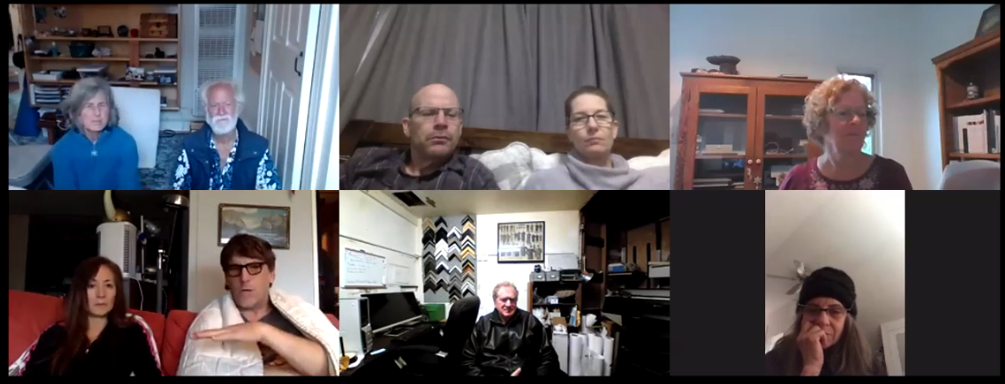
https://youtu.be/zmIafk5t2Io is the link to the Zoom video of this month’s Sunday meeting. The shorter first part of the meeting begins with a chapter reading followed by attendees’ commentary, if any. A little later on begins the longer open discussion part of the meeting when those who wish to discuss how the chapter relates to their personal experience.
Corrections?
None this time.
Reflections:
In desiring to inhale, one must first open up.
In desiring weakness, one must first strive.
In desiring to let go, one must first begin.
In desiring to get, one must first give.
This saying is little understood.
This saying is little understood was the first thing that caught my eye today. Was this referring to the four lines above it, or the three lines below it? The four lines above it describe the journey Yin takes to get to Yang, so to speak. Chapter 2 offers a more complete picture, Hence existence and nothing give birth to one another. But, what initiates the cycle? Chapter 40 is clear:
The root of existence appears to lie in nothing, loss, death — non-being. In modern language, I often think of this as entropy. But this is about just one half of the cycle, the half that living things pass through. In desiring to get, one must first give reminds me of the process an infant goes through to get to the point of walking. This is the elementary phase we all pass through, and offers a universal model for the rest of our lives. The infant must first give to crawling and stumbling. In desiring to let go, one must first begin points out that the only way to pass through the crawling and stumbling phase is to first begin. To paraphrase this process: In desiring to be adept, one must first make mistakes.
This suggests why This saying is little understood. After all, how utterly easy is it for us to attempt to save others, and especially our children, from making mistakes in life? We project our fear of failure, fear of mistakes, out onto the world blinding us to the essential phase mistakes play in getting us to where we are meant to be.
In desiring weakness, one must first strive is a little more difficult to pick apart. Reflecting over my life, I see patience as my more powerful approach to life. That seems paradoxical because we innately associate power with striving. Only through striving diligently do we feel we’ll get what we desire, which is true initially. Yet, without the deep patience required to persevere, any striving soon peters out. Taking life step-by-step over the long haul is the secret, yet to really appreciate that, one must first strive a great deal, rushing ahead to make life happen. “Fools rush in where angels fear to tread”, as they say.
In raising my kids, I realized that my patience was the only leverage they had little understanding of. Everything else they had in abundance. If I reacted emotionally to any aspect of life, they innately knew where I was coming from. But, waiting patiently while they clamored for something; that was a mystery to them. I could wait them out. And in being able to do that, I had gained their innate respect.
Open up, strive, begin, give encompass our lives, and gradually over the decades, we end up next to inhale, weakness, let go, get. Of course, there are more articulate ways to put these phases, but leaving them less defined invites the mind to look deeper, if it is ready. And if it isn’t, well, This saying is little understood.
Weakness is superior to strength.
Fish can’t escape from the deep.
A country’s weapons can’t instruct the people.
This saying is little understood unquestionably applies to the line, Weakness is superior to strength. Darwinian adaptation by natural selection would be impossible if life had such innate understanding. Evolution by natural selection works through ignorance, not through knowing. Organisms do not know what will succeed. They experiment blindly. Most attempts fail. A few succeed. Life advances through countless mistakes, not through foreknowledge. As chapter 38 notes, Foreknowledge of the way, magnificent yet a beginning of folly.
Weakness, after all, is the end of the adaptation journey, before beginning again through natural selection. And for an individual’s life, humility and patience result though the eventual “failure” of striving, beginning, giving, and opening up. I don’t mean short term failure; in the short term, striving and the rest bring success. But when one reaches the peak of success, what then? The only next step is back to the valley of new beginnings. “You can’t rest on your laurels”, as they say. Ironically, success is most powerful as a desire for, a dream of, but in reality is quite empty, at least for the “successful”. Others may benefit forever off such success, but not so for the one who succeeded. What drives them keeps driving them onward and upward, peak after peak. Until weakness and letting go overtake them.
Fish can’t escape from the deep makes much more sense now that I see it in its more literal form. D.C. Lau’s translation — The fish must not be allowed to leave the deep — never made sense to me. I think back to a time when I imagined what it would be like if all of creation were the color blue. I realized that I wouldn’t know it; there would be no contrast to what wasn’t blue. Likewise, fish in the water, in the deep, only know water; the fish can’t escape from their deep just as we can’t escape from our own “deep”. We can’t get outside of — escape from — the consciousness we are swimming in. And this may be especially bewildering for a creature with imagination. We can imagine escaping, which I assume gives rise to our myths of enlightenment, heaven, or even escape through drugs.
Finally we come to A country’s weapons can’t instruct the people. I’m sure I’ve found “clever” deeper readings of this before. Not this time. Then again — something just occurred to me, probably not for the first time. Weapons are simply tools to fight off threats to survival. Animals throughout the animal kingdom use various weapons, either evolved ones as defensive poisons or as Chimpanzees who throw rocks, sticks, and feces at rivals or threats, including humans and predators. So, yes, I don’t see how weapons would ever serve to instruct the people or chimps alike. Weapons are not instruments of instruction by anyone, only tools of deterrence, dominance, or aggression. Only lived experience serves to eventually instruct any creature, including us despite our persistent desires and ideals for otherwise. Chuang Tzu’s story about the Wheelwright nails that beautifully:
Duke Huan and the wheelwright
This wonderful little story, “Duke Huan and the wheelwright” by Chuang Tzu, speaks to the essential difference between understanding (i.e., knowledge) and knowing. (Excerpted from The Writing of Chuang Tzu)
Duke Huan was in his hall reading a book. The wheelwright P’ien, who was in the yard below chiseling a wheel, laid down his mallet and chisel, stepped up into the hall, and said to Duke Huan, “This book Your Grace is reading-may I venture to ask whose words are in it?”
”The words of the sages,” said the duke.
”Are the sages still alive?”
”Dead long ago,” said the duke.
”In that case, what you are reading there is nothing but the chaff and dregs of the men of old!”
”Since when does a wheelwright have permission to comment on the books I read?” said Duke Huan. “If you have some explanation, well and good. If not it’s your life!”
Wheelwright P’ien said, “I look at it from the point of view of my own work. When I chisel a wheel, if the blows of the mallet are too gentle, the chisel slides and won’t take hold. But if they’re too hard, it bites in and won’t budge. Not too gentle, not too hard-you can get it in your hand and feel it in your mind. You can’t put it into words, and yet there’s a knack to it somehow. I can’t teach it to my son, and he can’t learn it from me. So I’ve gone along for seventy years and at my age I’m still chiseling wheels. When the men of old died, they took with them the things that couldn’t be handed down. So what you are reading there must be nothing but the chaff and dregs of the men of old.”
And here I sit adding my own words to the pile, which at my age will likewise be chaff and dregs of one dead and gone. The wheelwright would set down his mallet and tell me the same thing: that whatever I’ve actually learned in eight decades of living can’t be in these paragraphs, because it can’t be put into words at all. I certainly am keenly aware of that! Yet, I write anyway, not to hand any wisdom across time, which can’t be done, but because the writing is itself a kind of chiseling, always attempting to make my own blows just right for the task at hand. Honestly, my commentary was never for the reader. It was my practice.
Chapter Archive https://youtu.be/cl6J8L8Kbv8
This is the complete video. It begins with blowing Zen followed by the meeting