Translation
In desiring to inhale, one must first open up.
In desiring weakness, one must first strive.
In desiring to let go, one must first begin.
In desiring to get, one must first give.
This saying is little understood.
Weakness is superior to strength.
Fish can’t escape from the deep,
A country’s good tools can’t instruct the people.
1) support (bring; handle, will> lead, command) desire (longing; wish; want; about to) inhale through the nose of certainly (must) solid (firm <frml> in the first place) open (spread; stretch) of.[1]将欲歙之,必固张之。(jiāng yù shè zhī, bì gù zhāng zhī.)
2) support (bring; handle, will> lead, command) desire (longing; wish; want; about to) weak (inferior <frml> a little less) of certainly (must) solid (firm <frml> in the first place) strive (make an effort; powerful) of. 将欲弱之,必固强之。(jiāng yù ruò zhī, bì gù jiàng zhī.)
3) support (bring; handle, will> lead, command) desire (longing; wish; want; about to) give up (abandon; waste) of, certainly (must) solid (firm <frml> in the first place) prosper (begin; encourage > get up) of. 将欲废之,必固兴之。(jiāng yù fèi zhī, bì gù xīng zhī.)
4) support (bring; handle, will> lead, command) desire (longing; wish; want; about to) take (get; seek) of, certainly (must) solid (firm <frml> in the first place) give (participate in) of . 将欲取之,必固与之。(jiāng yù qŭ zhī, bì gù yú zhī.)
5) <grm> is (yes <frml> this; that) say (call; name; meaning; sense) minute (tiny) bright (clear; honest; know). 是谓微明。(shì wèi wēi míng.)
6) weak (delicate) victory (success; surpass; be superior to) firm (staunch; unyielding). 柔弱胜刚强。(róu ruò shèng gāng qiáng)
7) fish no (not) can take off (cast off; escape from > neglect> if) in (at, to, from, by, than, out of) deep pool (deep), 鱼不可脱于渊,(yú bù kĕ tuō yú yuān,)
8) country (state; of our country) of sharp weapon (good tool) no (not) can show (notify; instruct) human (man; people). 国之利器不可以示人。(guó zhī lì qì bù kĕ yĭ shì rén.)
[1] of [之] connects modifier and word modified.
Fourth Pass: Chapter of the Month
(Trump era)
Zoom on YouTube Recordings:
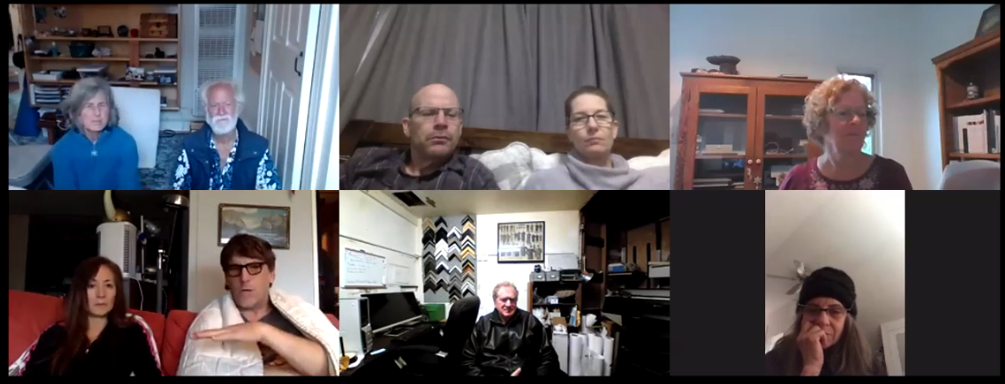
https://youtu.be/zmIafk5t2Io is the link to the Zoom video of this month’s Sunday meeting. The shorter first part of the meeting begins with a chapter reading followed by attendees’ commentary, if any. A little later on begins the longer open discussion part of the meeting when those who wish to discuss how the chapter relates to their personal experience.
Corrections?
None this time.
Reflections:
In desiring to inhale, one must first open up.
In desiring weakness, one must first strive.
In desiring to let go, one must first begin.
In desiring to get, one must first give.
This saying is little understood.
This saying is little understood was the first thing that caught my eye today. Was this referring to the four lines above it, or the three lines below it? The four lines above it describe the journey Yin takes to get to Yang, so to speak. Chapter 2 offers a more complete picture, Hence existence and nothing give birth to one another. But, what initiates the cycle? Chapter 40 is clear:
The root of existence appears to lie in nothing, loss, death — non-being. In modern language, I often think of this as entropy. But this is about just one half of the cycle, the half that living things pass through. In desiring to get, one must first give reminds me of the process an infant goes through to get to the point of walking. This is the elementary phase we all pass through, and offers a universal model for the rest of our lives. The infant must first give to crawling and stumbling. In desiring to let go, one must first begin points out that the only way to pass through the crawling and stumbling phase is to first begin. To paraphrase this process: In desiring to be adept, one must first make mistakes.
This suggests why This saying is little understood. After all, how utterly easy is it for us to attempt to save others, and especially our children, from making mistakes in life? We project our fear of failure, fear of mistakes, out onto the world blinding us to the essential phase mistakes play in getting us to where we are meant to be.
In desiring weakness, one must first strive is a little more difficult to pick apart. Reflecting over my life, I see patience as my more powerful approach to life. That seems paradoxical because we innately associate power with striving. Only through striving diligently do we feel we’ll get what we desire, which is true initially. Yet, without the deep patience required to persevere, any striving soon peters out. Taking life step-by-step over the long haul is the secret, yet to really appreciate that, one must first strive a great deal, rushing ahead to make life happen. “Fools rush in where angels fear to tread”, as they say.
In raising my kids, I realized that my patience was the only leverage they had little understanding of. Everything else they had in abundance. If I reacted emotionally to any aspect of life, they innately knew where I was coming from. But, waiting patiently while they clamored for something; that was a mystery to them. I could wait them out. And in being able to do that, I had gained their innate respect.
Open up, strive, begin, give encompass our lives, and gradually over the decades, we end up next to inhale, weakness, let go, get. Of course, there are more articulate ways to put these phases, but leaving them less defined invites the mind to look deeper, if it is ready. And if it isn’t, well, This saying is little understood.
Weakness is superior to strength.
Fish can’t escape from the deep.
A country’s weapons can’t instruct the people.
This saying is little understood unquestionably applies to the line, Weakness is superior to strength. Darwinian adaptation by natural selection would be impossible if life had such innate understanding. Evolution by natural selection works through ignorance, not through knowing. Organisms do not know what will succeed. They experiment blindly. Most attempts fail. A few succeed. Life advances through countless mistakes, not through foreknowledge. As chapter 38 notes, Foreknowledge of the way, magnificent yet a beginning of folly.
Weakness, after all, is the end of the adaptation journey, before beginning again through natural selection. And for an individual’s life, humility and patience result though the eventual “failure” of striving, beginning, giving, and opening up. I don’t mean short term failure; in the short term, striving and the rest bring success. But when one reaches the peak of success, what then? The only next step is back to the valley of new beginnings. “You can’t rest on your laurels”, as they say. Ironically, success is most powerful as a desire for, a dream of, but in reality is quite empty, at least for the “successful”. Others may benefit forever off such success, but not so for the one who succeeded. What drives them keeps driving them onward and upward, peak after peak. Until weakness and letting go overtake them.
Fish can’t escape from the deep makes much more sense now that I see it in its more literal form. D.C. Lau’s translation — The fish must not be allowed to leave the deep — never made sense to me. I think back to a time when I imagined what it would be like if all of creation were the color blue. I realized that I wouldn’t know it; there would be no contrast to what wasn’t blue. Likewise, fish in the water, in the deep, only know water; the fish can’t escape from their deep just as we can’t escape from our own “deep”. We can’t get outside of — escape from — the consciousness we are swimming in. And this may be especially bewildering for a creature with imagination. We can imagine escaping, which I assume gives rise to our myths of enlightenment, heaven, or even escape through drugs.
Finally we come to A country’s weapons can’t instruct the people. I’m sure I’ve found “clever” deeper readings of this before. Not this time. Then again — something just occurred to me, probably not for the first time. Weapons are simply tools to fight off threats to survival. Animals throughout the animal kingdom use various weapons, either evolved ones as defensive poisons or as Chimpanzees who throw rocks, sticks, and feces at rivals or threats, including humans and predators. So, yes, I don’t see how weapons would ever serve to instruct the people or chimps alike. Weapons are not instruments of instruction by anyone, only tools of deterrence, dominance, or aggression. Only lived experience serves to eventually instruct any creature, including us despite our persistent desires and ideals for otherwise. Chuang Tzu’s story about the Wheelwright nails that beautifully:
Duke Huan and the wheelwright
This wonderful little story, “Duke Huan and the wheelwright” by Chuang Tzu, speaks to the essential difference between understanding (i.e., knowledge) and knowing. (Excerpted from The Writing of Chuang Tzu)
Duke Huan was in his hall reading a book. The wheelwright P’ien, who was in the yard below chiseling a wheel, laid down his mallet and chisel, stepped up into the hall, and said to Duke Huan, “This book Your Grace is reading-may I venture to ask whose words are in it?”
”The words of the sages,” said the duke.
”Are the sages still alive?”
”Dead long ago,” said the duke.
”In that case, what you are reading there is nothing but the chaff and dregs of the men of old!”
”Since when does a wheelwright have permission to comment on the books I read?” said Duke Huan. “If you have some explanation, well and good. If not it’s your life!”
Wheelwright P’ien said, “I look at it from the point of view of my own work. When I chisel a wheel, if the blows of the mallet are too gentle, the chisel slides and won’t take hold. But if they’re too hard, it bites in and won’t budge. Not too gentle, not too hard-you can get it in your hand and feel it in your mind. You can’t put it into words, and yet there’s a knack to it somehow. I can’t teach it to my son, and he can’t learn it from me. So I’ve gone along for seventy years and at my age I’m still chiseling wheels. When the men of old died, they took with them the things that couldn’t be handed down. So what you are reading there must be nothing but the chaff and dregs of the men of old.”
And here I sit adding my own words to the pile, which at my age will likewise be chaff and dregs of one dead and gone. The wheelwright would set down his mallet and tell me the same thing: that whatever I’ve actually learned in eight decades of living can’t be in these paragraphs, because it can’t be put into words at all. I certainly am keenly aware of that! Yet, I write anyway, not to hand any wisdom across time, which can’t be done, but because the writing is itself a kind of chiseling, always attempting to make my own blows just right for the task at hand. Honestly, my commentary was never for the reader. It was my practice.
Chapter Archive https://youtu.be/cl6J8L8Kbv8
This is the complete video. It begins with blowing Zen followed by the meeting
Third Pass: Chapter of the Month
Corrections?
You bet! I’m rethinking the last line, A country’s weapons can’t instruct the people. I need to replace weapons for the more fundamental connotation. I’ll explain more at the end.
YouTube Recordings:
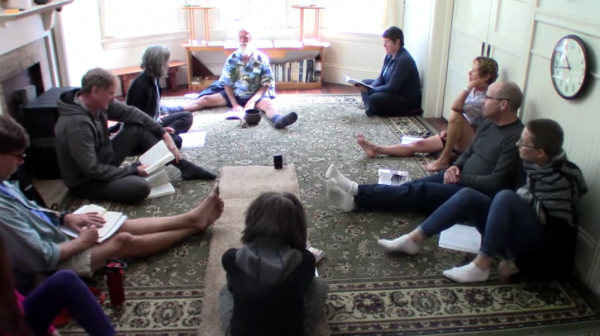 https://youtu.be/0U8qmTf0Img is the link to the complete video recording of our monthly Sunday meeting. For the nicely edited version, go to Kirk Garber’s YouTube channel. The edited version comes in two parts: The first and shorter Commentary part begins with a chapter reading followed by attendees’ commentary, if any. The second and longer Open Discussion part offers attendees’ observations on how the chapter relates to their personal experience.
Reflections:
In desiring to inhale, one must first open up.
In desiring weakness, one must first strive.
In desiring to let go, one must first begin.
In desiring to get, one must first give.
This chapter was one of the first that truly resonated with me early on. At the time, I had the ideal that selflessness was a virtue. This chapter helped me realize that, to paraphrase, In desiring to be selfless, one must first be selfish.
We easily find ourselves in various states of imbalance thanks to the tradeoff humanity ‘chose’ to make to maximize comfort and security. I say ‘chose’ in an evolutionary sense of the word, similar to how redwood trees ‘chose’ to reach to the sky, or the whale’s ancestors ‘chose’ to leave land for the sea. (See The Tradeoff )
Civilization requires a hierarchical social structure that leaves all of us more action oriented than our ancestors were. While our hunter-gatherer ancestors struggled to survive, their circumstances didn’t push for progress… starting with ideals to be more than you naturally are. Natural balance was the status quo. Such natural balance status quo is difficult to maintain in the face of the drive to ‘get ahead’, to climb the ladder to success… all essentially with the objective to be a bona fide somebody!
Entangled in our push for control, progress and power, our innate organic animal nature yearns to let go, inhale, relax, and feel content. In a word, find peace. These four lines bluntly remind us that there is a prerequisite. Through striving, you reach weakness; through beginning, you let go; through giving you get… and through selfish you reach selfless. And finally, through life you reach death.
This saying is little understood.
Naturally, this process is little understood. Civilization’s prime directive is the push for progress, achievement, power, control. We are reared from infancy, exposed to this achievement-oriented drumbeat of civilization. The weakness yin side of life’s cycle gets little attention or consideration.
Weakness is superior to strength.
Weakness correlates to death. Death = reality. Weakness and death also correlate to silence, emptiness, stillness — eternity. (See Tools of Taoist Thought: Correlations) This realm of profound sameness is invincible and impenetrable. Civilization, by and large, worships at the alter of strength and progress. Weakness is a thing to be overcome. That is civilization’s raison d’être.
Fish can’t escape from the deep.
If the whole universe was the color of blue, no one could see blue. Contrast of ‘otherness’ is necessary to identify and give a name to (label) something… anything. The human mind, especially since the end of the hunter-gatherer existence has been preoccupied with naming experience. Indeed, if ‘it’ doesn’t have a name we don’t feel it exists, or it hardly exists at all. The naming of our experience becomes a blinder that prevents us from knowing the deep… the ‘blue’ of the universe, so to speak. Without labels, the mind must confront itself in utter honesty. There is no rationalization to hide behind.
A country’s weapons can’t instruct the people.
The actual characters translated here as weapon is worth a deeper look. The dual character 利 器 (lì qì) means sharp weapon or good tool. Most, if not all translators interpret this duo as ‘weapon’. ‘Weapon’ certainly forces an overly narrow view compared to ‘good tool’. Consider how these characters suggest a broader interpretation…
利 lì = sharp; favorable; advantage; profit; interest.
器 qì = implement; utensil; ware; organ; capacity; talent.
Thus, I favor using ‘good tool’ over ‘weapon’. ‘Good tool’ encompasses more of the various character meanings above, e.g., favorable + talent; profit + capacity; advantage + implement.
Briefly, the favoring of good tools overshadows deeper instruction. Alas, this is all part of the tradeoff humanity made long ago.
Again, civilization lies at the core of this problem. Power and achievement are overwhelmingly and intimately linked to the use of tools. Tools play a major role in our pursuit of greater security and comfort. Left far behind are instruction on the deeper qualities of life issues that everyone values, but nevertheless take a back seat to progress.
Chapter Archive https://youtu.be/4NTOl-5ULmM
This is the complete video. It begins with blowing Zen followed by the meeting
Second Pass: Work in Progress
Issues:
Nothing other than a missing period stood out today. The translations / interpretation is pretty straightforward. I shortened the formal xī (歙) inhale through the nose to simply inhale. Truth be told, there is a difference, as you will see if you ‘consciously’ inhale through the nose. Our breathing often reflects the life tensions we harbor. Relaxing enough to open up and take a full breath through the nose (not the mouth) really helps ground us during stressful circumstances. I suppose I felt inhale through the nose fails to convey this subtly well enough. That probably means I’ll change it back someday.
D.C. Lau’s last two lines don’t convey what I see the characters say. His interpretation is, The fish must not be allowed to leave the deep; The instrument of power in a state must not be revealed to anyone. I can’t help but hear undertones of free will. More importantly, the characters more literally say, Fish can’t escape from the deep. A country’s weapons can’t instruct the people.
As I see it, the idea of ‘allowing the fish to leave the deep’ is not an option. Frankly, we can only see the ‘fish’ we want to see. The ‘deep’ is more about a depth of mind of the observer, that anything ‘out there’. Depth of mind naturally sees the deeper fish, so to speak. Thus, it is not a question of “allowing” or not, but rather, about how deep ‘fish can’t escape from the deep‘. The same applies to the so called “instruments of power”. Our own fears and needs blind us to the obvious. Everything is open for view in nature; it is our blind spot that obstructs perception.
Commentary:
I’ve always liked the way D.C. Lau translated the beginning of this chapter. Maybe this is an example of when more words can actually say more, even if it isn’t exactly what the original says?
His, If you would have a thing weakened, You must first strengthen it is another way of considering entropy. It is not that entropy is a desirable goal in life. Just the opposite usually; life’s main task is resisting entropy. However, it is the cold hard reality. Coming to terms with how nature works is the only way to find contentment, and well, ‘peace on earth’. Roller coasters are a good metaphor for life. Gestation in the womb is the cog-journey to the top of the ride. Birth is the rush into life. As time goes by, the ups and downs gradually smooth out. One begins to see the ups when down, and the downs when up. It’s called perspective. Knowing the process helps cope with the ups and downs a little better, I find… as I head toward the end of my ride.
Just a few more words on the last two lines:
The Chinese says the “fish can not escape the deep”, not as Lau puts it, The fish must not be allowed to leave the deep. This is significant. The former is attempting to reveal what nature is really like. The later is attempting to tell us what we should do to ‘control’ nature. In my view, the principles (truths, axioms) the Tao Te Ching speaks about are self evident and knowable to all. The only reason we can’t see the self-evidence is that it doesn’t show us what we desire to see. That is why the sage did not use it to enlighten
the people but to hoodwink them. Not only the sage, but also biology (see How the Hoodwink Hooks).
Suggested Revision:
In desiring to inhale, one must first open up.
In desiring weakness, one must first strive.
In desiring to let go, one must first begin.
In desiring to take, one must first give.
This saying is little understood.
Weakness is superior to strength.
Fish can’t escape from the deep.
A country’s weapons can’t instruct the people.
First Pass: Chapter of the Week
No matter how strong and active life is, it always ends in weakness and stillness (death). That is why we say, the submissive and weak will overcome the hard and strong. Yet, even at the everyday level, weakness is profoundly useful. It is the ‘power’ of the mysterious female. I see this linkage between ‘power’ and weakness as a co-generating principle of nature.
This co-generating principle is obvious in how before and after follow each other. Likewise, but perhaps less obvious, selfish and selfless complement each other, life and death harmonize with each other, right and wrong produce each other, and so on. We make life more difficult than need-be by favoring one side at the expense of the other. Although, this is just the way nature (instinct) intends it to be, I might add. Why? Let’s just say such hoodwinking serves interaction and evolution. Curiously, defying this instinct and doing my utmost to attain emptiness, allows the weak to get the better of the unyielding. This breaks up any ’emotional log jams’ and helps bring on a resurgence of effort to move forward.
Feeling the importance of moving forward in life is universal. We must move forward and persevere (or at least feel we are) to feel Right with life. Fundamentally, life meaning lies in movement. When we feel stuck, movement becomes impossible. The way of addressing this ‘movement issue’ is what differentiates Taoism from ‘common sense’. For example, pushing for movement can often produces its opposite – feeling even more stuck. Rather than push even harder, the Taoist way does not contend with the ’emotional log jam’, but rather becomes one with it. Curiously, this allows life’s movement to return naturally and effortlessly. In short, the easiest way to bring about the side desired is to return to the other. Put another way, we can only truly have what we let go of. (That such going against natural inclinations works so well probably accounts for the continuous state of irony I feel.)
I translate / interpret the end of this chapter quite differently than D.C. Lau. First, I reckon it is not that ‘the fish must not be allowed to leave the deep‘. Rather, fish can’t escape from the deep. The implication of the former is that we have a choice in the matter. The later offers a view of ‘that which is naturally so‘. Next, how can one reveal ‘the instruments of power’, even if one wanted too? After all, ‘my words are easy to understand...’.More realistic, if still somewhat obscure, is the idea that a state’s weapons can’t instruct the people. Although it does parallel my sense that true learning can only arise from within. True ignorance can’t be un-taught through external measures like ‘education’. Nuts, that’s not what we want to hear!