Superior virtue is not virtuous, and so has virtue.
Inferior virtue never deviates from virtue and so is without virtue.
Superior virtue never acts and never believes.
Inferior virtue never acts yet believes.
Superior benevolence acts yet never believes.
Superior justice acts and believes.
Superior etiquette acts but when none respond,
Normally rolls up its sleeves and throws away.
Hence, Virtue follows loss of way.
Benevolence follows loss of virtue.
Justice follows loss of benevolence.
Ritual follows loss of justice.
Ways of chaos follow loss of loyalty and thinning faith in ritual.
Foreknowledge of the way, magnificent yet a beginning of folly.
The great man dwells in the thick, not in the thin.
Dwells in the true, not in the magnificent.
Hence, he leaves that and takes this.
~~~~~~~~~~~~~~~~~~~~~~~~~~~~~~~~~~~~~~

Word for Word
Limits: Translations, even the nearly literal one above, lose some of the original meaning due to the cultural context of contemporary words. Studying the numerous synonym-like meanings of the Chinese characters in the Word-for-Word translation mitigates this.
Fourth Pass: Chapter of the Month
(Trump era)
Archive: Characters and past commentary
Zoom on YouTube Recordings:
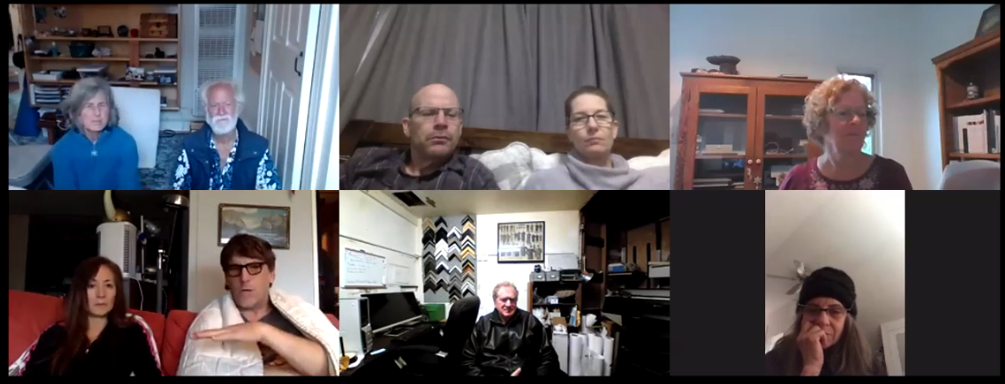
https://youtu.be/pDJywOWL_s0 is the link to the Zoom video of this month’s Sunday meeting. The shorter first part of the meeting begins with a chapter reading followed by attendees’ commentary, if any. A little later on begins the longer open discussion part of the meeting when those who wish to discuss how the chapter relates to their personal experience.
Corrections?
This is more an honest accounting of what I’m doing here: I write thousands of words of naming to argue that naming cuts us off from the way—thin abstraction praising the thick present it isn’t in. And yes, I catch myself doing it, constantly. This catching, this awareness, is more thinking; the accounting more naming. The ape that thinks can’t think its way out of thinking. So I don’t offer this as escape—only as the disease describing itself, one layer watching the next, all the way down. Chapter 71 lays it out well: Realizing I don’t know is better; not knowing this knowing is disease. Man alone faults this disease; this so as not to be ill. Line 1 diagnoses the disease, and line 2 offers the only treatment possible, which is acknowledging the disease. The faulting is still more thinking, but the kind that loosens the grip rather than tightens it. This doesn’t cure the disease that natural selection “gifted” us with evolutionarily, but it does make it less severe.
Interpretation is everything
The same disease shows up in how the line gets translated. Note my Word for Word translation of lines 3 and 4:
Superior virtue never acts and never believes. 上德无为而无以为
Inferior virtue never acts yet believes. 下德无为而有以为
The line 无以为 splits two ways. One parse—无 + 以为—reads “never believes,” the story-over-the-drive. The other—无以 + 为—reads “nothing by which to act,” which looks like without motive, and at first glance the two seem roughly equal. The second dissolves the moment you press it: no living thing acts without motive. Fear drives need, need drives action; that current runs through every creature, superior grade and inferior, animal and human alike. If 无以为 meant “without motive,” it would describe nothing that lives—so it can’t be what the chapter contrasts.
Yet, a translator can easily choose “motive” over “never believes”. And as it happens, the mainstream lands almost entirely on motive/purpose, not “belief.” The “take-to-be / regard / believe” reading of 以为 that I favor is essentially my own. For example:
Translator — Rendering
D.C. Lau — “from no ulterior motive”
Waley — “no ulterior motive”
Legge — “did nothing (with a purpose)… no need”
Henricks — “no reason for acting this way”
Addiss & Lombardo — “take no action / don’t need to act”
Feng / English — “no need to act”
Stenudd — “without ulterior motive”
Every canonical translator takes motive or need, over believing, although ‘ulterior’ already gestures at the layer I mean. As a lexical reading, “believing” stands essentially alone. So the mainstream half-sees the layer but keeps the vocabulary of motive; their contrast is more about intention-vs-none, not story-vs-drive.
Belief is arguably the sturdier reading. 以为—”take-to-be,” regard, assume—points not at the drive underneath, which is universal, but at the story laid over it: the naming, the “should,” the self watching itself act. The animal has fear, need, action, full stop. The human adds the layer. Both act from motive; only one believes. The chapter never contrasted motive with no-motive—every grade has both. It contrasts unstoried drive with storied drive, and naming, once again, is the culprit. So why do most translators opt for motive over belief? Perhaps they are still in the story, which leans toward an implied freedom to choose our motive, our intention.
Reflections:
Superior virtue is not virtuous, and so has virtue.
Inferior virtue never deviates from virtue and so is without virtue.
Superior virtue never acts and never believes.
Inferior virtue never acts yet believes.
Superior benevolence acts yet never believes.
Superior justice acts and believes.
Superior etiquette acts but when none respond,
Normally rolls up its sleeves and throws away.
This begins with Superior virtue is not virtuous, and so has virtue which ties right back to chapter 1, The way possible to think, runs counter to the constant way. The name possible to express runs counter to the constant name . The seeming paradox of, superior virtue is not virtuous, demolishes the word meaning, and invites the curious mind to enter the wondrous entrance. As chapter 1 concludes: These two are the same coming out, yet differ in name. The same, meaning dark and mysterious. Dark and dark again, the multitude of wondrous entrance.
Setting aside the entwined nature of Superior virtue, the idea that nature abhors a vacuum fits nicely here. When a vacuum—the loss or waning of something—exists, Nature fills the void; here the loss is filled with Inferior virtue and so on down the line.
I note how believes and never believes is a cornerstone of these lines. Belief, of course, is tied directly to chapter 71’s, Realizing I don’t know is better; not knowing this knowing is disease. Thus, Superior virtue never acts and never believes is what natural virtue would look like; allowing nature to play out can only occur when there is no belief of a “better” outcome to drive action. Is this not an essence of chapter 3’s Doing without doing, following without exception rules? Of course, allowing nature to play out goes against the grain of biological forces, the needs and fears, that drive all living things. Honestly this is pointing to an idea beyond possibility. Yet the ideal offers hope to at least move in this direction—be more patient, count to 10 before acting, and as chapter 16 suggests, Devote effort to emptiness, sincerely watch stillness. This is where Inferior virtue never acts yet believes enters. We feel what we feel, and feelings drive our beliefs, and vice versa. But, if we are fortunate enough to have presence of mind, at least we can refrain from acting on our feelings and beliefs.
Superior benevolence acts yet never believes would be the kind of empathetic actions that an animal would take. They have no back-story to prodding them on, simply spontaneous emotion. Of course, that also happens in us, when our actions are arising from Superior benevolence. The chapter doesn’t continue with “inferior benevolence” but we can infer… “Inferior benevolence acts and believes”. I assume this form of benevolence is accompanied by the usual, “should do” and the pressure of guilt and self-identity—complicated layers of fear, need, worry.
And when all else fails, we Normally roll up [our] sleeves and throw away.
Hence, Virtue follows loss of way.
Benevolence follows loss of virtue.
Justice follows loss of benevolence.
Ritual follows loss of justice.
Ways of chaos follow loss of loyalty and thinning faith in ritual.
A vacuum destabilizes negentropy — the improbable order that is life — so a stabilizer is needed, not merely convenient. I’ve always read this as a layered chain, each layer serving as a stabilizer when the most stable, more foundational, layer loses its ability to stabilize. Virtue wanes, benevolence waxes; as benevolence wanes, justice waxes; as justice wanes, ritual waxes.
Another way to picture this is to see the way as the foundation, and virtue, benevolence, justice, ritual stacked upon the way, each narrower than the last. Not that narrower is “bad”, but rather the necessary layer to stabilize life. Each becoming the dominant stabilizer when the more foundational one’s stabilizing effect diminishes. For example, we only devise the ritual of stop signs and the laws enforcing compliance when the watchful sense of benevolence becomes swamped by our rush to get where we’re going. We post a stop sign only after the accidents, where awareness has already failed and the mind was elsewhere. Ritual is the stop sign of a distracted species. The narrowing simply measures how far we’ve travelled from the wide root.
But to be honest, the “root”—the way—encompasses all, down to the narrowest of narrow, as chapter 34 alludes: The great way flows, such as it may left and right. It is easy to take a hierarchical view of this, where the way is seen as something to seek, as in “seek and ye shall find”. The hardest thing to see is how what we are really doing is attempting to feel the way that is already and always here. It’s not that ritual is outside the way; it is more that, being distracted, we don’t feel the way. Animals use ritual all the time; it is an essential part of life. They too face the danger of distraction—just not via naming. Essentially we are just animals, so the same processes apply to us as to them. In the big picture there may be no difference at all: we are simply blinded by our own story, and that is just something we must work through. What we’ve actually done is give a name, a story, for something we feel behind it all and to which we long to reconnect.
What is really happening is that our dipolar mind, by naming its perceptions, creates a feeling of disconnection within us. By dipolar I mean bipolar in the literal, scientific sense—two-poled: subject and object, knower and known, self and world. Naming splits the single field into these two poles, and in that split we feel cut off. We then make things up, a story to tell us there is a way back. It is all contained in the word religion, which breaks down like this: religion is from the Latin religare—re = again + ligare = to bind, to connect. Similarly, yoga is from the Sanskrit yuj = to join, to unite. Both are primarily about our dire need for connection. The paradox is that we are seeking something already and always within; we just don’t feel it, because our naming disconnects us.
The first three lines here are a more pithy review of the chain of command listed at the beginning of the chapter. The way is the foundation of reality, that is impossible to think or have a name to express… but, we need something to hold onto, and so chapter 25 offers us a few crumbs to clutch onto.
Ways of chaos follow loss of loyalty and thinning faith in ritual brought to my mind today of the life our hunter-gatherer ancestor lived compared to civilized life. They lived in a maximum loyalty environment, intimately sharing life, birth to death, with each other. Their faith in the way of life, and in each other was largely unquestioned. They had no alternative story; theirs was one of lived maximal homogeneity. With the advent of civilization and its hierarchical social structure, much of that deep lived faith and loyalty was lost… Ways of chaos follow loss of loyalty and thinning faith in ritual. Ritual, by the way, can be understood to be life habit or way of life, and so faith in ritual would be simply faith in their way of life.
Ritual made personal has a sharp little test built into it. When another’s way of doing a thing irritates me—their order, their method, their habit—that irritation is the tell. It means I’m stuck in my own ritual, my own need to have it my way… justice, benevolence, virtue, the way, all gone for the moment. The more stabilizing layers have waned, and if I’m not careful the last layer will replace even ritual: I’ll roll up my sleeves and throw it away. The irritation was never really about them. It’s a symptom of my own narrow clinging.
Foreknowledge of the way, magnificent yet a beginning of folly.
The great man dwells in the thick, not in the thin.
Dwells in the true, not in the magnificent.
Hence, he leaves that and takes this.
Foreknowledge of the way, magnificent yet a beginning of folly I’ve always taken to mean predictive thoughts, projection into an imagined future. That’s still part of it I feel, but today I see it the knowledge aspect to be key, whether knowledge of the past, present, of future. This magnificent cognitive ability we have to objectify reality, and store this in memory, in imagination, is what seems to truly separate us from the rest of nature. Yet a beginning of folly is when we don’t realize that we don’t know, as chapter 71 puts it, not knowing this knowing is disease.
The great man dwells in the thick, not in the thin is simply the person described in the next line of chapter 71, Man alone faults this disease; this so as not to be ill. Our true problem is not the emotional certainty we place in our thoughts, so much as our inability to realize that we have this problem. It is like an addict before he realizes he has a disease; only after acknowledging he’s an addict has he any hope of good management of the problem. We are who we have evolved to be. It is foolish to criticize natural evolution for trying out enhanced cognition to further survival in a hominid species.
But there’s a paradox here the chapter keeps circling. We are who we’ve evolved to be, and yet we spend our lives willing ourselves into someone else, some ideal we can picture but never reach. The squirrel cannot will itself into a crow. Neither can we, yet we imagine we can. The struggle to transform our lived reality to our imagined ideal is the upshot of the disease chapter 71 warns of. We are certain in our belief in the ideal; the very fight to change is itself the clinging. Only surrender—accepting who I actually am—settles the dust. When I finally accepted I was a smoker and gave up trying to quit, I stopped within weeks. But you cannot choose this, because the struggle to choose it is the very thing in the way.
I see one aspect of this magnificent yet a beginning of folly is how we are so overly taken with magnificence: Grand Canyons, Olympic champions, and all the other “shiny objects” we are drawn towards. So, dwells in the thick, not in the thin is also pointing towards one who has a more egalitarian view of life; a level playing field of reality as opposed to the mundane on one edge and the magnificent on the other. Of course, some of this bias is a biological necessity for survival. Our strength in the bias I assume to be an aspect of the hierarchical viewpoint we conditioned ourselves into—its collateral damage, so to speak. Dwells in the true, not in the magnificent just describes a mind that has broken free of this conditioning… perhaps. Aging out of life, approaching death, has a sobering effect on one’s outlook, the peaks don’t feel so high, the valleys, not so low. The road to death is paved with equanimity if you’re lucky enough.
And what is left to do along that road is simply the work of life just like every living thing must do. But note the additional work we face that other animals don’t. Other animals live wei wu wei — doing without doing or to paraphrase, working without working— unselfconsciously; they never left it. We push for ideals, act from our certainty, our agenda… and agenda is not wei wu wei. So much of our work is the peculiar human task of struggling to live up to the unrealistic agenda we set for ourselves; that makes life feel like hard work because we expect a reward—success. The more we expect, the harder the work feels. There’s no getting out of life’s work, but we can find peace within it as we trade the harder work of chasing our ideal for the easier… work in the moment at hand, which chapter 3 names doing without doing. Well… to be honest though, either way it’s work!
Perhaps our real difficulty here is an intrinsic wish to work as little as possible. I call it the laziness instinct that drives all life to be as economical as feasible when expending energy. We are caught between a rock and a hard place.
Hence, he leaves that and takes this is literally taking the present moment fully, and leaving behind fantasies of foreknowledge and the magnificent. In the end, this is all there truly is.
Chapter Archive https://youtu.be/Ynj04qdM1sQ
This is the complete video. It begins with blowing Zen followed by the meeting.