The way normally does nothing, yet there is nothing not done.
If kings and noblemen will abide by this,
Everything will self transform.
Transform yet desire rises;
Press it down using nameless simplicity.
Of nameless simplicity, man also supports without desire.
No desire and still, all under heaven will settle themselves.
~~~~~~~~~~~~~~~~~~~~~~~~~~~~~~~~~~~~~~
Word for Word
Limits: Translations, even the nearly literal one above, lose some of the original meaning due to the cultural context of contemporary words. Studying the numerous synonym-like meanings of the Chinese characters in the Word-for-Word translation mitigates this.
Fourth Pass: Chapter of the Month
(Trump era)
Archive: Characters and past commentary
Zoom on YouTube Recordings:
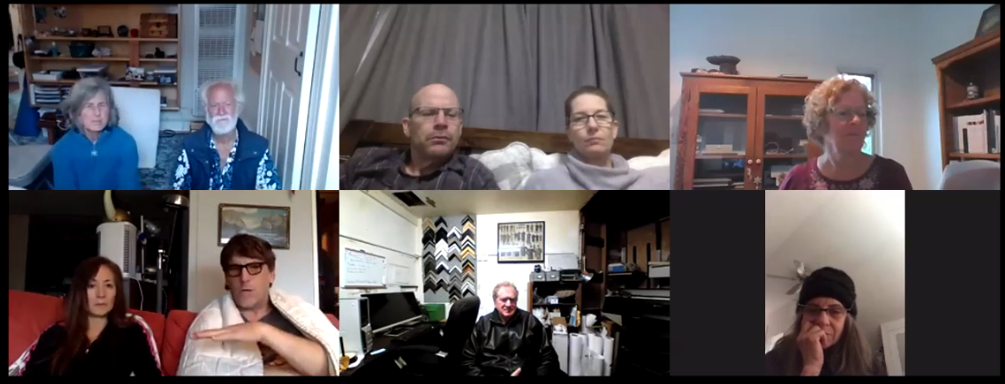
https://youtu.be/zmIafk5t2Io is the link to the Zoom video of this month’s Sunday meeting. The shorter first part of the meeting begins with a chapter reading followed by attendees’ commentary, if any. A little later on begins the longer open discussion part of the meeting when those who wish to discuss how the chapter relates to their personal experience.
Corrections?
None this time.
Reflections:
The way normally does nothing, yet there is nothing not done.
The first thing that stood out for me this time was how The way normally does nothing counters our cherished belief in free will. The idea of having the freedom to choose directly implies the directional aim steered by a personal agenda; “I want such and such to happen, and so I choose to act in a way that results in the outcome I want.” Nature has no agenda that I can see. So, naturally, the way normally does nothing. I should note here that normally is cháng ( 常= normal; constant; often). This is the constant chapter 1 points to right off the bat: The way possible to think, runs counter to the constant way. The reason the way does nothing is that it has no agenda, no deadline to meet, yet there is nothing not done.
If the way, the universe, and nature are perfect just as they are, what does that say about our freedom to choose in our pursuit of getting the things in life done? This ideal of personal agency and the free will to act is a uniquely human device; we deem ourselves the only living creature with the power of free choice. Every other life form, we believe, merely acts out of instinct.
For a deeper look at free will, see • Free Will: Fact or Wishful Thinking? • Is ‘Free Will’ the Only Option? • Of Free Will, I Am • Instinctive Free Will • Free Willers Anonymous.
If kings and noblemen will abide by this,
Everything will self transform.
Taken literally, kings and noblemen mean nothing for any of us managing our lives… unless you take kings and noblemen to instead symbolize the fact that each of us, each creature, is the king of its own life. As such, it is up to each creature to find the best way to govern their life. The point here is that if we abide by the precept that the way normally does nothing, life becomes a completely different animal. Then we set out on a path to rejoin the rest of nature rather than forcing our “free will” upon it in our futile effort to transform reality to match our ideal of what the reality should be. Instead, Everything will self transform.
I’ve proven this time and time again in my own life. And it does require constant vigilance to allow nature to take its course. Acceptance is not part of nature; biology always insists we act—now! Acceptance of the status quo for any creature soon threatens survival. I’ve found that each time I “count to ten”, life usually turns out much better than I trusted it would. Each cycle of this lesson in the way strengthens my faith in letting reality play out. This is why it takes a lifetime to gain wisdom; our stumbling gradually teaches us to walk the path of life more gracefully and patiently.
How is this process any different from Darwinian evolution, or on the smaller scale, from how an infant learns to walk? Errors, missteps, failures are the necessary steps both evolution and an infant must take to proceed successfully to the next stage. And from there, the next, and the next, and so on. Every stumble is the walking. Every mistake is perfection in that moment. The ideal of “perfection” only exists because we imagine an ultimate end, often unaware that “mistake” is the other half— the entangled nature of perfection and mistake, their profound sameness.
Reaching any next stage almost immediately becomes the new baseline, the new normal, of our life. There is no secret to a successful life; all creation follows the same process. And when you fully abide by that, the process becomes fluid. Chapter 3 sums this up: Doing without doing, following without exception rules.
Transform yet desire rises;
Press it down using nameless simplicity.
Transform yet desire rises is simply pointing out that biology is in charge; no matter how sincerely we abide by this so that everything will self transform, we are nonetheless servants of our biology. Fear, need, desire and worries propel life forward; no matter how earnestly I’m following without exception, I’m still treading water. No matter how much things change, they still end up the same. Mmm… there’s another example of profound sameness underlying apparent difference.
The solution, Press it down using nameless simplicity, is our only hope. Nameless is the key here. Our certainty, our trust and faith in names and the field of imagination our thought plays around in, keeps us going round and round. Chapter 71 diagnoses this unique human problem: Realizing I don’t know is better; not knowing this knowing is disease. And it offers a treatment: Man alone faults this disease; this so as not to be ill. That sounds good, but as usual, walk the talk is beyond our ability when facing reality. Often, just plunging in, using the body to be the off-switch works in the moment: chop wood, carry water, sweat, actual hunt and gather.
Alas, the more removed we are from ‘the wild’ the harder it is to find a physical off-switch, and when we do, it is only temporary. Over time, the longer path is weakening trust in names and the imagination that surrounds them. Chapter 23 puts it plainly:
Fluttering breezes change direction; sudden showers can’t last the day.
What does this? Heaven and earth.
Even Heaven and earth are unable to long continue,
And so what about people?
This matter is no different from a drunk finally reaching rock bottom, and viscerally knowing he is an alcoholic. Until that pivot, he trusts alcohol will solve his life’s problems and challenges. Only upon reaching bottom is he ready for AA. Likewise, we have complete trust that our words, names, and the thoughts we build from them can solve our life’s problems and challenges. I dare say, it is far easier for an alcoholic to reach bottom than for a thinking human being to see the error of his thinking. Realizing one doesn’t know feels so counterintuitive. And naturally so, for it is our ability to imagine, think, that is a key survival asset. Here, too much of a good thing has simply become our deepest problem.
That pivot — viscerally knowing, not just thinking — is exactly what weakening trust in word meaning feels like. Press it down using nameless simplicity is only possible if you can take your thoughts with a grain of salt. The weaker the trust you place in word meaning, the more you return to your original self, before thought began dominating your mind. Weakening my trust really began when my brother’s death triggered the insight that life and death were the same thing—essentially. However, it took a few decades before that led me to the correlation insight in the early ‘80s. That shattered my trust in word meaning, and all the biases that word meaning helps sustain. Yet, I don’t know whether it would also help destroy the lock names have on your mind. If you’re interested, see Tools of Taoist Thought: Correlations. In truth, does it really matter? I always find myself here, Transform yet desire rises; Press it down using nameless simplicity. So who knows? How does one actually press desire down?
There is no perfect answer because no life form would ever evolve an innate drive for simplicity—that leans toward entropy, not survival. Indeed, research shows that denying desire often intensifies it. Psychologists call this the white bear effect — try not to think of a white bear, and that’s all you think of. Desire works the same way. It can help to redirect our survival energy out of the mind and into the body — move, and the mind quiets because the body has taken over. Counting your blessings, appreciating what you have rather than mulling over what you lack are the remedies we commonly offer others and ourselves.
However, it helps to know that appreciation is not part of our DNA. Just the opposite—survival insists we take everything seriously, which for us often means we end up taking our things too seriously. This is why constant vigilance and reflection are needed to feel content with reality. Chapter 46 offers the ideal: Therefore, in being contented with one’s lot, enough is usually enough indeed. Turning chapter 46’s ideal into a practice takes vigilance, takes work.
Of nameless simplicity, man also supports without desire.
No desire and still, all under heaven will settle themselves.
Of nameless simplicity, man also supports without desire for me means not getting too carried away with nameless simplicity as the “answer”. The ideal is a useful target for life, but to empower it with emotion would destroy its utility. Emotion, drama, simplify nothing—just the opposite. Have you not felt the strong need to simplify life, throw out junk or rearrange things, from the urge to anchor life? I find it is only useful if allowed to happen naturally. It still comes down to chapter 3’s advice: following without exception rules. Only then do I actually trust that all under heaven will settle themselves.
Note: Of nameless simplicity, is the closest I can get to wú míng zhī pǔ … 无名之朴 = nothing (without; not) name (fame; reputation) of simple (plain) . I find most, if not all, translate this as “the uncarved block”, which is evocative, but loses the precision of the literal. The tool here is simple broad perception without names. Here your mind attempts to soften the glare of difference that names enable. You attempt to perceive the essence of reality without attaching a name. Uncarved block is a beautiful metaphor, but as chapter 81 reminds us, True speech isn’t beautiful, Beautiful speech isn’t true.
Chapter Archive https://youtu.be/LcpS3d5nycE
This is the complete video. It begins with blowing Zen followed by the meeting.